Auriga and Its Three Bright Open Clusters

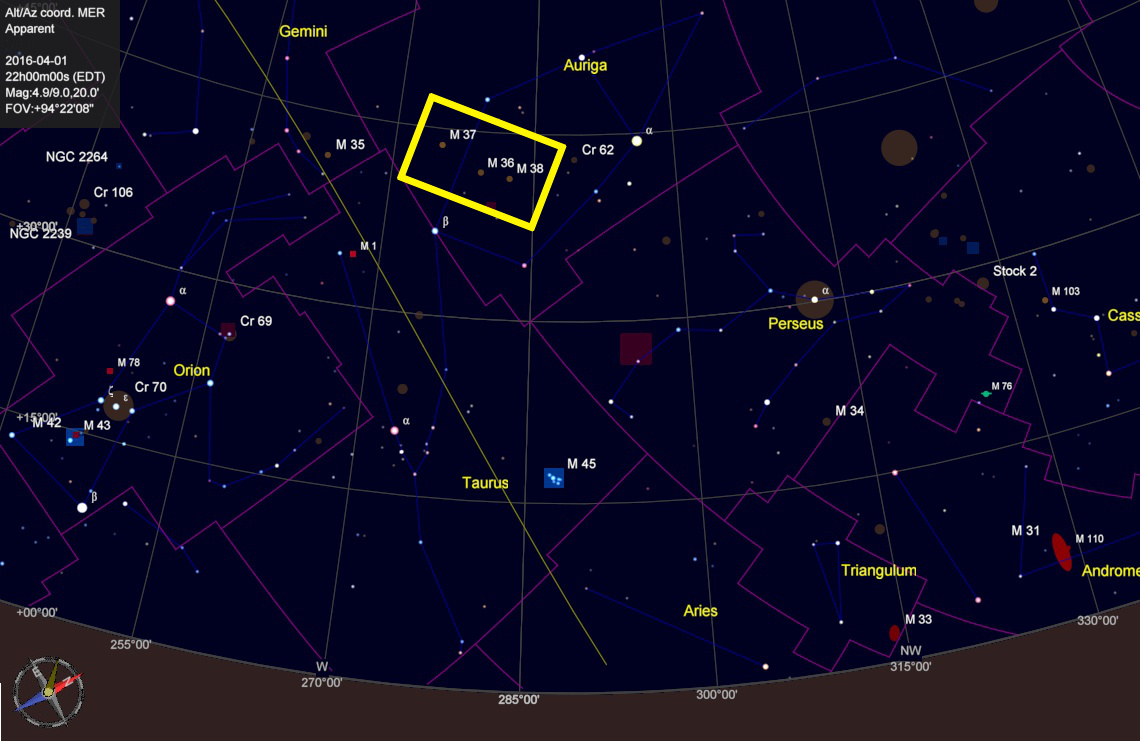
An easy target for anyone is the constellation Auriga and it’s three bright open star clusters.  It may be considered a winter constellation, but there is still plenty of time for some decent observation.  In the early April evenings , Auriga lies west about 45 degrees over the horizon.  It’s brightest star, Capella,  the sixth brightest in the night sky can easily be located.  Therefore these open clusters are easy targets for a quick star-hopping observation for anyone with a small telescope or binoculars.

Auriga in April with three bright open clusters (boxed)

Auriga in April with three bright open clusters (boxed)

My last few posts have been the photos that I’ve captured of these three Messier objects: M36, M37 and M38.  Below is a view if the boxed area from above but with the photos of the open clusters inserted at their correct location.

M37, M36 and M38 (respectively) in Auriga

M37, M36 and M38 (respectively) in Auriga

To see larger images of the open clusters, refer to my following blogs:

Messier 36 – Open Cluster in Auriga
Messier 37 – Brightest Open Cluster in Auriga
Messier 38 and NGC1907 – Open Clusters in Auriga


Composition with Landscape

I’ve mentioned it before that you don’t need a fancy telescope and tracking equatorial mount to get into astrophotography.  Simply a camera on a tripod with a short focal lens can do wonders, especially with the high ISO settings in new cameras. A single 10 seconds exposition can reveal lots of stars, however to capture more photons a longer exposure is not better as the stars will become streaks.  But one can easily improve the image and get better signal/noise ratio by stacking multiple images.

However, there is one drawback to stacking multiple exposures if you decide to also capture the landscape: Earth rotates, therefore the sky moves while the landscape stays still.  If you align the images using the stars, then the landscape becomes a blur.  Not the end result that we want.  Luckily a quick composition with two layers and a mask solves everything.

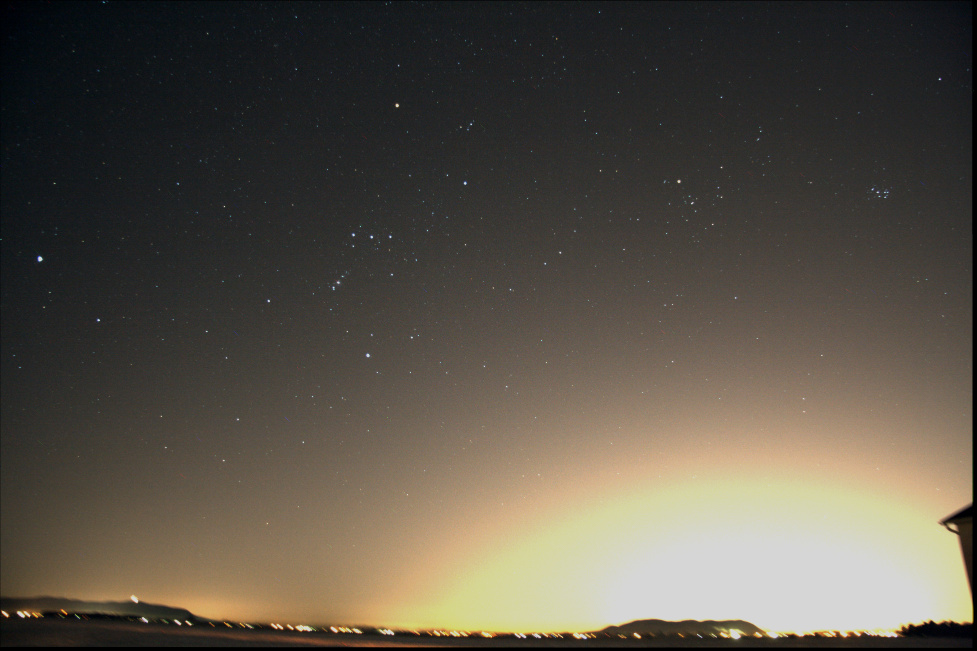
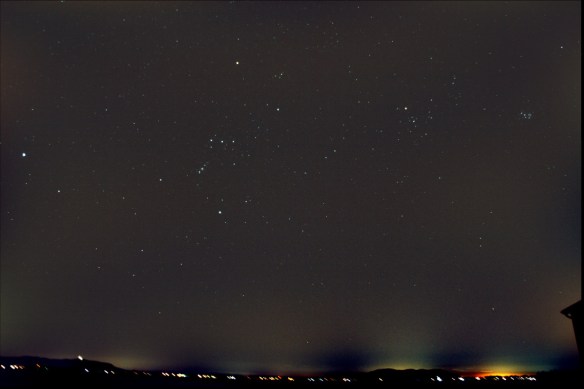
Below is a single 10 seconds exposure at ISO 800 with a 17mm F4 lens; you have the landscape with city lights and the stars above.  Yes that is Orion…

Single 10sec exposure (ISO 800)

Single 10sec exposure (ISO 800)

In order to improve my signal, I worked with IRIS to align and stack 5 frames, this reveals many more stars, but also amplified the light pollution.

Aligning and stacking 5 images. More stars appear.

Aligning and stacking 5 images. More stars appear.

Luckily within IRIS there is a function to remove sky gradient.  The algorithm takes a series of sample points and attempts to make the sky uniform.  Not bad, the images are not a hopeless case.
Removing the sky gradient with IRIS

Removing the sky gradient with IRIS

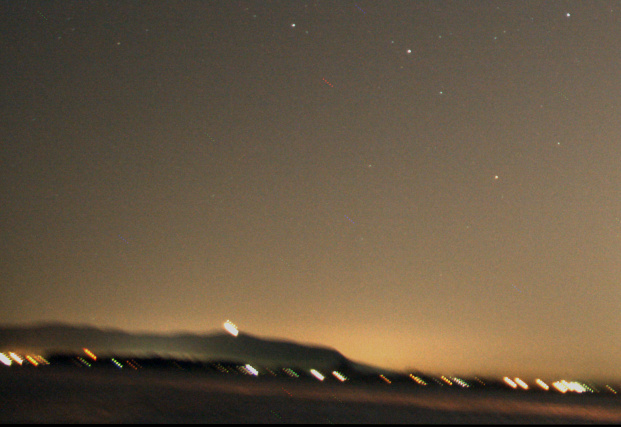
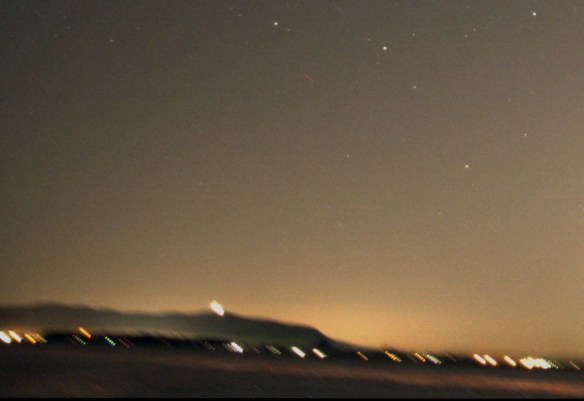
As mentioned above, the alignment was performed with the stars, hence the background is now blurring.  Below is a close-up.
But when aligning on stars, the landscape blurs.

But when aligning on stars, the landscape blurs.

That is just 5 images, stack a much larger quantity or with more time between frames and it will only get worse.  It becomes pointless to shoot with the landscape if the end result is blurry.  Luckily working with layers in a photo editor can easily solve the issue.  We want to keep the stars from the stacked image, but the landscape from a single frame.  Follow these easy steps:

  1. Load into your base layer one of you single frames.  This is what will be used for the landscape.
  2. Load into a new layer your stacked image.  As your stacked image contains more and brighter stars select to Lighten Only instead of normally adding both layers.  You can play with the brightness of the stacked layer, and/or darken the base layer to get the desired blending.
  3. Create a mask to the stacked layer such that the blurred landscape is not permitted to show through.  See image below, I simply grabbed the airbrush and blackened the landscape area in the mask such that it will not show through the layer.  Note that the I only edited the mask, not the image itself.

Creating a mask for my layer: white is transparent, black will block

Creating a mask for my layer: white is transparent, black will block

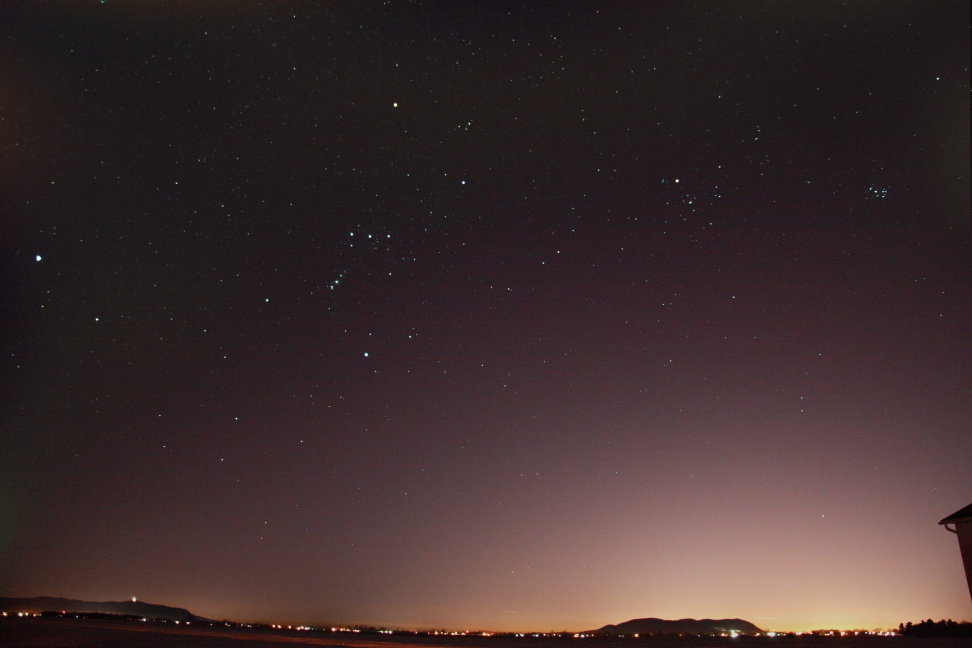
The end result, is improved image of the sky, and a landscape that is still sharp.

Both layers added with the mask

Both layers added with the mask

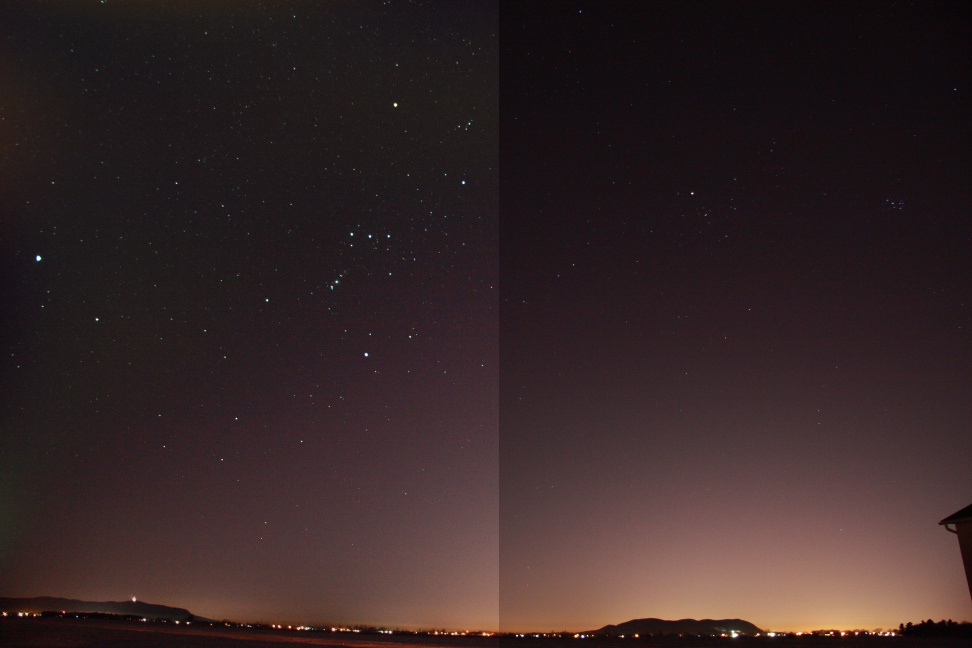
Below is a comparison the composition with stack and layer (left) and a single shot (right).  We are able to achieve both of our goals of getting more stars (more signal) while keeping the landscape from becoming a blur.

Comparing the composition with layers (left) and single shot (right)

Comparing the composition with layers (left) and single shot (right)

And why not take some time to identify some key features in the image.

Constellations Orion and Taurus above the landscape.

Constellations Orion and Taurus above the landscape. (Click to open)

New Years Eve Aurora Borealis

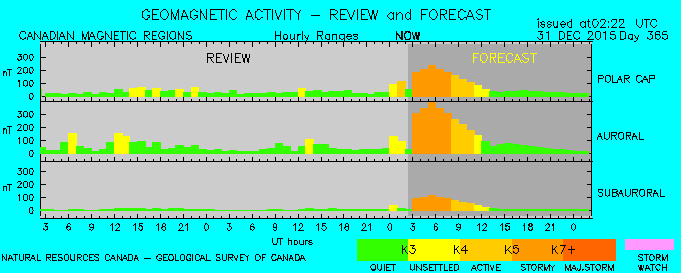
After the Christmas Full Moon, our beloved Sun has unleashed a CME (coronal mass ejection) towards Earth on December 28th, and those charged particles are predicted to reach us on the 31st (NOAA predicts G3-Strong Geomagnetic Storm).  Below is the snap-shot of the past and forecasted geomagnetic activity from Natural Resources Canada as provided at 9:22pm EST.

Geomagnetic Activity Review and Forecast 31Dec2015

Geomagnetic Activity Review and Forecast 31Dec2015 – Canada.ca

Based on their prediction model the peak of the activity will happen the night of 30th to 31st.  Therefore if you live outside of the city and in northern latitudes (north of 50 degrees latitude) you may be surprised by a wonderful light show tonight and tomorrow. Because Earth magnetic field is “springy” it will “ring” for some time and auroras should be present until New Year’s Eve.

Other effects that you may notice is larger GPS errors or longer time to get a “lock”.  Mobile phones won’t be affected by this type of storm.  You need a snow storm to affect your mobile phone signal.  Snow flakes are just the right size and their density in the sky to scatter the signals in the frequency range used by mobile phones.

Bright Comet C/2013 US10 (Catalina) – Visible to Northern Hemisphere end of November

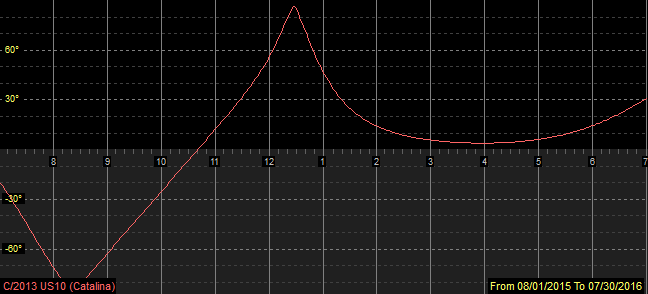
There’s a bright comet in the sky, currently at magnitude 6 and predicted to brighten to 5 by November. Not yet visible in the Northern Hemisphere, but just as it peaks in brightness towards the end of November, it will start showing up in the early morning sky, gradually rising earlier every day until late January 2016

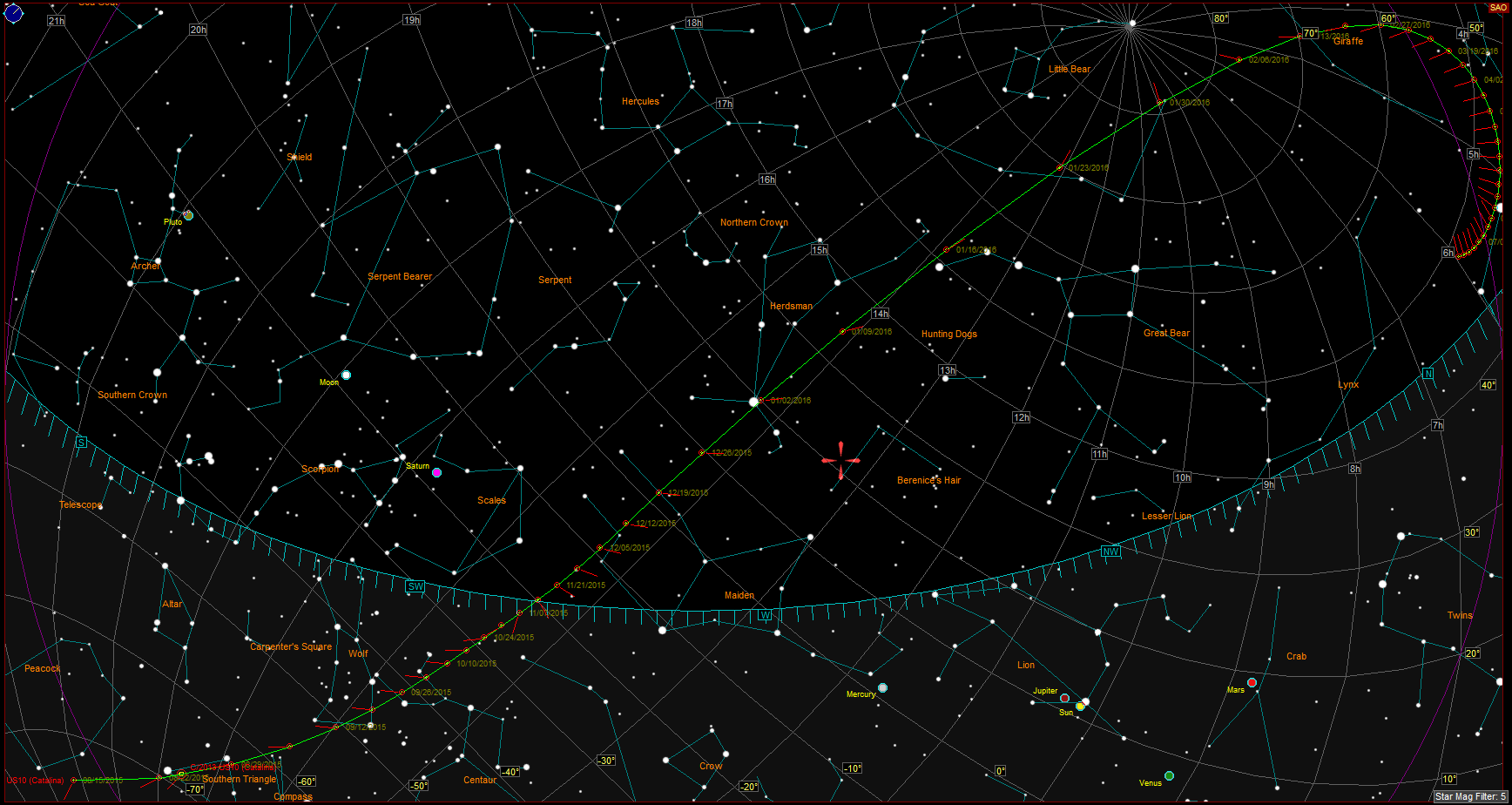
Note that a good opportunity will be around January 2nd when it will pass within 1deg of magnitude 0 star Alpha Bootis – Arcturus.  Until then, people in the south keep enjoying it, I’ll just have to wait for the cold winter nights to get a peek at this comet.

Comet C/2013 US10 is not periodic, but comes from the distant Oort Cloud and this will be it’s only recorded passage by the Sun.   After spending millions of years slowly orbiting the outer solar reaches, it got disturbed, possibly by a nearby star and is now on an ejection trajectory; its velocity is such that it will be flung into interstellar space, away from the Sun’s influence until it’s picked up by another star.

Trajectory of Comet C/2013 US10 Catalina for 2015-2016

Trajectory of Comet C/2013 US10 Catalina for 2015-2016


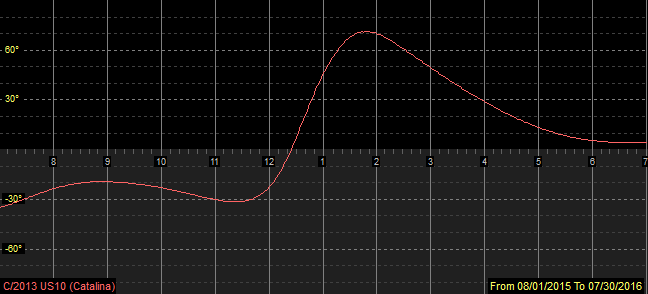
Visibility of Comet C/2013 US10 Catalina in the Evening

Visibility of Comet C/2013 US10 Catalina in the Evening

Visibility of Comet C/2013 US10 Catalina in the Early Morning

Visibility of Comet C/2013 US10 Catalina in the Early Morning

August 13th Celestial Pole Time Lapse

Video

Couldn’t put all those frames to waste, so I processed and assembled them into a time-lapse video showing the Earth’s rotation and the various layers of clouds flying by.

The video was created with Microsoft MovieMaker, a tool that all Win7 and Win8 users have by default.  So it’s FREE!  Yay!

These were processed in IRIS and saved as BMP, but MovieMaker will also create videos with Canon CR2 RAW Files directly.  Therefore dump all your frame and you can generate an instant video without any processing.  By default it sets 7.0sec delay between images.  Simply select all images and change the value to 0.100 or whatever frame rate you wish.  And then export your video.


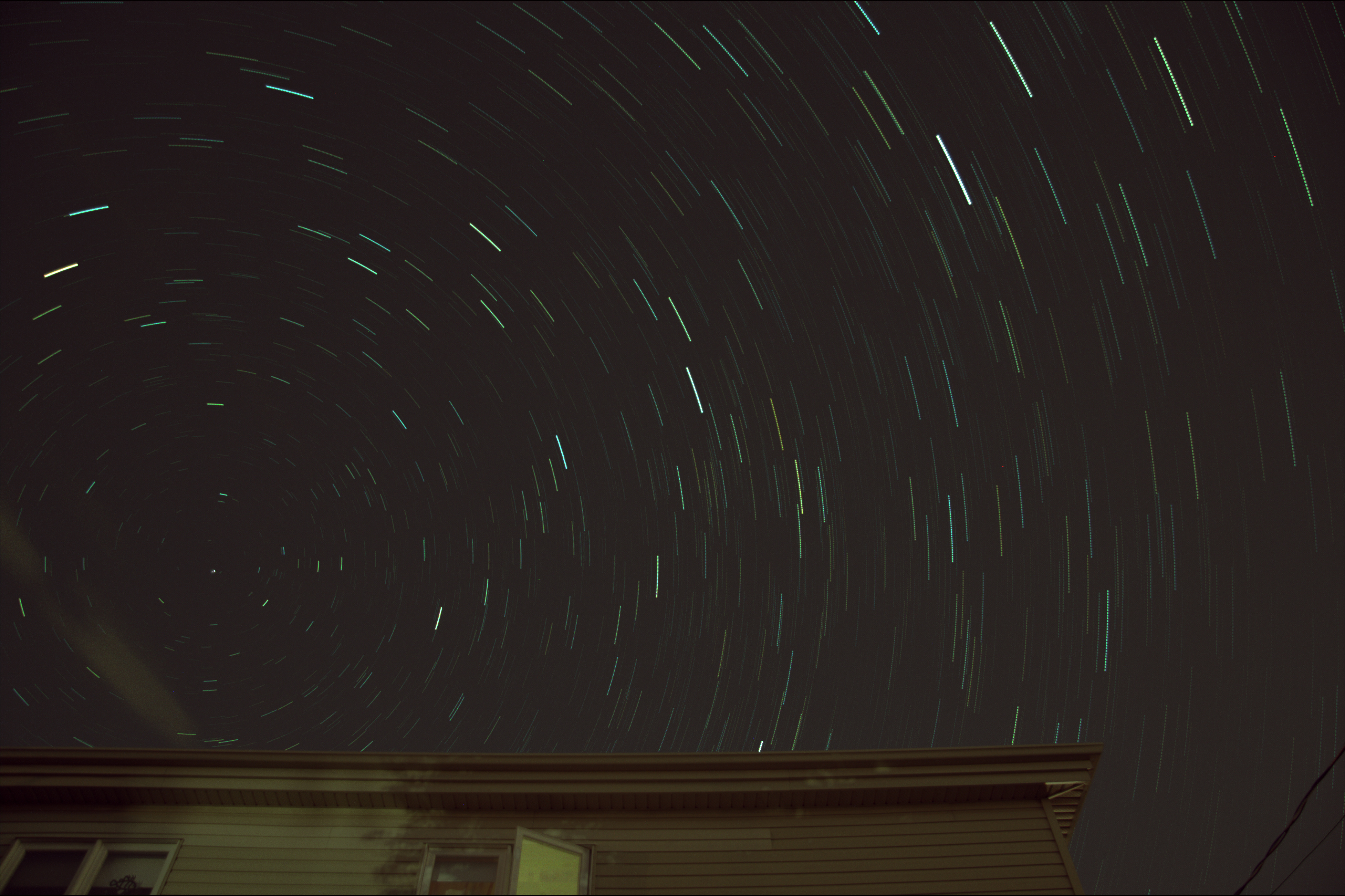
August 13th – Celestial Pole Over the House

Image

The Perseids peak had already passed, but the sky was better so I decided to set up the trusty Canon XTi and see if I could catch some meteors.  This time instead of pointing the camera straight up, I decided to frame the top of the house to provide some reference.

Out of the over 120 shots taken, a sequence of 30 frames were without clouds obscuring the stars.  This was a perfect opportunity to mark the celestial pole by adding the images without alignment.

Celestial Pole on August 13, 2015 30 x 30sec

Celestial Pole on August 13, 2015
30 x 30sec

Canon XTi
17mm F4.0 ISO800
30 x 30sec