Time Lapse Video of Lunar Eclipse

Video

Stitched together the 330 photos of the September 27th Lunar Eclipse into a video.

A few things to note.  The Moon “jumps” a few times in the video, and I now realize that it’s due to my presence on the wooden deck is sufficient to cause the telescope to shift ever slightly.  Also I didn’t really take time for proper polar alignment, I was a good 5deg off and had to re-align during the total eclipse because the tracking was not perfect.  And last, some cloud cover rolled in so I wasn’t able to capture the tail end of the eclipse.

Nevertheless, still much better than the few frames I captured back in 2008.

For the curious of the camera setting.  The start with the full moon is taken at ISO 200 1/320sec and then increased up to 3.2sec exposures at ISO 400 during the eclipse.

September 27th 2015 – Lunar Eclipse

Image

Transferring over 300 photos (2.5GB) from the old astro-laptop via USB key to my main PC will take some time (30 minutes just to transfer 1.0GB on the key).  Therefore the work towards making a time lapse video will be tomorrow.

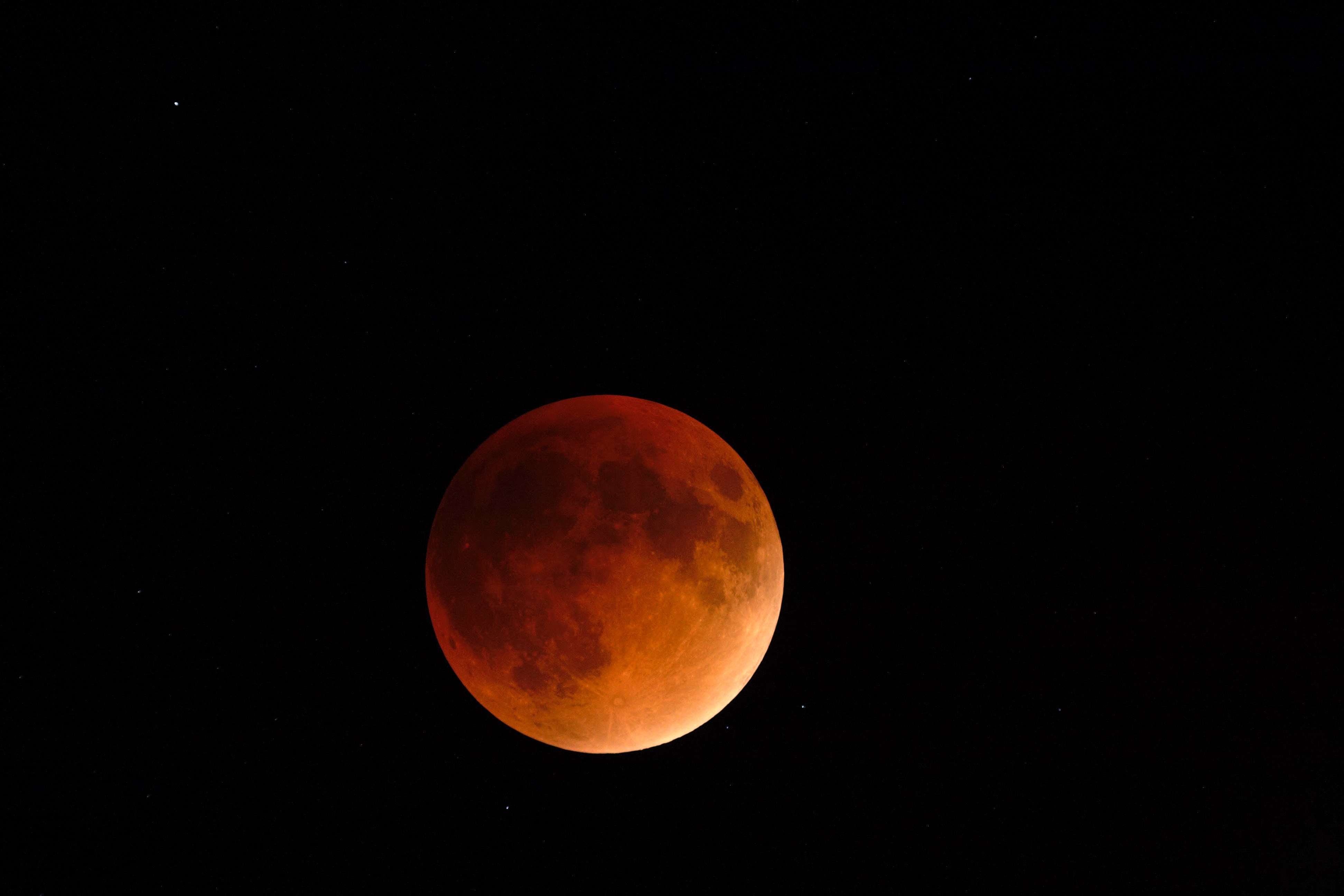
In the meantime here is one quick pick from the lot of photos taken with the Canon mounted on the telescope.  Did a quick stretch and level adjustment, just so I’d have something to show before going to bed.

September 27th 2015 Lunar Eclipse

September 27th 2015 Lunar Eclipse

Comet C/2013 US10 (Catalina) Continues To Be Visible

Comet C/2013 US10 (Catalina) continues to be visible at around magnitude 6 to observers in the southern hemisphere.  For people north of the equator, we’ll have to wait until late November when it will become an early morning comet.

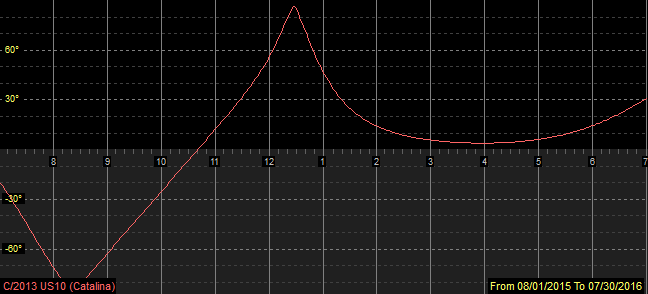
One date to mark on your calendar is the morning of December 7th.  A wonderful early morning opportunity to spot C/2013 US10 next to Venus and a Lunar crescent all within a 6 deg window.  This will be fairly low (20 deg) over the South-East horizon.

Comet C/2013 US10 Catalina, Venus and the Moon

Comet C/2013 US10 Catalina, Venus and the Moon

Under dark skies it should be observable to the naked eye.  But binoculars or even a camera zoom lens will provide for better observation.

September 27th 2015 – Don’t Miss it: Superbloodmoon

A total lunar eclipse is sometimes referred as a Blood Moon due to the reddish-brown hue the Moon takes when passing in Earth’s shadow.  So why “Super“?  The Moon has an elliptical orbit around Earth, with the distance varying by 20,000km between the closest (perigee) and farther (apogee) approaches.  When there is a full Moon during its closest approach it’s called a Supermoon.  The result is a Moon that is 14% larger in area and 30% brighter than at apogee.

September 27th 2015 happens to be special because both events will take place at the same time: a total lunar eclipse at perigee.  Last time that happened was nearly 30 years ago!

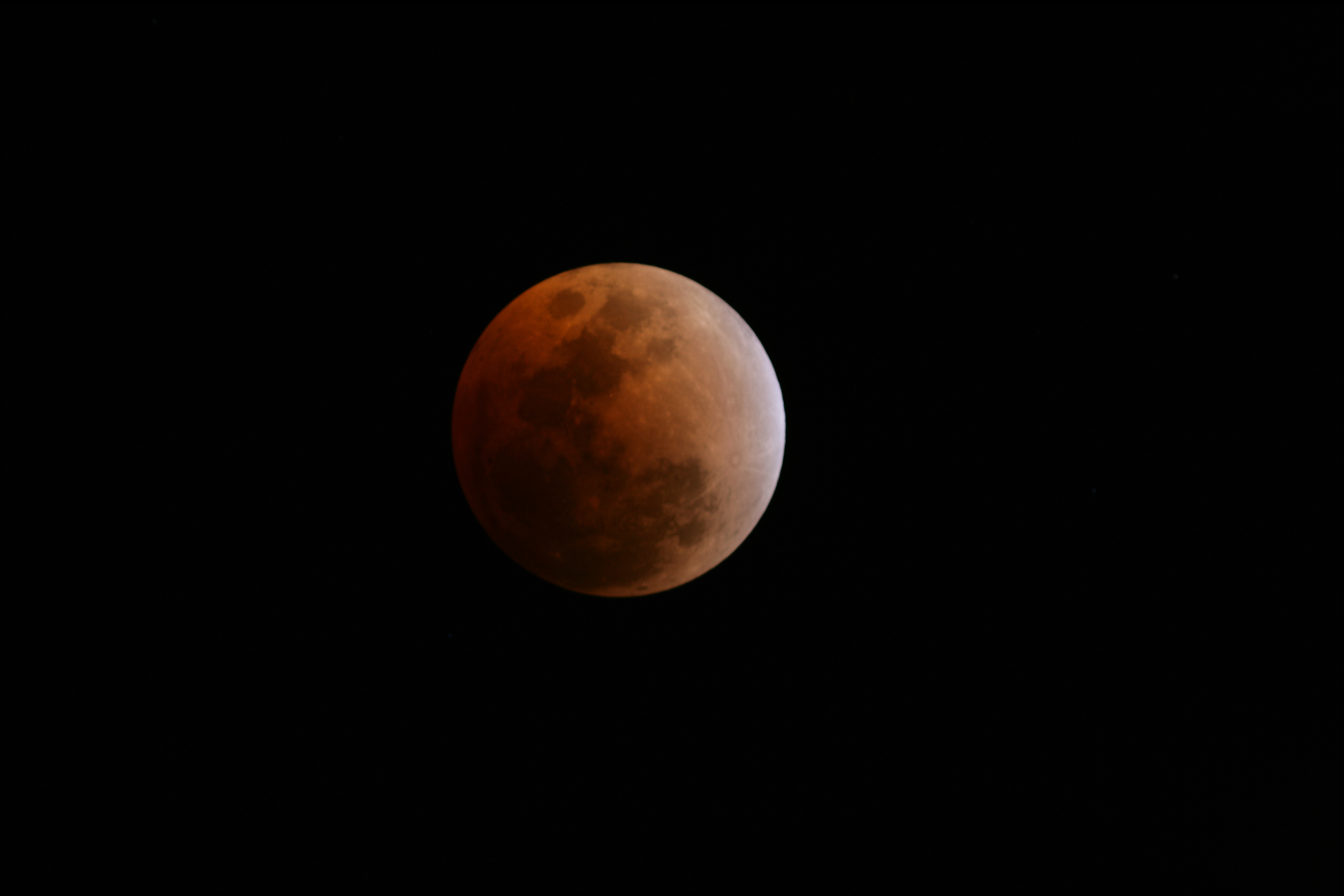
Total Lunar Eclipse 20-Feb-2008 - Benoit Guertin

Total Lunar Eclipse
20-Feb-2008 – Benoit Guertin

Bright Comet C/2013 US10 (Catalina) – Visible to Northern Hemisphere end of November

There’s a bright comet in the sky, currently at magnitude 6 and predicted to brighten to 5 by November. Not yet visible in the Northern Hemisphere, but just as it peaks in brightness towards the end of November, it will start showing up in the early morning sky, gradually rising earlier every day until late January 2016

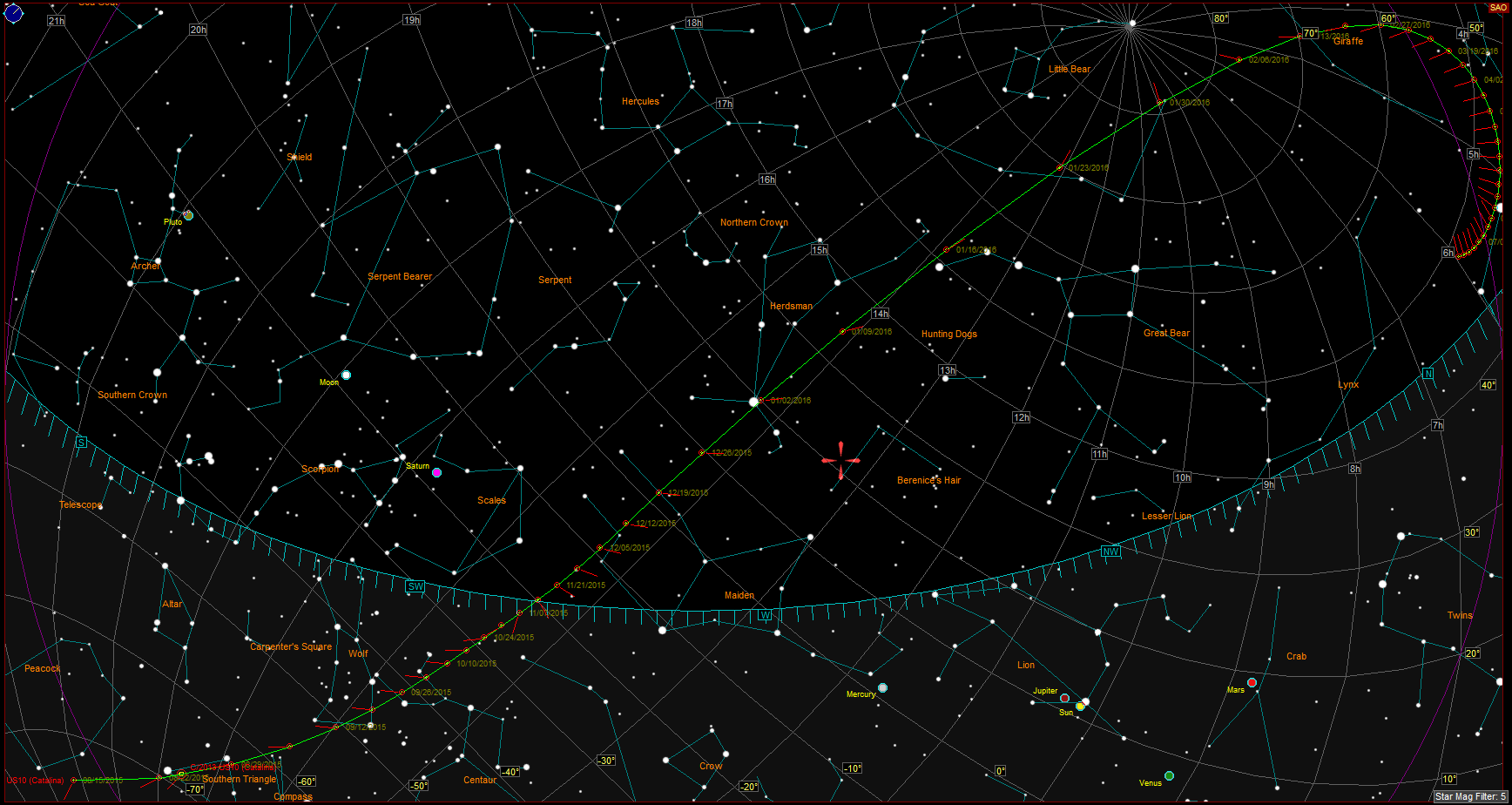
Note that a good opportunity will be around January 2nd when it will pass within 1deg of magnitude 0 star Alpha Bootis – Arcturus.  Until then, people in the south keep enjoying it, I’ll just have to wait for the cold winter nights to get a peek at this comet.

Comet C/2013 US10 is not periodic, but comes from the distant Oort Cloud and this will be it’s only recorded passage by the Sun.   After spending millions of years slowly orbiting the outer solar reaches, it got disturbed, possibly by a nearby star and is now on an ejection trajectory; its velocity is such that it will be flung into interstellar space, away from the Sun’s influence until it’s picked up by another star.

Trajectory of Comet C/2013 US10 Catalina for 2015-2016

Trajectory of Comet C/2013 US10 Catalina for 2015-2016


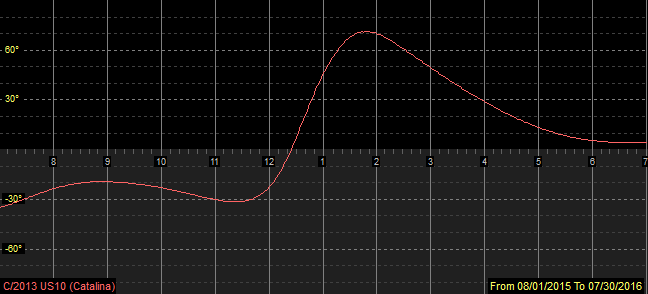
Visibility of Comet C/2013 US10 Catalina in the Evening

Visibility of Comet C/2013 US10 Catalina in the Evening

Visibility of Comet C/2013 US10 Catalina in the Early Morning

Visibility of Comet C/2013 US10 Catalina in the Early Morning

August 13th Celestial Pole Time Lapse

Video

Couldn’t put all those frames to waste, so I processed and assembled them into a time-lapse video showing the Earth’s rotation and the various layers of clouds flying by.

The video was created with Microsoft MovieMaker, a tool that all Win7 and Win8 users have by default.  So it’s FREE!  Yay!

These were processed in IRIS and saved as BMP, but MovieMaker will also create videos with Canon CR2 RAW Files directly.  Therefore dump all your frame and you can generate an instant video without any processing.  By default it sets 7.0sec delay between images.  Simply select all images and change the value to 0.100 or whatever frame rate you wish.  And then export your video.


August 12th – No Perseids but did get some constellations

Image

The 2015 Perseids were predicted to be great, largely thanks to Mother Nature turning off its night-light (aka our Moon).  Unfortunately the weather wasn’t as cooperative…  With clouds over the horizon I knew my window to try to capture some Perseids was quickly vanishing.  Nevertheless I setup my camera on a tripod and hoped for the best.

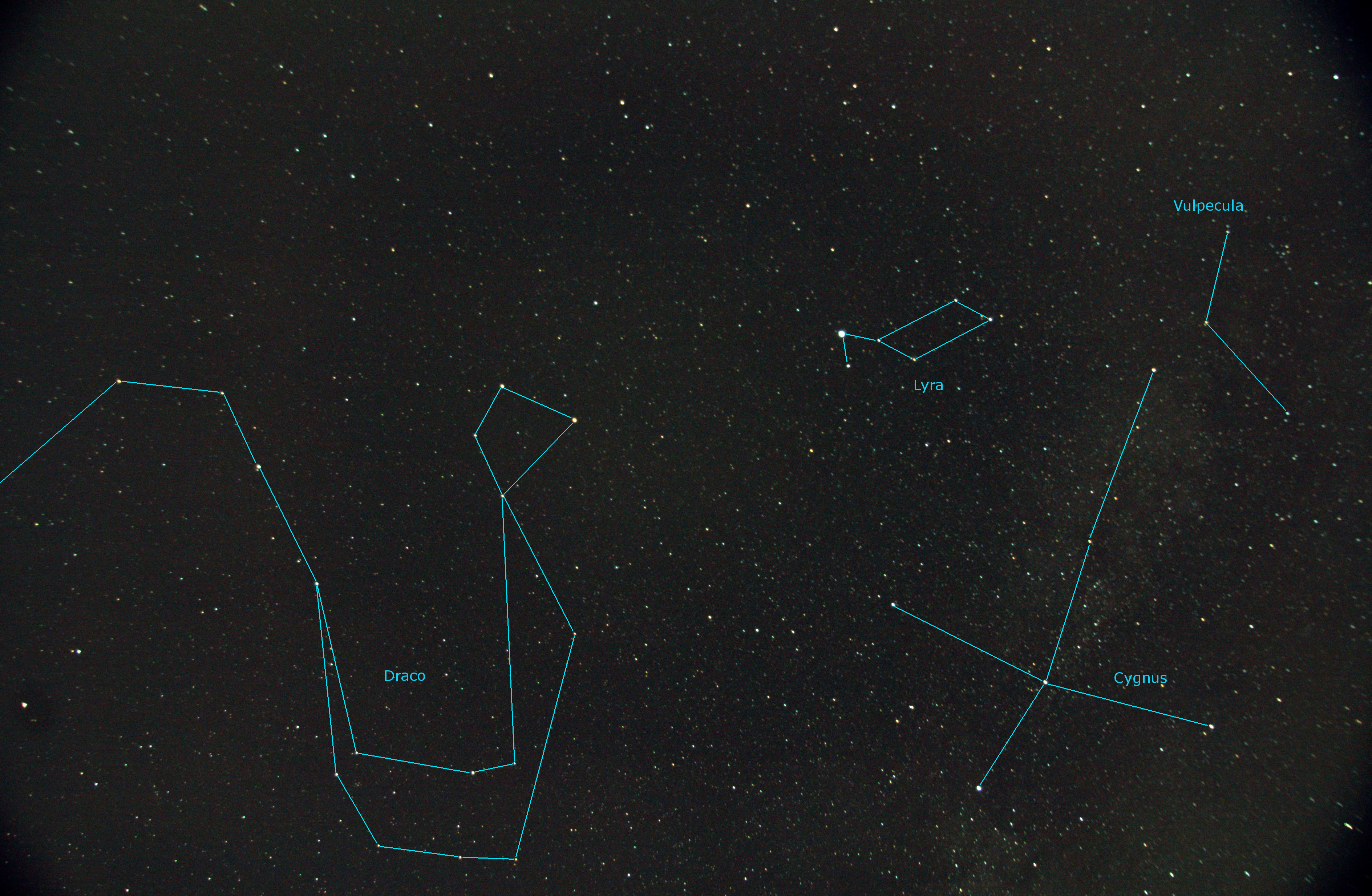
The best I got was 13 shots without clouds.  A quick scan of them did not reveal any notable meteor streak.  But it wasn’t all a waste.  I was able to process, align and stack them to provide a good 60deg field of view around the zenith.

Constellations Draco, Lyra, Cygnus and Vulpecula 13 x 30sec (17mm F4.0 ISO400) 12-aug-2015 Benoit Guertin

Constellations Draco, Lyra, Cygnus and Vulpecula
13 x 30sec (17mm F4.0 ISO400)
Benoit Guertin

Canon XTi
17mm F4.0 ISO400
13 x 30sec
Fixed mount, no tracking

Hubble Space Telescope – 25 Years of Exploring the Universe

Hubblesite.org

Hubblesite.org

Exactly 25 years ago today, the Discovery space shuttle took off with the Hubble Space Telescope aboard.  For all the mind-blowing images Hubble has been able to bring to us, the project started actually pretty badly…

Above all the funding challenges that such a large project faced, there were many issues on how and who should grind the primary mirror.  In all three mirrors were built by three different companies should there be issues during production.  The Challenger disaster in 1986 delayed the launch of the telescope, and when it was finally placed in orbit, a faulty mirror wasn’t able to correctly focus the image to the clear and crisp views everyone had expected.  As the flaw was due to an error in the calibrating instrument during the final shaping of the mirror, it meant it was flawed to perfection, and could therefore be corrected by giving it “glasses”.  It wasn’t until 1993 that corrective optics were incorporated and we could finally start exploring the potential of the telescope.

As the Hubble Space Telescope is in low earth orbit it is within easy reach to be serviced by astronauts, and five shuttle missions were dedicated to servicing Hubble, the last one being in 2009 to extend the operation until 2020.  By then the James Webb Space Telescope (JWST) should be operational.  Something to note here is that while Hubble could be serviced and maintained over time due to its proximity to Earth, JWST will be too far out, located at the L2 Lagrange point – 1.5 million km, beyond Moon’s orbit.

To celebrate these 25 years, NASA and ESA have released this wonderful galactic firework: Westerlund 2

NASA Unveils Celestial Fireworks as Official Hubble 25th Anniversary Image
Source: Hubblesite.org

Faint Images of Galaxies M95 and M96

Image

Galaxies are always a challenge… Imaging objects such as nebulas within our galaxy is much better suited to my small telescope.  At 700mm focal length, galaxies over 30 million light years away are rather small and lack detail.  Nevertheless this is my go at Messier 95 and 96 in the constellation of the Lion.

These galaxies were discovered by Pierre Méchain in 1781 with a 12in telescope, nearly 4 times the size of mine.

Galaxies Messier 95 and 96 - Benoit Guertin

Galaxies Messier 95 and 96 – Benoit Guertin

The image was scaled to 30% and I’ve added insets of the galaxies.

Telescope: Sky-Watcher 80ED
Camera: Canon XTi (ISO 400)
Image: 30 x 30sec

iOptron Tri-Pier

In astrophotography, a solid mount is key.  But you don’t want something that is too heavy that can’t be transported to your favorite spot away from light pollution.  iOptron has released a Tri-Pier combines the stiffness of a pier with the portability of a tripod.  It can be used with their mounts, or with proper adapter to other makes.  With 220lbs of maximum capacity, this can hold some serious gear.  I can’t even think up 220lbs of astro-gear!

iOptron Tri-Pier (photo: iOptron)

iOptron Tri-Pier (photo: iOptron)

Source: iOptron