Clear Sky Chart – Can I take my gear out?

We are all dependent on the weather, and knowing what Mother Nature has in store for us in the next 24hrs helps our daily routine.  Backyard astronomers don’t have the luxury to be setup on top of a mountain range, above the clouds where the air is crisp and dry all the time.  Therefore knowing in advance if it’s worth hauling out all your gear for a six-hour deep-sky photo-session or a minimalist setup to scan the planets and the Moon can save lots of frustration.

One of the great tools out there is Clear Sky Chart.
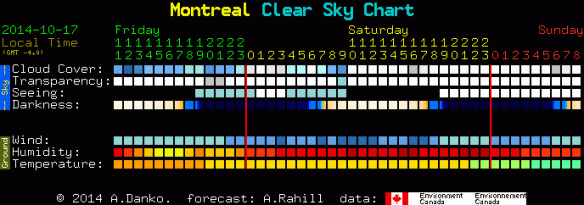
Clear Sky Chart

Clear Sky Chart

Using data and forecasting models from Environment Canada specifically tailored for astronomers the site provides a simple chart with past, current and forecasted conditions of various parameters that affect the viewing quality.  In the above snap-shot cloud cover, transparency and humidity all indicate bad viewing conditions for Friday and Saturday night. (Boooo…..)

While the data is from Environment Canada, Clear Sky Chart provides coverage for the USA and part of Mexico.  On the web site you can select the closest observation site, or request to create your own.  If your setup is mobile, you can check the viewing conditions at various locations to see if it’s worth to pack up your gear for a road-trip to a place with less light pollution and better weather.

An Android app is also available for your mobile devices and tablets: Clear Sky Droid, essentially using the same charts and data set.

Clear Sky Droid

Clear Sky Droid

As the saying goes: Clear and dark skies!

M57 – Ring Nebula

Image

Messier 57, also known as the Ring Nebula is an easy target with all sizes of telescopes, even large binoculars.  Conveniently located almost midway between the bright magnitude 3 stars Beta and Gamma Lyr, it’s very easy to locate.  In the wide field of view photo below, we can clearly see M57’s position with respect to the two bright stars.

Ring Nebula - Messier 57 Planetary Nebula Benoit Guertin

Ring Nebula – Messier 57 Planetary Nebula
Benoit Guertin

M57 is a small target, therefore not ideal for short focal lengths like my Skywatcher 80ED (600mm focal length).  Below is a 1.5x zoom on the nebula itself.  The digital zoom was performed by cropping and scaling the aligned sub images, prior to stacking them.

Ring Nebula - Messier 57 Planetary Nebula Benoit Guertin

Ring Nebula – Messier 57 Planetary Nebula
Benoit Guertin

Telescope: Skywatcher 80ED
Camera: Canon XTi (ISO 800)
Stacking: 21 x 25sec

Full 10Mpix photo

Mars and Comet Siding Spring – Chance of a lifetime

NASA/JPL-Caltech

NASA/JPL-Caltech

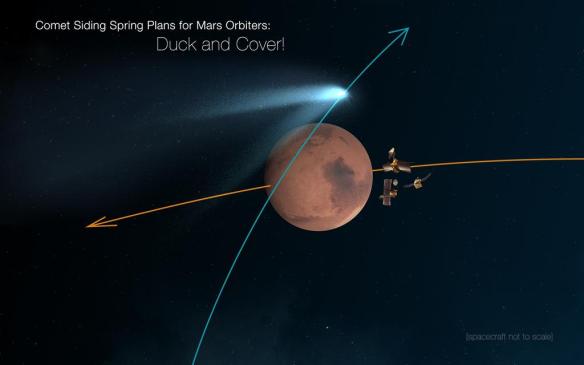
On October 19th a once in a lifetime event will happen.  Comet Siding Spring (C/2013 A1) will pass very close to Mars, one tenth the distance of the closest Earth-comet pass.  While there is no chance of impact, NASA has moved some of its Mars orbiting satellite to be behind the planet is it passes through the comet’s dust tail in order to protect the equipment.

At predicted magnitude 11, it will be limited to large telescopes with camera or CCD.  But its close proximity to Mars will make it an easy target to locate.  Unfortunately for North America, the closest approach will take place 2:28pm EDT.

Luckily NASA has setup as dedicate web site leading up to and after the even publish information and photos.  The SLOOH telescope will also have a live webcast.

M13 Globular Cluster

Image

Messier 13 Globular Cluster

M13 Globular Cluster

M13 Globular Cluster – Benoit Guertin

Equipment: SW80ED, Canon XTi
Imaging: 29x15sec ISO800

The above image is a crop of the original.  In the full frame image, galaxy NGC6207 (60 million light years away) is faintly visible on the top of the image at 1 o’clock from M13.  As a reference M13 is 22,000 light years away.

Creating GIF Animation with Lunar Eclipse Photos

Eclipses happen in a relatively short time span and the change can be dramatic, therefore they are great candidate for GIF animations.  Below is a sequence of 24 individual photos taken with a Skywatcher 80ED telescope and Canon XTi camera from the February 2008 Lunar Eclipse.

Feb 2008 Lunar Eclipse - Benoit Guertin

Feb 2008 Lunar Eclipse – Benoit Guertin

To create the GIF animation I used two software packages:

  1. Registax – astro-imaging processing software used to align the individual images in order to ensure the Moon remains centered.
  2. GIMP – image processing software used to create the GIF animation

In GIMP, GIF animation is done by assigning individual images to a layer.  The animation is therefore build frame-by-frame as it cycles through the layers.  A simple animation tutorial is available to step you through the process.

On the other hand, if you prefer to make a movie, Picasa is capable of creating a video from a series of photos.

Link

Good article from CBC News on the October Lunar Eclipse.  Includes photos and videos.

http://www.cbc.ca/news/technology/lunar-eclipse-left-moon-glowing-blood-red-1.2792098


Total Lunar Eclipse – Only a few hours

Aside

Only a few hours left before the start of the Total Lunar Eclipse of October 2014.  Unfortunately the weather won’t be cooperating as the forecast calls for cloud and rain in my parts of the woods.  But no worries, the SLOOH telescope will be broadcasting the event live!  Event starts October 8th 5:00AM EDT .

live.slooh.com

Stargazers worldwide are invited to watch the spectacular Total Lunar Eclipse, sometimes known as the “Blood Moon,” unfold live on Slooh. The free, real-time broadcast will begin on October 8th starting at 2:00 AM PDT / 5:00 AM EDT / 0900 UTC with live feeds from multiple locations located in Australia and North America. This eclipse will be difficult to view for most of the planet as it mainly takes place over the Pacific Ocean. As such, the eclipse will only be visible in its entirety from parts of eastern Australia, New Zealand, eastern Asia, most of Japan, Hawaiian Islands, and the western part of North America. But fear not – Slooh will have strategic sites in these locations allowing the world to view the eclipse live on Slooh.com


Another webcast is available over at the Coca Cola Space Science Center.


Total Lunar Eclipse – Wednesday October 8th, 2014

In North America, not long before sunrise on Wednesday, a Total Lunar Eclipse will take place.  The fun thing is that you don’t require any special equipment to enjoy.  However if you do plan on taking a photo with a telescope or long focal length lens, an equatorial mount will be required to get a sharp image of the moon.

February 20th, 2008

February 20th, 2008 Benoit Guertin

On the east coast, the event will start around 6:35am EDT with the Moon low in the West.  This will be a great photographic opportunity, as with the Moon low on the horizon, the optical illusion will exaggerate the size of the Moon, making it look much larger than in reality.

Further west on the continent, the Moon will be higher in the sky and therefore better positioned to enjoy the entire event.  No need to rush out in your pajamas, a Lunar Eclipse is a slow event; Totality lasts for nearly one hour!

See NASA News website for more information: http://science.nasa.gov/science-news/science-at-nasa/2014/18sep_lunareclipse/

Ref: NASA News