Comets to Pass Near Earth

Status

Benoit Guertin's avatar

Two comets will pass near Earth between March 21st and 23rd. Comets 252P/LINEAR and P/2016 BA14 will pass between 14 and 9 lunar orbits with the Earth.  As both comets  have similar orbits they most likely broke in two following a close encounter with a planet’s gravity.

252P/LINEAR  has surprised everyone by brightening to magnitude 6 as it was predicted to remain in the 12-14 range.  Presently accessible to folks in the southern hemisphere it will be visible to northern observers after the Earth fly-by.

ExoMars March 14th Lift Off, The Sign of a Earth-Mars Close Approach?

In the early in the morning of March 14th, 2016, a joint EASA-Roscosmos mission blasted off from Kazakhstan on top of a Proton launch vehicle.  The space vehicle will take 7 months traveling through space before arriving to Mars around October 19th.  The mission is actually composed of two vehicles, which will separate 3 days prior to the Mars arrival: Trace Gas Orbiter (TGO) and Schiaparelli, the later entering the martian atmosphere and landing on the surface.
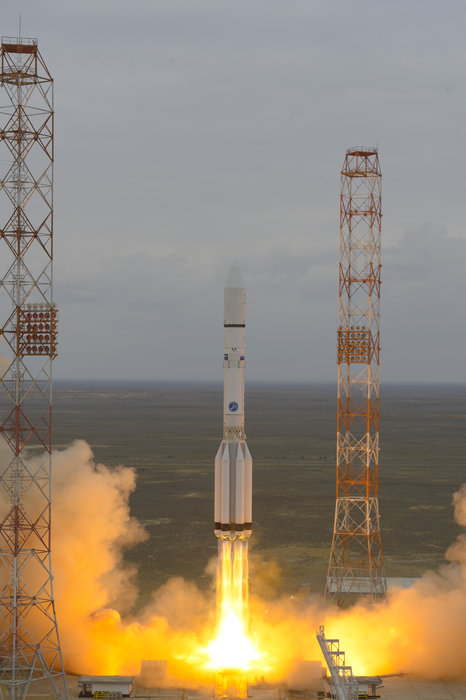
ExoMars 2016 Launch campaign

ESA–Stephane Corvaja, 2016

I wondered if the launch signaled an upcoming Earth-Mars close approach.  A space program wanting to reach Mars on a budget would select a launch date at a time when both planets are at their closest to reduce the fuel required, and time spent traveling through space.  Sure enough, the next Earth-Mars close approach is May 30, 2016, a few days after opposition of May 22nd.  An upcoming great opportunity to turn the telescope to Mars and hopefully capture some of the planet’s features.  Mars’ angular size varies from as little as 3.5″ to an easy observing 25.1″ which is quite dramatic.

Earth-Mars close approach happen roughly every 26 months, and often coincide to Mars missions launches.  The following list from NASA of recent Mars mission launches show a lovely two year interval.

2001:      Mars Odyssey
2003:      Mars Exploration Rovers
2005:      Mars Reconnaissance Orbiter
2007:      Mars Phoenix Lander
2009:      (skipped opportunity)
2011:      Mars Science Laboratory/Curiosity Rover
2013:      MAVEN

The last one in 2013 was in November, hence a Mars 2016, 28 months later falls within that window of opportunity.  The ExoMars program actually has two space vehicles.  The next one is planned for… you guessed it 26 months later: May 2018 launch.

Sources:
[EASA] [NASA]

New Years Eve Aurora Borealis

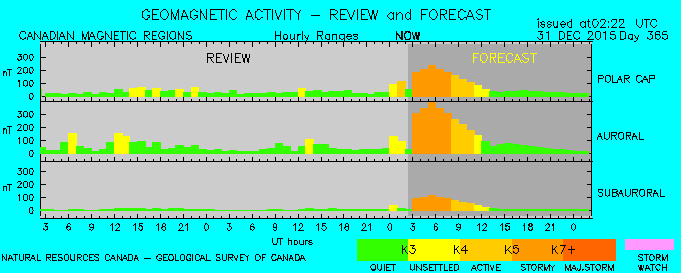
After the Christmas Full Moon, our beloved Sun has unleashed a CME (coronal mass ejection) towards Earth on December 28th, and those charged particles are predicted to reach us on the 31st (NOAA predicts G3-Strong Geomagnetic Storm).  Below is the snap-shot of the past and forecasted geomagnetic activity from Natural Resources Canada as provided at 9:22pm EST.

Geomagnetic Activity Review and Forecast 31Dec2015

Geomagnetic Activity Review and Forecast 31Dec2015 – Canada.ca

Based on their prediction model the peak of the activity will happen the night of 30th to 31st.  Therefore if you live outside of the city and in northern latitudes (north of 50 degrees latitude) you may be surprised by a wonderful light show tonight and tomorrow. Because Earth magnetic field is “springy” it will “ring” for some time and auroras should be present until New Year’s Eve.

Other effects that you may notice is larger GPS errors or longer time to get a “lock”.  Mobile phones won’t be affected by this type of storm.  You need a snow storm to affect your mobile phone signal.  Snow flakes are just the right size and their density in the sky to scatter the signals in the frequency range used by mobile phones.

Christmas 2015 Full Moon

Image

After sneaking the kids’ gifts under the tree while they were sound asleep, I decided to see if the Christmas 2015 Full Moon was visible.

A thin cloud lightly obscured the view, and I wasn`t sure if the early morning sky would yield any better weather.  A few quick shots at 17 and 85mm on the Canon EFS lens to record the event as the next Christmas full Moon will be in roughly 30 years.

Christmas Full Moon of 2015

Aside

If you get up early on Christmas morning, don’t open your presents, or shake that box right away.  Head towards the window and glance west at the sky.  There over the horizon you’ll see the last full Moon of 2015.

The last time that full Moon happened on December 25th was 1977.  Disco was all the rage and “Saturday Night Fever” starring John Travolta, premiered in NYC.  So yeah, a long time ago…

I’m guessing with the full Moon to light the way, Rudolf might get a bit of a rest this year. 🙂

Taurid Meteor Shower Already Producing Some Fireballs

Video

While the Taurid Meteor Shower is expected to peak on November 11th and 12th for the Northern Hemisphere, some fireballs have already been observed and recorded.

The following video was recorded in Bangkok Thailand just before 9pm local time November 2nd

https://www.youtube.com/watch?v=RfWozVsMOsY

And a few days prior to that the following was captured in Poland on October 31st.

https://www.youtube.com/watch?v=_PG3Bszho-c

These fireballs as they streak across the sky often produce color due their chemical composition and the heat generating entering the atmosphere.  Some may even leave behind a smoke trail that will persist for some time.

The Taurid Meteor Shower are remnants of a large comet that probably got broken up by repeated close encounters with Earth and other planets 20,000 to 30,000 years ago.

Cassini’s 48km Close Approach to Saturn’s Moon Enceladus

Video

Today the Cassini spacecraft made a close approach and dive through the plume of icy spray from Enceladus, Saturn’s sixth largest moon.  What surprised me was the low altitude flyby: just 48km from the moon’s surface.

OK, by aircraft standard a 48km altitude is still way up there as commercial aircraft operate at an altitude of 10km, and even the famed U2 and SR-71 spy planes designed to fly above surface or air launched missiles top out at 20 and 25km altitude respectively.  But for a multi-billion dollar spacecraft this is quite low due to the high risk.  Low Lunar Orbit used during the Apollo missions were at a 100km altitude, and all the hype on New Horizons Pluto flyby, it was at a distant 12,500km pass.  OK ESA’s Rosetta spacecraft was maneuvered down to 29km around comet 69P, but has since moved out to a safer 300km orbit.

Looking forward to seeing what comes out of Cassini’s E-21 flyby.

Source: JPL’s Cassini E-21 Flyby Page

Observing Pluto – What Does it Take?

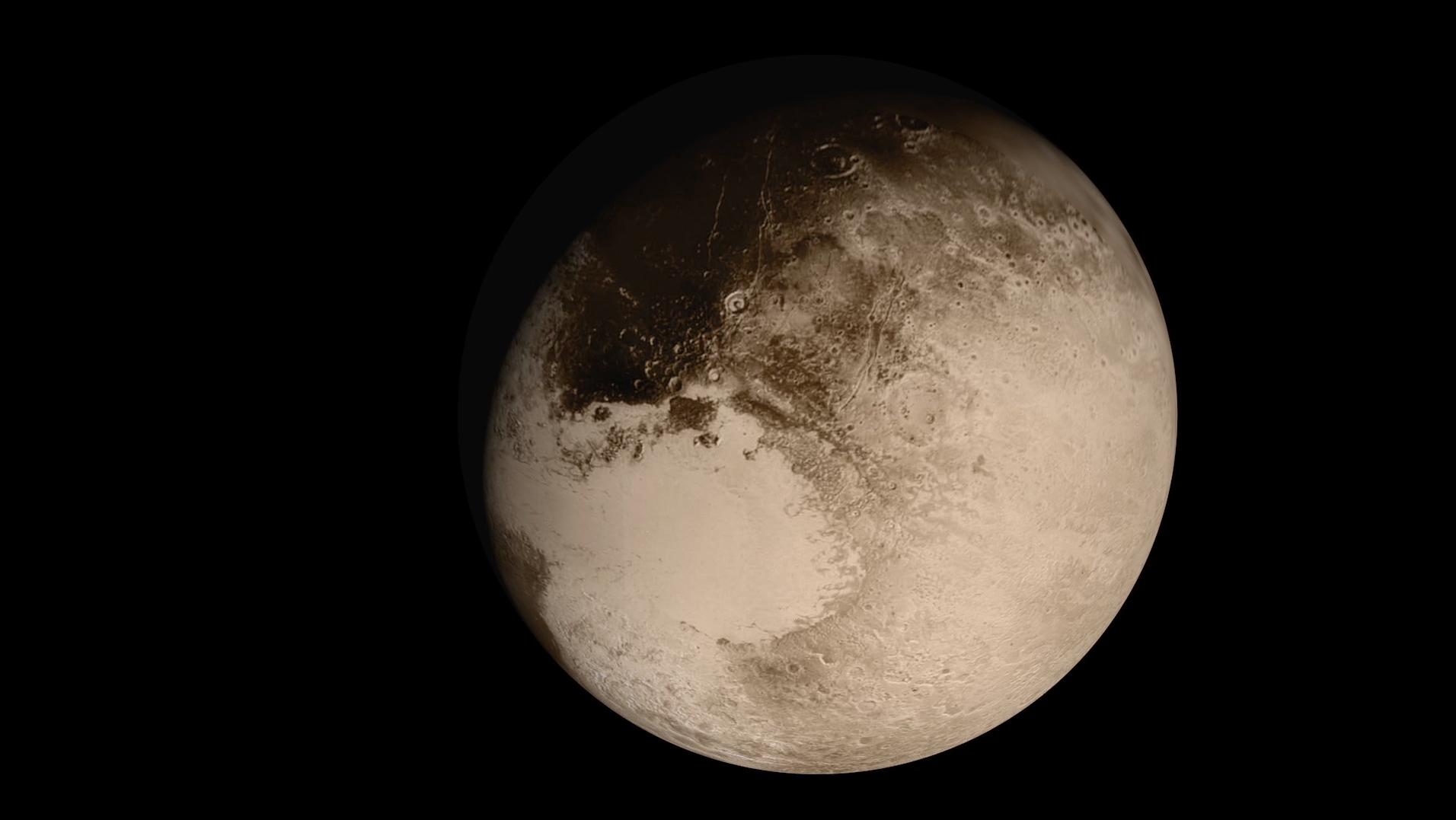
With New Horizons‘ flyby of Pluto and all the great images the spacecraft has been returning I’ve wondered: Is it possible to observe Pluto from one’s backyard?  Personally I’ve never bothered trying for Neptune and beyond as I knew my small 80mm aperture telescope would not be up to the task.  Nevertheless I looked up Pluto’s apparent magnitude and found that it varies between 13.6 and 16.3 due to its elliptic orbit around the Sun.  It’s last closest approach (perihelion) was September 1989, and unfortunately Pluto is currently distancing itself for its 248 year journey around the Sun therefore slowly dimming, sitting right now at apparent magnitude 14.

Pluto as viewed by New Horizons during flyby (14 July 2015) - NASA

Pluto as viewed by New Horizons during flyby (14 July 2015) – NASA

What size of telescope does it take to observe an apparent magnitude 14 object?  Based on the theoretical limits it should be possible to make visual observation with a 10in aperture telescope, but most would say you need a 12in if you plan to observe with an ocular.  Of course, equipped long exposure cameras you can have a smaller telescope, but a high focal length would be preferred to reduce to better pick it out from the background of stars.  And I’ve managed to pick up mag 14 stars in my photos with the Skywatcher 80ED with 60sec exposures.  Therefore Pluto should be accessible to backyard astronomy.  Note that at Pluto’s size and distance it shows up as a light point and not a sphere like the other planets.

Up to the challenge?  Middle of November will be a great opportunity to locate Pluto as it will swing within 1deg of Ksi 2 Sagittarius, a magnitude 3.5 star.  In the June edition, Sky & Telescope created a great star-chart to locate Pluto until December 2015.  Good Luck!

Click on image for Sky & Telescope Pluto 2015 Sky Chart

Click on image for Sky & Telescope Pluto 2015 Sky Chart

Reference: Sky & Telescope

Time Lapse Video of Lunar Eclipse

Video

Stitched together the 330 photos of the September 27th Lunar Eclipse into a video.

A few things to note.  The Moon “jumps” a few times in the video, and I now realize that it’s due to my presence on the wooden deck is sufficient to cause the telescope to shift ever slightly.  Also I didn’t really take time for proper polar alignment, I was a good 5deg off and had to re-align during the total eclipse because the tracking was not perfect.  And last, some cloud cover rolled in so I wasn’t able to capture the tail end of the eclipse.

Nevertheless, still much better than the few frames I captured back in 2008.

For the curious of the camera setting.  The start with the full moon is taken at ISO 200 1/320sec and then increased up to 3.2sec exposures at ISO 400 during the eclipse.

“Super” Moon Just Prior to the Eclipse

Image

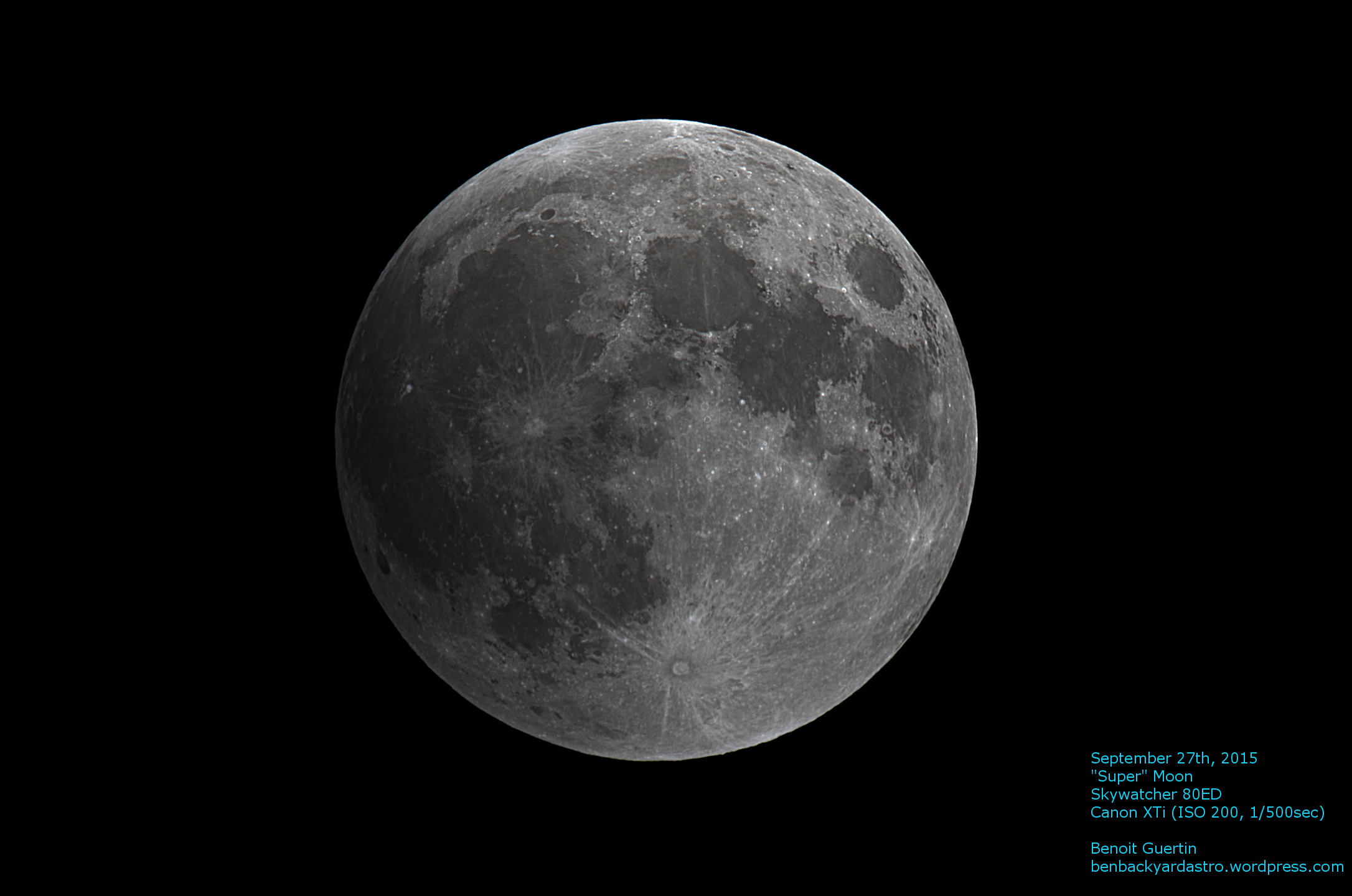
On September 27th, there wasn’t just a lunar eclipse… There was a large magnificent full moon in the sky.  Therefore once I had all my gear setup and ready for the show, I decided to snap a few frames before the start of the eclipse.

The sky was wonderfully clear and the seeing great.  Through the telescope I noticed very little turbulence in the air.  Below is a stack of 11 frames, to which I adjusted the color, the levels and played with the wavelets sharpening to get some detail out of the lunar surface.

Click on the photo for a full resolution version.

September 27th Full Moon

September 27th Full Moon