Missed the 2016 October Hunter Moon? No Worries

Aside

Missed the photo opportunity with the October Hunter Moon?  No worries, while some are claiming it to be a Supermoon, they are mistaken.  November’s full moon will be just 3hrs after perigee (closest to Earth), while the difference was 20hrs for October.  So the November full moon will be larger than the Hunter Moon that just gone by.

So mark November 14th at 13:52 UTC on your calendar!  For North-America, morning of November 14th prior to sunrise will be your best bet.  In Asia it will be in the evening.  Unfortunately for Europe it’ll take place in the afternoon.


Apollo 11 and 17 Landing Sites

Image

What is the smallest detail of the lunar surface can I get with a 80mm telescope (600mm focal length) and Canon 10.1Mpixel camera?  Matching some of the smaller craters in a Moon atlas gives me roughly 6-8km/pixel.  But with image processing anything below 10km doesn’t really show or will blur in the noise.

I tagged a few geological features and dimensioned two craters for reference.  At the same time identified the approximate Apollo 11 and 17 landing sites.  The Apollo Lunar module is only 9.4m wide, hence it is impossible for any Earth bound telescope can possibly pick them up (even Hubble).  However the Lunar Reconnaissance Orbiter (LRO) did manage to pull it off by lowering its orbit as low as 50km above the lunar surface.

Apollo 11 and 17 landing sites and other features

Apollo 11 and 17 landing sites and other features. Moon (October 6th, 2016) – Benoit Guertin

My original photo of the Moon.

Moon – October 6th, 2016

Image

Quick picture of the Moon with the telescope balanced on a railing.  Didn’t trouble getting the mount out.

Moon - October 6th, 2016 - Benoît Guertin

Moon – October 6th, 2016 – Benoît Guertin

October 5th 2016 – Mars, Saturn and the Moon

Image

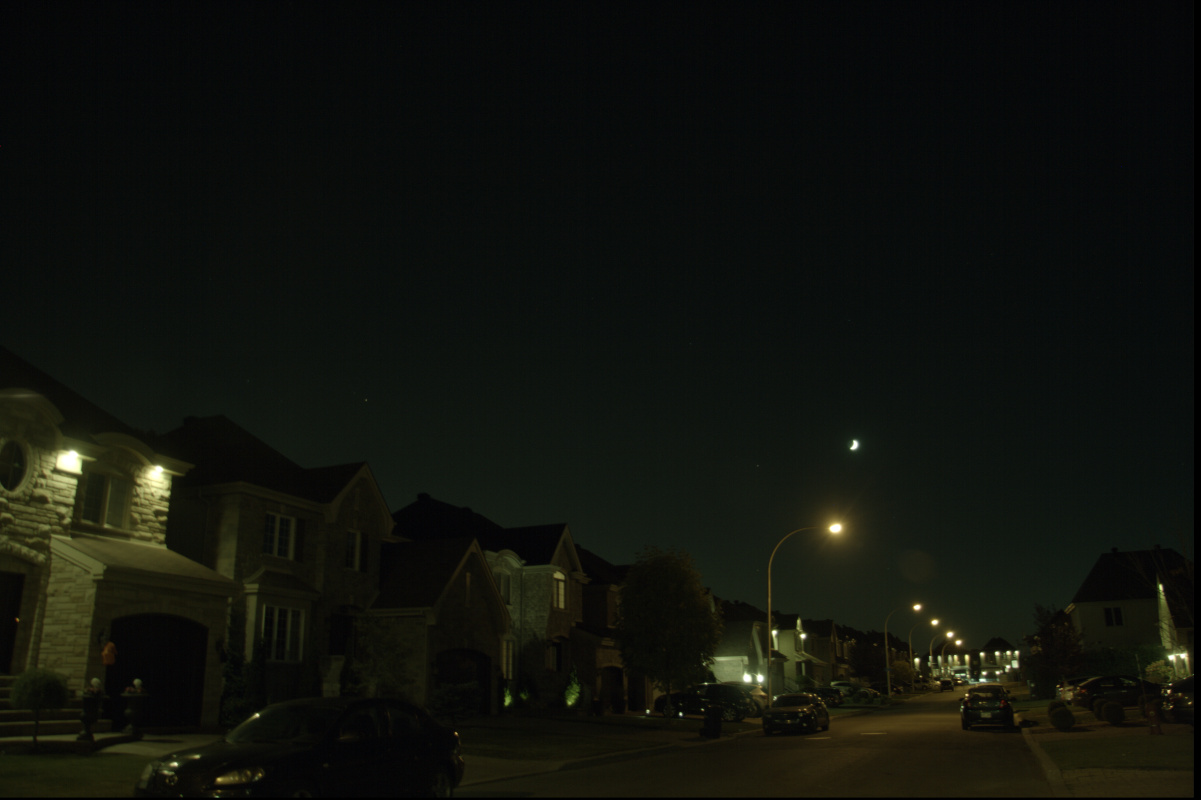
Didn’t have the luxury to scout a better setting to frame the picture.  In the street was actually better than my backyard with all the electric and utility poles/wires.  But nevertheless took a few minutes to frame the scene down the street while standing under a street light.  Click on the image to expand.

October 5th, 2016 - Mars, Saturn and the Crescent Moon

October 5th, 2016 – Mars, Saturn and the Crescent Moon

Almost in the same horizontal plane, you have Mars on the left and Saturn close to the Moon.

As it wasn’t fully dark yet, and I was on a tripod the exposure was rather short: 1/2sec at ISO 400.  Hence no rich star field this time around.  But you do see some of the bright stars such as Antares below Saturn.  Below is an overlay with a star chart.

Overlay with star chart - October 5th, 2016

Overlay with star chart – October 5th, 2016

If you missed it, there is still tomorrow… the Moon will have moved to a position above Saturn.

October 5th 2016 Photo Opportunity 

Great photographic opportunity tonight and tomorrow with a crescent Moon near Saturn in the early evening sky.  Mars is also visible a bit further east and if you have a clear view of the horizon you may catch a glimpse of Venus before it sets.

Octobre 5th 2016 Southwest Evening Sky

Octobre 5th 2016 Southwest Evening Sky (SkyNews.ca)

Ref: SkyNews.ca

Wide Field Around Vulpecula

Image

Continuing my wide field photography of the Milky Way I centered on the constellation Vulpecula (little fox) located in the middle of the Summer Triangle.

In the same frame, three Messier objects are identified:  globular cluster M56 and M71; planetary nebula M27.  Interesting fact is star HD189733 (second bright star above M27 in the framed portion) is the nearest extra-solar planet (63 light years) where the presence of water was detected.  But at 700degC, chances for life are pretty slim.

vulpecula_15sep2016_46x30sec_ident

Left to Right: Globular Cluster M71 in Sagitta; Planetary Nebular M27 in Vulpecula; Globular Cluster M56 in Cygnus

The three constellations from left to right are: Sagitta, Vulpecula and Cygnus (also know as Northern Cross).

As a footnote, this was captured with nearly a full moon in a heavily light polluted suburb.  At 30 seconds of exposure time, the luminosity peak was around 75%.

Canon XTi (450D)
50mm F3.2 (ISO 800)
46 x 30sec (23 minutes)

Rosetta spacecraft’s last few days

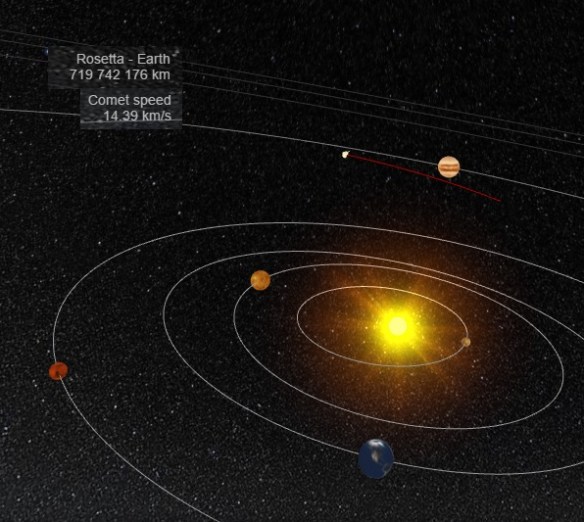
After over 12 years Rosetta will be decommissioned by sending it down to impact with comet 67P/C-G.  This fate was decided as the comet is moving away from the sun, beyond the orbit of Jupiter and the solar panels will not generate enough power to keep the spacecraft operational.  Even “hibernation” is not a possibility as heaters are still required to keep the critical systems idling.  Hence mission control will send commands in the next few days such that on September 29th a series of maneuvers will send it on a impact trajectory with the comet.  As the comet’s gravity is rather weak (1/10,000 of Earth’s) it will most likely not be a fatal impact.  However the Rosetta will be instructed to shutdown upon contact with the surface in order not to “pollute” the deep space communication network with spurious and uncommanded signals.  This is expected to happen on September 30th 10:40 GMT.

So where is comet 67P/C-G?  Travelling towards the orbit of Jupiter, in constellation Virgo, opposite to the sun from Earth’s perspective.  Normally an event like this would be timed to be observable at night from Earth such that telescopes can gather scientific data.  But at apparent magnitude 20 (to compare, Pluto has a mean apparent magnitude of 15) it will be very difficult to observe.  And the impact is not expected to generate a large plume of dust.  Therefore it will be up to Rosetta to record and beam back to Earth as much data during the descent before shutting down for good.

Rosetta and comet 67P/C-G position on September 30th

Rosetta and comet 67P/C-G position on September 30th

Reference: ESA

Dark Nebula – Barnard 142 and 143

Image

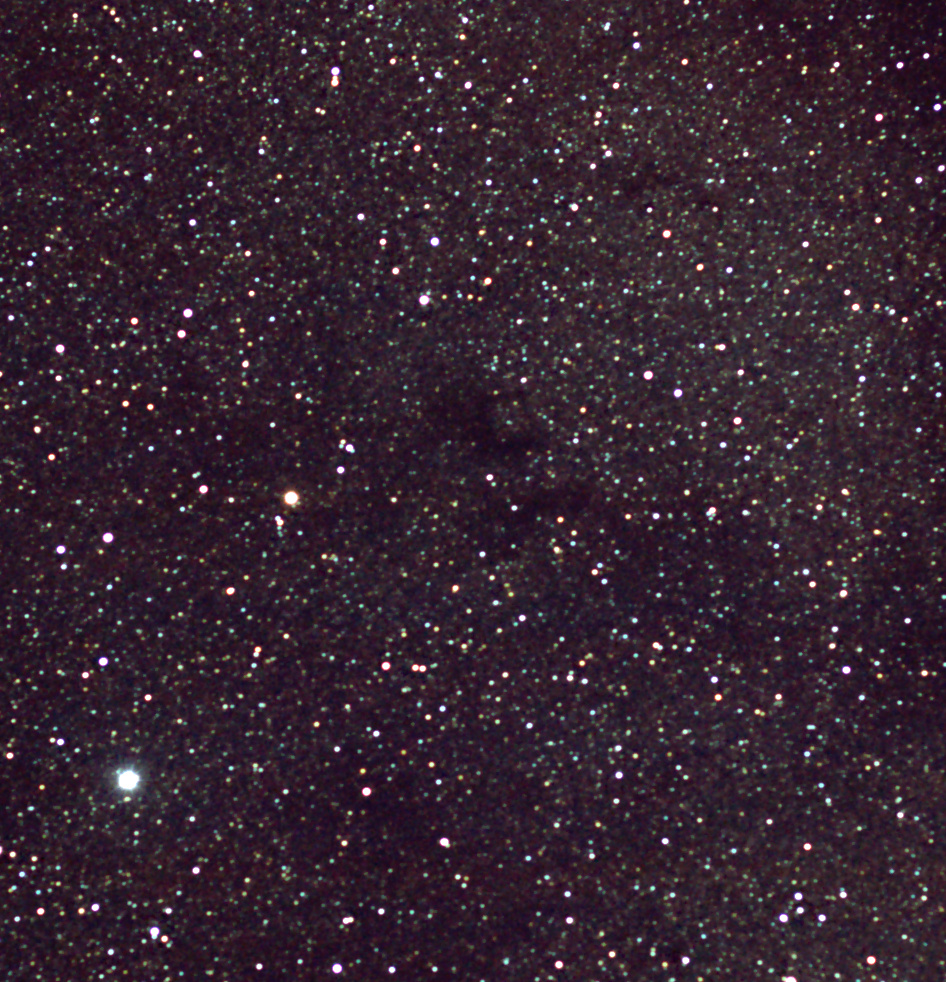
In my previous post I captured a hint dark nebula Barnard 142 and 143.  But as the lens drifted out of focus, I could only use a few frames (14 out of 60).  At the next clear sky I aimed Altair in the constellation Aquila with the goal to capture a good 60 frames in-focus to once again capture Barnard 142 and 143.

Dark Nebula Barnard 142 and 143 near Altair (Aquila)

Dark Nebula Barnard 142 and 143 near Altair (Aquila)

The entire image scaled 40% (the above is a crop) is available here.

Canon XTi
50mm F3.2 ISO800
59 x 30sec (29.5 minutes of integration)

2016 Harvest Moon

Image

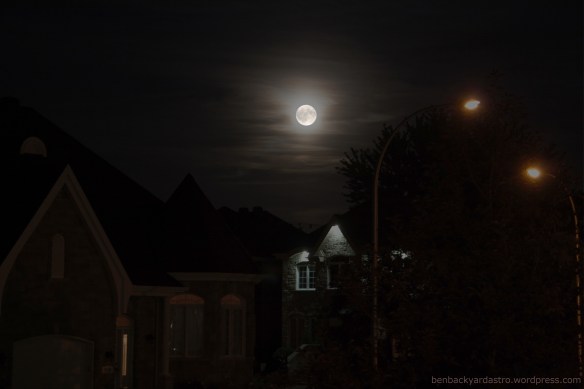
A Full Moon near the autumn equinox?  Well that’s a Harvest Moon.  While the Moon over the horizon can look rather large, there’s some disagreement whether the 2016 Harvest Moon should also be a Super Moon.  I’ll let them sort it out while I snap a few pictures…

2016 Harvest Moon - Benoit Guertin

2016 Harvest Moon – Benoit Guertin

Photo details:
Combined a short and long exposure with Canon XTi
85mm F5.6 1/250sec (ISO200)
61mm F5.6 0.5sec (ISO400)

Autumn – Darker Skies and No Mosquitos

I hadn’t taken the telescope out since April. With other projects and hobbies I just didn’t bother setting up the equipment.  But a few nights ago looking at a dark blue evening sky I noticed a nice crescent Moon and a triangular star formation over the horizon. The kids weren’t in bed yet so I grabbed my gear and made a quick set-up for observation with the 80ED telescope.

After an observation of the Moon, spending time examining the lights and shadows across the lunar craters and valleys I looked at the triangular star formation and suspected that at least one was a planet.  Slewed the telescope over and discovered Mars. Tried different eye pieces and settled for an Orion Edge-On 9mm planetary with Televue 2x Barlow.

With the kids off to bed I changed the set-up for webcam imaging before Mars could dip below the horizon. Follow up processing that evening wasn’t very rewarding.  Mars is some distance with Earth therefore appeared rather small compared with other times I pointed the telescope and with the heavy atmospheric turbulence imaging at such a low altitude it blurred the scant details I could have captured.

But that evening I broke the ice and got the gear out. And since I’ve been enjoying the night sky when weather permits. With the galactic plane crossing the sky it’s a great time for wide angle shots. It’s also much faster to set-up and more forgiving to an incorrect polar alignment. I got three photo sessions to analyze and hope to have some good shots to show in the next few days.

Autumn,  with cooler nights, dark skies and no mosquitos it’s prime time to enjoy the night sky.