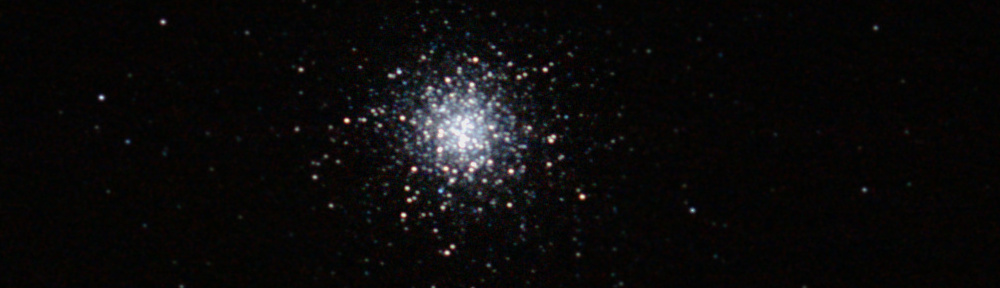
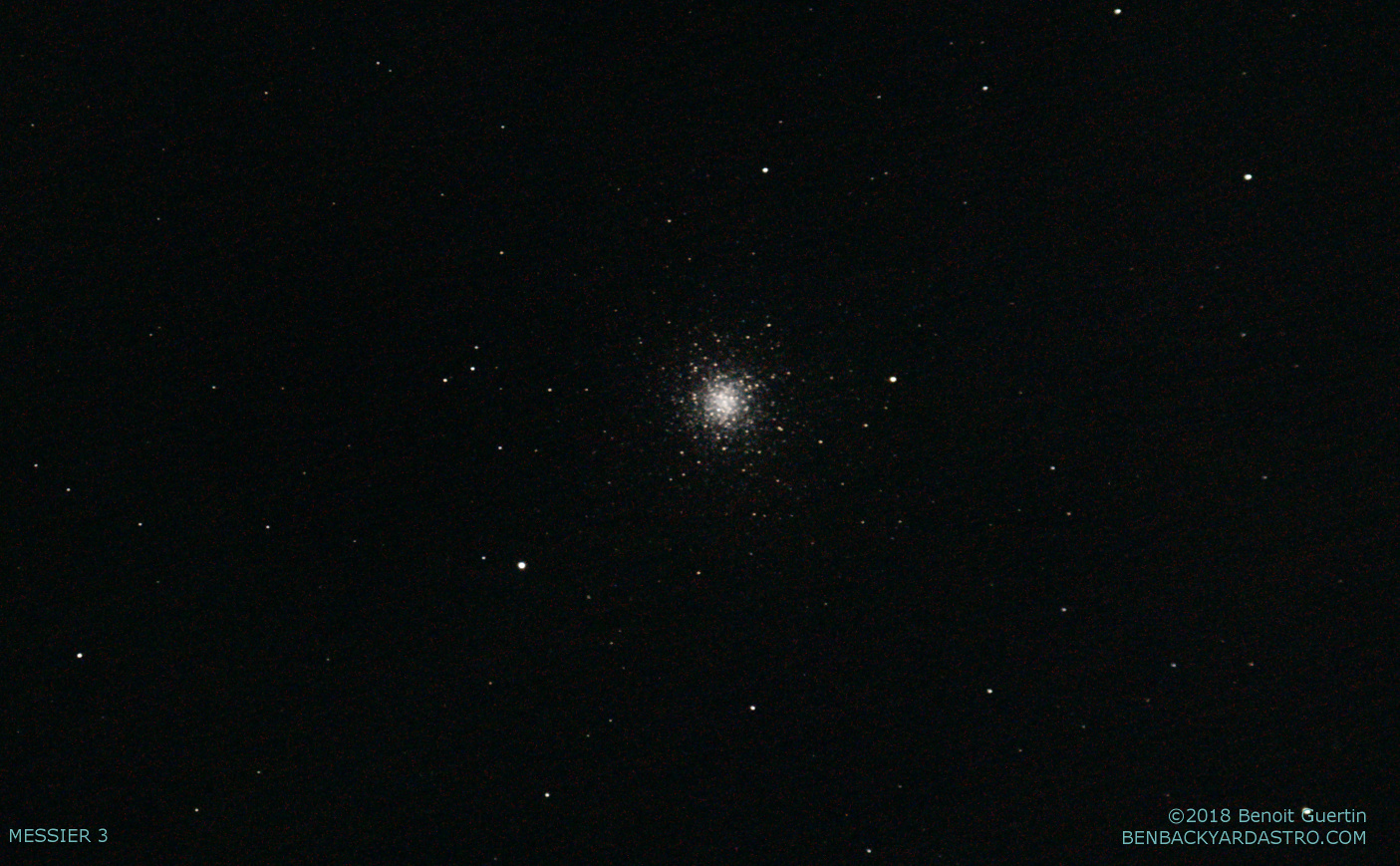
A few weeks ago after taking some photos of Jupiter, I changed my setup to do some long exposures on an easy target: a globular cluster. Unfortunately I forgot to note down the name of what I had photographed! So a few weeks later when I found the time to process the images I was at a loss to identify what Messier object it was. However, after an evening of matching up stars surrounding the cluster and I was able to correctly identify it as Messier 3.
Globular Cluster – Messier 3 (Benoit Guertin)
The above was taken with my Skywatcher 80ED and Canon 80D. It is a stack of 27 x 10sec exposures at ISO3200 on an unguided and roughly aligned mount.
Looking at my archives I found that I had imaged M3 about 10 years ago with the same telescope, so I decided to align both old and new image and see if anything would stand out. And to my surprise, spotted one star that appeared to have shifted. To help identify the star I colorized one of the photos and subtracted from the other (done in GIMP). All the stars within the field of view lined up except this one; the two colored spots are not aligned!
Its inevitable, what goes up must come down. On average there is one large piece of equipment that re-enters our atmosphere every week. Some are controlled and planned decommissioning of satellites after their useful life. They are purposely commanded for re-entry and burn-up in the atmosphere to avoid adding debris to our already crowded space orbits or worse, cause a collision with another satellite creating an enormous field of debris. Other objects that re-enter are left to fall on their own such as discarded rocket bodies and old satellite that ceased to operate long ago or malfunctioned and can no longer be controlled.
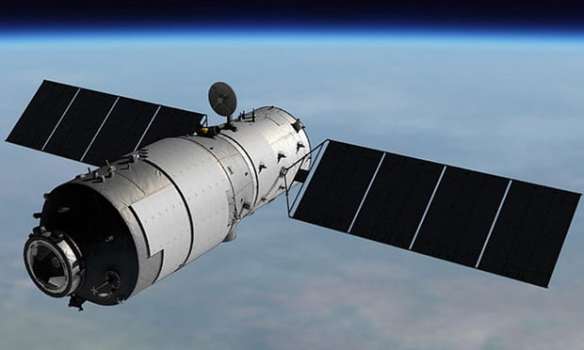
Tiangong-1 : First Chinese space station launched in 2011
This coming March the 8,500kg (18,700lbs) Tiangong-1 Chinese space station is coming back to Earth. Launched in September 2011 and used for two manned missions, it suffered a malfunction and the Chinese have not been in control of it since 2016. The space station has been in a decaying orbit ever since, and now below the 300km altitude where Earth’s atmosphere is causing the space station to slow down due to aerodynamic drag it will soon make its re-entry.
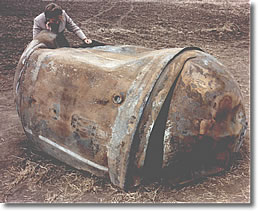
Delta 2 rocket fuel tank surviving re-entry near Georgetown, TX, on 22 January 1997
Now there is no need to panic. Most of Earth is ocean, and we’ll probably not see anything let alone have a piece of it land in a city. However as this is a fairly large body, there is a good chance not all pieces will burn up and some may make it to the surface.
This isn’t the first time a space station makes a re-entry. The American Skylab at 77 tons re-entered in 1979, and Russian Mir (120 tons) made its re-entry in 2001.
For the Mir re-entry, Taco Bell even got it onto the re-entry buzz by anchoring a large
Taco Bell target for Mir re-entry (2001)
target off the Australian coast along the planned re-entry track, and should Mir crash into it there would be free tacos for all Americans. The fast food chain even took out an insurance policy just in case it would happen.
In early January 2018, Tiangong-1 is orbiting at an altitude of around 270-290km (to put that into perspective, ISS is at a 400km orbit) and in a 45 deg orbit, hence the re-entry will be within those latitudes. The green area in the map below is where Tiangong-1 could make a re-entry, and also marks where the re-entry could be observed.
It’s still too early to determine the time and location of potentially crash site, as Earth’s atmosphere is influenced by space weather and swells based on our Sun’s moods, which alters the drag force on the space station. However various space centers and organizations will continue to track the space station the coming weeks to improve the prediction.
You can follow everything at Aerospace.org for up to date information and predictions.
What could the re-entry look like? Below is a video shot by NASA of the Japanese Hayabusa spacecraft during a controlled re-entry on June 13, 2010
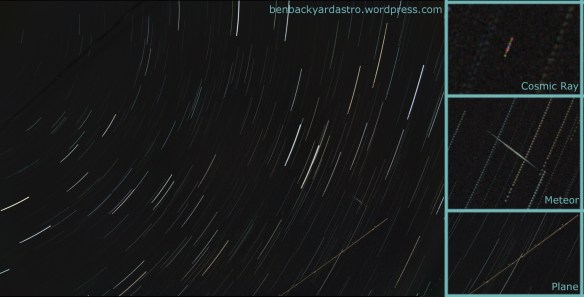
Simply setting up a camera to take a series of images of the night sky can pick up a lot more than a few stars.
If you have a wide-angle lens, and live near a large city there is a good chance that some aircraft will fly into the field of view. The linear streak and alternating lights are a dead give-away of a plane having crossed the camera’s field of view. If you don’t have the alternating lights, it’s mostlikely an orbiting satellite reflecting sunlight.
Meteors are also somewhat of a common occurrence. These are easily recognized by their characteristic increasing than decreasing brightness as they burn up in the upper atmosphere. The meteor in the image above is from the Geminid shower.
The last artifact comes for outside our solar system, it is cosmic rays. The CCD or CMOS sensor of your camera works by performing an electric read-out of photons captured by the lens. Cosmic rays are high-energy sub-atomic particles that have traveled through space and managed to make it through the atmosphere down to us. The one in the photo above just happens to hit my camera sensor. As the near light-speed sub-atomic particle smashes into atoms on the sensor it looses energy, freeing up electrons which register as “light” by the CCD. Most of the time the cosmic ray will hit the sensor straight on, but sometimes it impacts at a shallow angle and causes a series of pixels to “light” up, as in the photo above.
Take time to examine your photos, you never know what surprises you may find.
I recently came across an article in the french Science & vie magazine, where a reader asked if Earth influences the Sun. I found it rather interesting, and while I had my doubts I still wanted to know more about it.
The reader wasn’t the first to wonder if there was any interaction, various models and observations have been put forward since the late 1800s. We often read about two bodies interacting in space. The first exoplanet was discovered due to its gravitational influence on its star causing it to wobble. This type of gravitational influence works when two bodies have a mass within one or two orders of magnitude of each other. But in the case of our Sun, it is 99.86% of the solar system’s mass, and most of the remaining is taken up by Jupiter and Saturn. Therefore from a gravitational perspective Earth has no effect on the Sun.
But could the 11 year period in solar activity, characterized by the rise and fall of number of observed sun spots be caused by the planets? The exact source of that periodicity has yet to be clarified. Well a team of researchers at the Helmholtz-Zentrum Dresden-Rossendorf (HZDR) put out a paper in 2016 after demonstrating that every 11.07 years the planets Venus, Earth and Jupiter are aligned. Coincidence?
They explained that while the effects are rather small, the repeated nudging could be enough to tip the Sun’s magnetic field instabilities one way or the other causing this 11 year solar cycle that we observe, much like an object entering into resonance. In this case it’s the Sun’s magnetic field acting like a dynamo that would resonate due to the planet’s alignment every 11 years.
However many are skeptical about any real effect pointing that the source of the Sun’s magnetism comes from deep within, while the planet’s effect, if ever, would be limited to the Sun’s surface. But the crushing blow is when you look at fact that the solar cycle varies between 7 and 14 years, the number 11 just happens to be the average over the last 24 observed cycles. Unfortunately the three planet’s alignment don’t vary by that amount.
In the end, the Sun is still king and does what it wants in this solar system, regardless what the planets say or do.
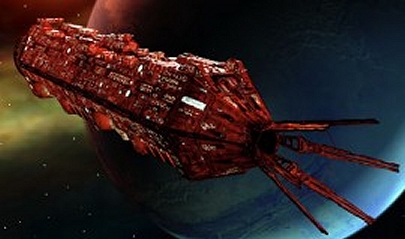
The big news this week is the first recordings and observations of an interstellar object. Of the 750,000 asteroids and comets that have been cataloged up to now, every one of them originate from within our solar system. This object detected by the Pan-STARRS1 telescope and named A/2017 U1 or “Oumuamua”, a Hawaiian word for scout or messenger from the distant past, came from another part of our galaxy. Based on measurements made from multiple ground-based telescopes it is believed to be rather long and of a deep red color . Below is an artist’s rendering of this extra-solar visitor. While a comet would have generated some type of coma or tail travelling near the Sun, no such activity was recorded, hence it’s believed to be an asteroid-type object.
Credit: ESO/M. Kornmesser
Measurements over multiple nights allowed to establish the trajectory, which clearly shows that it did not originate from the Oort cloud or other asteroid/comet rich fields surrounding the Sun. While the discovery was made only on an October 19 image, its closest approach to the Sun was September 9th.
Diagram showing the trajectory of A/2017 U1 (ESO/K. Meech, et al.)
Now I thing they got it all wrong. What they picked-up was the Red Dwarf mining ship swinging by our neighborhood!
The Moon is white right? OK, OK… it only looks white because of the high contrast with the dark sky, it’s more grey. What? No? You mean it has color?
From samples returned by the Apollo missions we know that two of the main minerals making up the lunar regolith is titanium oxide (TiO2) and iron oxide (FeO) based basalts. While TiO2 is quite white and used in many household products from white toothpaste to white kitchen tiles, FeO is rust and closer to orange-brown (think Mars). On the Moon the result is a slightly blue-ish color in the areas with high TiO2, and more of a brown-red for the higher FeO and low TiO2 zones.
A normal image of the moon taken with DSRL, the different in hues is subtle as seen below.
Moon Natural Color (November 7, 2017) – Benoit Guertin
But it can be exaggerated by playing with the color saturation, and you get the image below, where various hues of blue-grey, orange and brown become apparent. The sharp boundaries between colors are caused by the different mineral make-up of the lava flows during the early formation of the Moon. Common interpretation of the age of the lunar surface is that the blue-grey areas are “younger” than the orange-brown.
Who says you can’t pull scientific information with simple backyard astronomy gear? The same technique, but with narrow-band filters is used by NASA and other space and research agencies to catalog the make-up of the lunar surface.
So if you are planning lunar prospecting for future mining rights, all you need is a telescope and a DSLR.
On Wednesday NASA made headlines by announcing that researchers had detected seven exoplanets orbiting a dim dwarf star. These exoplanets are determined, based on measurements, to be approximately Earth-sized solid planets and three happen to fall in the “Goldilocks Zone” where water could exist in liquid form; not too hot, not too cold. Lots of people started speculating that in a few years we’ll find out if one of those planets harbors life. However that is just plain crazy-talk. The importance of this discover is that complex exoplanet systems do exist; the Solar System is not an exception, and that life is also not an exception.
The TRAPPIST-1 system contains a total of seven planets, all around the size of Earth. Three of them — TRAPPIST-1e, f and g — dwell in their star’s so-called “habitable zone.” [NASA/JPL]
0.60m Ritchey-Chrétien Reflector [TRAnsiting Planets and PlanetesImals Small Telescope–South / ESO]
The TRAnsiting Planets and PlanetesImals Small Telescope–South made the discovery back in May 2016 of three exoplanets around the small star. But it was with the help of larger telescopes and the space-based Spitzer telescope that the count increased to seven and their orbits could be confirmed. What I find interesting is the initial discover was done by a relatively “small” 0.60m telescope. OK not your typical backyard astronomy gear, but scale that down by 1/3 and you have equivalent optics for about $3000. Add a mount and CCD and for $10,000 you could probably have your very own exoplanet hunter!
Back to the crazy-talk of finding life in this exoplanet system… Anyone who has studied the history and formation of the Solar System knows that there have been a series of unlikely events that have led to where we are today. Starting with the Sun, probably a 3rd generation star, where heavy elements like Calcium and Iron necessary for life as we know it were produced by previous stars and supernovas that used to exist in this spot of the galaxy we now occupy. All elements beyond Hydrogen are produced by stars, either through fusion or when they dramatically explode as supernovas. The atoms making up the air, the trees, the oceans, ourselves were not created in our Solar System during its formation. The Sun is currently only generating Helium and Lithium out of Hydrogen through the wonders of fusion. All the heavier atoms within us were created by previous stars that no longer exist. Hence for solid Earth-like exoplanets to exists there needs to have been one to two previous generation of stars in the region.
An alien race observing our Solar System would surely first spot Jupiter. One could almost say that it characterizes our home in this part of the galaxy. With its strong gravity this gas giant plays the vital role of neighborhood vacuum cleaner. It is either mopping up or launching away asteroids and comets that would otherwise impact Earth, bringing relative calm to the inner Solar System. If Earth was constantly bombarded by solar objects, there is no way that life could suitably evolve from slimy unicellular organisms. It took 3 billion years for multi-cellular organisms to show up once life appeared on Earth. If cataclysmic comet and asteroid impacts are a frequent occurrences, then there is little chance that complex organisms would come to be.
Looking at another element, TRAPPIST-1 is described as an ultra-cool dwarf star just shy of 40 light years from Earth in the constellation Aquarius. If we forget that it’s a fraction of our Sun’s size and brightness (hence heat generation), it is relatively young at 1 billion years old. So while there may be three planets that could be habitable, life may not have even begun yet. Our own Sun is 4.3 billion years old, and the animals we see around us have only been around for the last 14-16 million years. So what could be in a 1 billion year old planetary system? Assuming all the ingredients are there for life to exist, you probably only have bacterial soup.
Now, my article was getting long, and I wanted to cover many more subjects, too many for a single article. Hence I’ve decided to break them out into the EXOPLANET SERIES and will publish them over time.
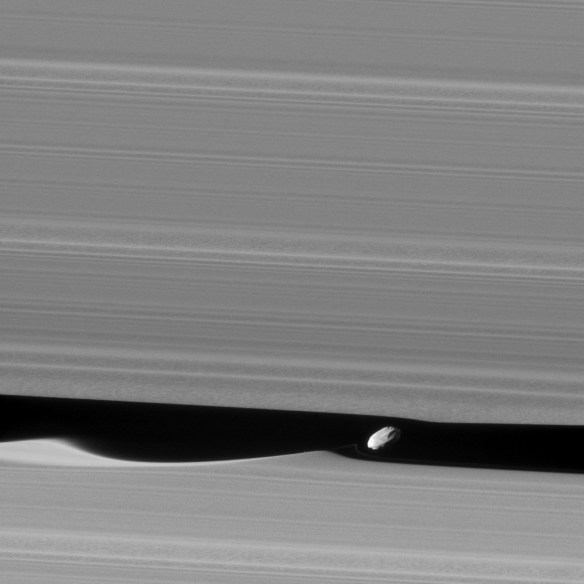
Did you know that you can get access to the latest RAW images from the Cassini spacecraft directly from the NASA and JPL website? Not only will you have first look at some stunning images of Saturn, the rings and the Moons like this one below from January 16th. Click the image below for more information from NASA/JPL on that specific photo.
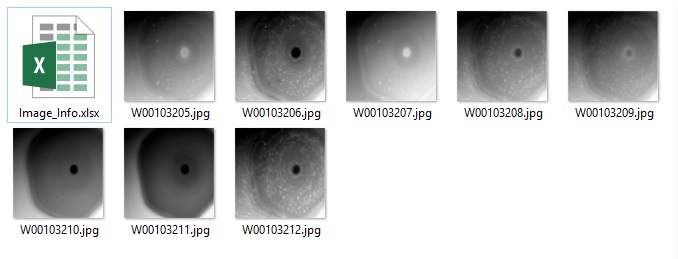
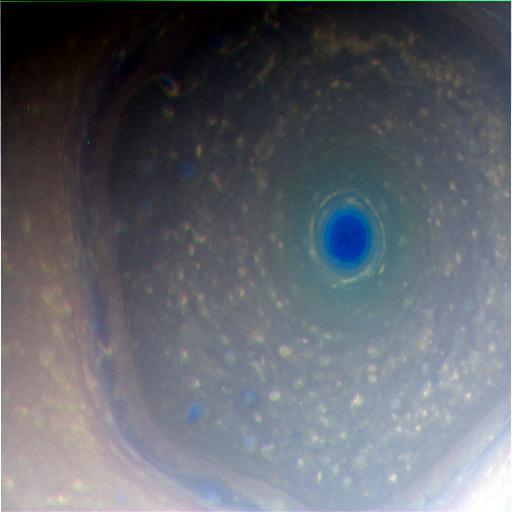
But you can also download raw images to try your luck at processing. For this exercise I selected these series of pictures of the strangely perfect hexagonal-shaped storm on Saturn’s north pole.
Downloaded raw image set
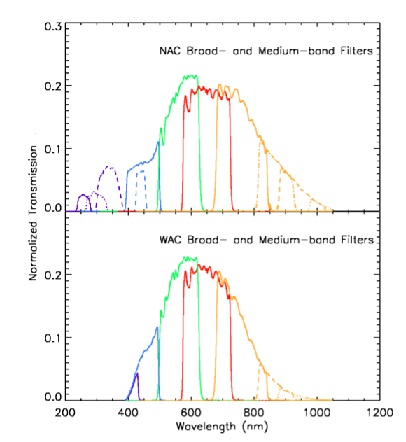
These are images taken with different filters by the wide field camera, and I noted in an Excel file some information on each image, most importantly which filter was used. Both the narrow and wide CCD on Cassini operate with two filter wheels, hence each image will always list two filters. For those surprised at the rather “small” 1 mega-pixel camera, keep in mind the spacecraft was launched nearly 20 years ago, and development started in the 1980s.
There is a very detailed document on how to use, calibrate and process the images found at the following link. But for what I wanted (quick processing) I only needed to find out which filters were the closest to an RGB setup.
Cassini ISS Broadband Filters
Luckily this is well documented, and found them with the BL1, RED and GRN filters.
The image below is a quick addition of those 3 respective images assigned to red, green and blue channels. The resulting image would be somewhat near the real colours, but I did not take any time to calibrate, hence they are probably a little off…
Saturn with normal RGB assignment (close to real colours)
I also decided to try something that would provide a little more contrast and dive a little into the atmosphere and went with a IR-Red-Blue for RGB assignment by using a one of the narrow-band filters.
Cassini ISS Narrow Band Filters
Saturn with IR, Red and Blue for RGB assignment
Both images above have not be calibrated, stretch or adjusted other than combine the raw images from Cassini.
The NASA/JPL site even has a section for amateurs to submit their photos and host a gallery to see what others have done.
JunoCam onboard the Juno spacecraft is providing us with some great pictures of the Jupiter cloud top, but from the rarely seen polar angle. Pretty much all spacecrafts that have visited Jupiter did so with a fly by along the equatorial plane, which is also the same plane we observe Jupiter here on Earth. However with the Juno spacecraft, we now have a chance to enter into a polar orbit and take pictures of the polar regions.
Part of the reason behind JunoCam is to get the amateur astronomer community participating in selecting what parts of Jupiter the camera should be snapping pictures, and of processing the raw images. The image below was captured by JunoCam during Juno’s 3rd swing around Jupiter at a distance of about 37,000km. The south polar region is on the left.
The above was the PeriJove3 encounter (3rd pass), and voting on the next PeriJove4 will take place between January 19th and 23rd 2017. This is where the community can propose and vote for Points of Interest to photograph with JunoCam during the rather quick (2 hours) close pass with Juno. You can even submit images of Jupiter taken with your equipment to help plan the Points of Interest.
Welcome to a journey into our Universe with Dr Dave, amateur astronomer and astrophotographer for over 40 years. Astro-imaging, image processing, space science, solar astronomy and public outreach are some of the stops in this journey!



 If you have a wide-angle lens, and live near a large city there is a good chance that some aircraft will fly into the field of view. The linear streak and alternating lights are a dead give-away of a plane having crossed the camera’s field of view. If you don’t have the alternating lights, it’s mostlikely an orbiting satellite reflecting sunlight.




![0.60m Ritchey-Chrétien Reflector [TRAnsiting Planets and PlanetesImals Small Telescope–South / ESO]](https://benbackyardastro.com/wp-content/uploads/2017/02/eso1023e.jpg?w=274&h=398)




 Ben Backyard Astronomy