Link

With the last maneuver planned for April 24th, the Messenger spacecraft will be officially out of fuel and unable to maintain proper orbit around planet Mercury.  Scientists expect the spacecraft to crash onto Mercury on April 30th.  Unfortunately the impact is expected on the opposite side of the planet, out of view from Earth’s observation posts.

I know for past spacecraft impacts such as those on the Moon, NASA had asked the amateur astronomy community to observe and record the impact.  Out of luck and out of reach this time…

Sources: SPACE.COM / NASA

Weekend Observation Opportunity: Venus and the Pleiades

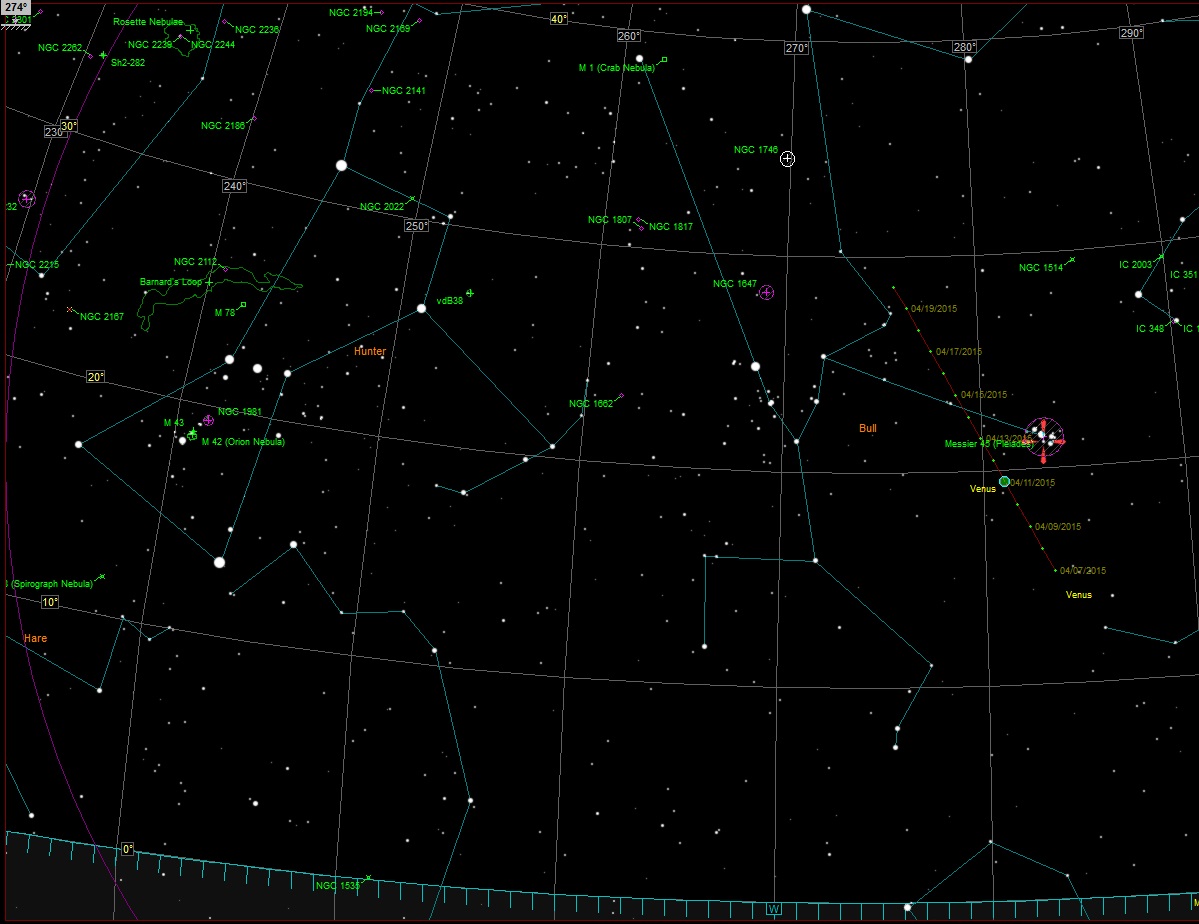
There is a great weekend observation and photo opportunity as Venus is passing within a few degrees of the Pleiades open star cluster (Messier 45).  You won’t need a sky chart for this one, simply look West in the evening and Venus should be easily spotted as the brightest point in the sky.  The Pleiades can be observed without any instruments, but if you have binoculars you’ll better appreciate this open star cluster also called Seven Sisters.

A camera and a tripod?  Why not!  Try different settings to see which one give you the best results.

Around April 10th, Venus will pass within 2deg of the Pleiades (Messier 45)

Around April 10th, Venus will pass within 2deg of the Pleiades (Messier 45)

While you are checking out that part of the sky, scan 40 degrees towards the South (to the left) and you’ll find the Hunter constellation (Orion) also great to look at and photograph.  Take the time to observe the colour of the stars, from the red supergiant Betelgeuse to the blue supergiant Rigel, the two brightest stars in Orion.

These two constellation (Taurus and Orion) will set around midnight, therefore they will be low over the horizon (20deg above horizon at 9pm local time).

April 10, 2015 - Orion and Taurus Constellations

April 10, 2015 – Orion and Taurus Constellations

Link

Missing the April 4th lunar eclipse?  No problem, NASA has posted on YouTube the entire event, all 45 minutes.

Comet 67P/Churyumov–Gerasimenko – Can we see it?

First of all I want to congratulate the Rosetta team on their successful landing of Philae on the comet surface.  When you consider that the spacecraft was launched 10 years ago, it was essentially designed and assembled with 15-year-old technology.  Back then, digital cameras were just entering the market and the Palm III PDA was the mobile device everyone wanted.  In fact, much of the code running on Rosetta and Philae was developed after the aircraft was launched.

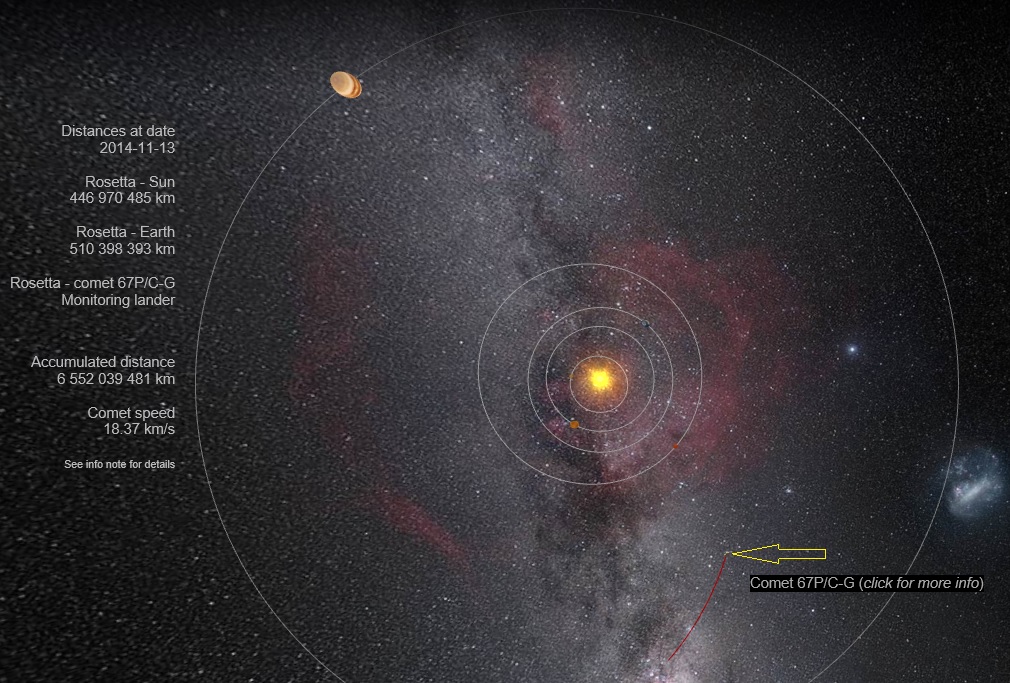
Presently 67P is located between Jupiter and Mars, on its swing towards the sun. To give you an idea how far out it’s located in the solar system, it takes over 28 minutes for radio communications from Rosetta to reach Earth.  Therefore if mission control sends a comment to Rosetta, the results are only known one hour later!

Location of comet 67P/Churyumov–Gerasimenko on November 13th, 2014

Location of comet 67P/Churyumov–Gerasimenko on November 13th, 2014 (Credit: ESA)

Starting in May 2015 67P will become visible to observers in the Northern Hemisphere, and will gradually brighten until achieving perihelion on August 13, 2015.  Because it does not venture very close to the sun, past observations indicate that it will only reach magnitude 11 at best; a challenge to backyard telescopes.

Better slew your observation by 9 degrees north, that’s where comet 141P/Machholz will be in the same constellation (Gemini) and at magnitude 8; a slightly brighter target.  And if you have no luck observing either comets or capturing them on photo, open cluster M35 is in the area.

Until then, you can follow Rosetta and Philae’s adventure on their blog: blogs.esa.int/rosetta/

Jupiter’s Great Red Spot – Could it be gone in 20 years?

One of the great targets for backyard astronomers is Jupiter, and spotting its moons, the cloud bands and the Great Red Spot is always a treat. Observations over a few days provides a good view into the dynamic nature of the clouds and the orbits of the Moon.  I haven’t yet managed to capture the Great Red Spot on photo, but maybe this fall as Jupiter comes back into view in the evening sky, I should make the effort to spot the GRS.  This is because ever since it’s discovery in the 1800s, it has been shrinking in size.  And at the current rate, it could be gone all together in as little as 20 years!

Jupiter's Great Red Spot (1995 and 2014) - NASA

Jupiter’s Great Red Spot (1995 and 2014) – NASA

In the last 10 years it has shrunk by 3000km, taken a more circular form and increased its rotational speed.  Amateur observations since 2012 have revealed that this phenomenon is even accelerating, shrinking by as much as 930km per year.  Current measurements have the GSR now pegged at under 15,000km in diameter.

As we head into the fall, Jupiter will become easier to observe.  By December Jupiter will be high in the sky around midnight. On February 6th, Jupiter will be at Opposition, fully illuminated by the Sun and at its closest to the Earth.

The photo in the title bar was taken by me back in September 17th, 2010, only 4 days before its closest approach, which shows that even with a small 80mm scope, quite a bit of detail can be captured when the conditions are right.

Today at Sunset – Partial Solar Eclipse

Aside

Weather permitting, North America will have a partial solar eclipse today October 23rd.  The eclipse will take place at sunset

Information available at the NASA Eclipse web site.

People located west and north will be at a better location to see a greater portion of the eclipse.  In the east, the eclipse will start around 5:40pm EDT, but will end after sunset.

Various methods of viewing the eclipse safely is listed in a CBC News article

Mars and Comet Siding Spring – Chance of a lifetime

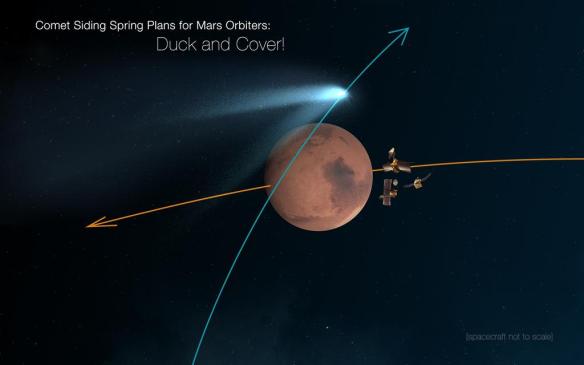
NASA/JPL-Caltech

NASA/JPL-Caltech

On October 19th a once in a lifetime event will happen.  Comet Siding Spring (C/2013 A1) will pass very close to Mars, one tenth the distance of the closest Earth-comet pass.  While there is no chance of impact, NASA has moved some of its Mars orbiting satellite to be behind the planet is it passes through the comet’s dust tail in order to protect the equipment.

At predicted magnitude 11, it will be limited to large telescopes with camera or CCD.  But its close proximity to Mars will make it an easy target to locate.  Unfortunately for North America, the closest approach will take place 2:28pm EDT.

Luckily NASA has setup as dedicate web site leading up to and after the even publish information and photos.  The SLOOH telescope will also have a live webcast.

Link

Good article from CBC News on the October Lunar Eclipse.  Includes photos and videos.

http://www.cbc.ca/news/technology/lunar-eclipse-left-moon-glowing-blood-red-1.2792098


Total Lunar Eclipse – Only a few hours

Aside

Only a few hours left before the start of the Total Lunar Eclipse of October 2014.  Unfortunately the weather won’t be cooperating as the forecast calls for cloud and rain in my parts of the woods.  But no worries, the SLOOH telescope will be broadcasting the event live!  Event starts October 8th 5:00AM EDT .

live.slooh.com

Stargazers worldwide are invited to watch the spectacular Total Lunar Eclipse, sometimes known as the “Blood Moon,” unfold live on Slooh. The free, real-time broadcast will begin on October 8th starting at 2:00 AM PDT / 5:00 AM EDT / 0900 UTC with live feeds from multiple locations located in Australia and North America. This eclipse will be difficult to view for most of the planet as it mainly takes place over the Pacific Ocean. As such, the eclipse will only be visible in its entirety from parts of eastern Australia, New Zealand, eastern Asia, most of Japan, Hawaiian Islands, and the western part of North America. But fear not – Slooh will have strategic sites in these locations allowing the world to view the eclipse live on Slooh.com


Another webcast is available over at the Coca Cola Space Science Center.


Total Lunar Eclipse – Wednesday October 8th, 2014

In North America, not long before sunrise on Wednesday, a Total Lunar Eclipse will take place.  The fun thing is that you don’t require any special equipment to enjoy.  However if you do plan on taking a photo with a telescope or long focal length lens, an equatorial mount will be required to get a sharp image of the moon.

February 20th, 2008

February 20th, 2008 Benoit Guertin

On the east coast, the event will start around 6:35am EDT with the Moon low in the West.  This will be a great photographic opportunity, as with the Moon low on the horizon, the optical illusion will exaggerate the size of the Moon, making it look much larger than in reality.

Further west on the continent, the Moon will be higher in the sky and therefore better positioned to enjoy the entire event.  No need to rush out in your pajamas, a Lunar Eclipse is a slow event; Totality lasts for nearly one hour!

See NASA News website for more information: http://science.nasa.gov/science-news/science-at-nasa/2014/18sep_lunareclipse/

Ref: NASA News