Photos from the 2024 Great Solar Eclipse

This was my first time experiencing a total eclipse, and it did not disappoint! But the day did not go as planned.

April 8, 2024 total solar eclipse
Montreal, Canada
Benoit Guertin

A friend amateur astronomer invited me to his cottage in Sutton, Quebec, to be able to view the eclipse in a location that was ideal, located just a few kilometers from the center of the path of totality. At that spot, the eclipse would last nearly 3 minutes and 30 seconds. The forecast was for perfect blue skies, in fact eastern Quebec appeared to be the best spot in all of North America to watch the eclipse without cloud cover.

That morning I planned my trip, packed up the car with my telescope, camera, laptop table, chair, and was looking forward to the day. According to Google Maps, I would get to Sutton with 1hr to spare, enough time to setup the equipment.
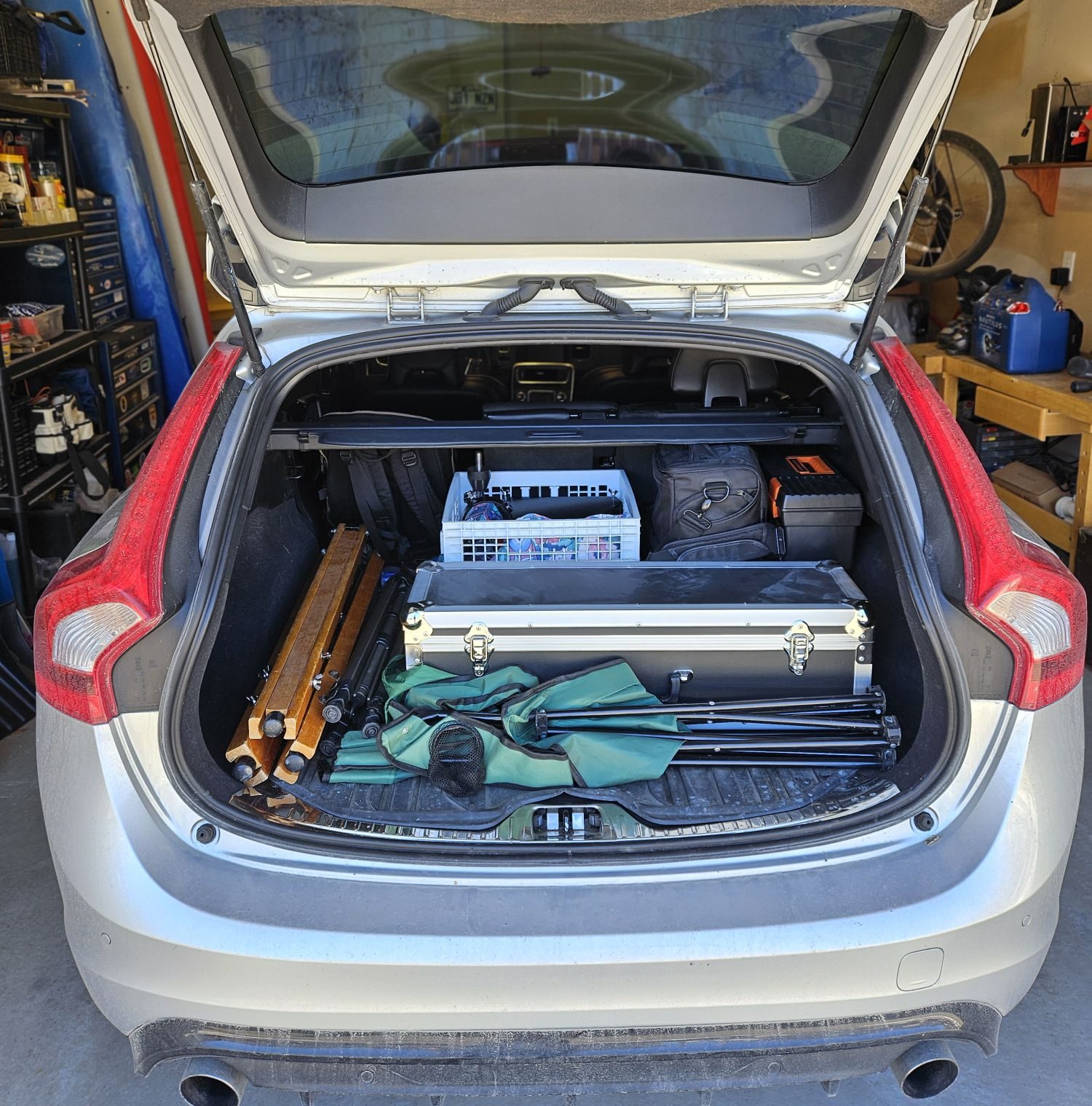
However once on the road the traffic situation changed rapidly as thousands of people were heading out to the eastern townships searching the ideal place to view the eclipse. Montreal being an island, the crossing points are limited and this resulted in terrible gridlock traffic as everyone appeared to hit the road at the same time. Two hours later, when I should have been approaching Sutton, I was still on the island of Montreal trying to make it across a bridge.
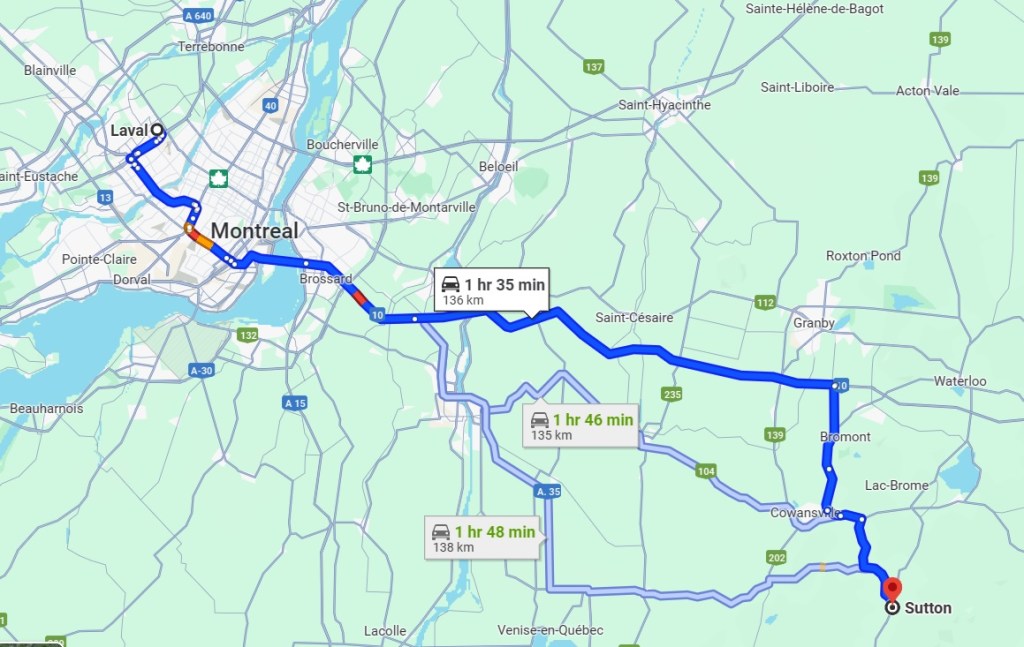
There I was sitting in a traffic jam, Google Maps kept increasing the ETA as I was barely moving a car length per minute and I was loosing all my equipment setup time. On top of that, I was starting to wonder if I even had enough gas in the car to make it. Creeping along in stop-n-go traffic was killing the fuel economy. I was starting to wonder if I should think of a plan B.

With a lot of patience I reached Brossard on the south short and was now on highway 10 to the eastern townships, free from the city of Montreal. But the highway was behaving closer to a shopping center parking lot on December 23rd. The worse scenario was starting to materialize: stuck on a highway with my telescope and gear in the trunk and no place to setup. Would the shoulder of a highway be my destination?

I was now next to an offramp and the next exit was over 10 kilometers away, likely a 1 hour ordeal. I decided to get off the highway, abandon the Sutton destination and go for plan B: find a suitable spot to setup. The eclipse would begin in 1 hour, I needed to find a spot quickly.

That arrived moments later as I spotted from the highway a commercial zone with a vacant lot away from buildings. It would have to do, my nerves were about to fray. There was amble space to safely setup my gear with no disruptions and more importantly, time to do so before the eclipse would start.

I’m sure there were people driving by wondering what I doing there, but it didn’t matter as I was ready to observe and photograph the eclipse. Two visible sun spots on the sun were much welcomed focusing aids. But not being correctly polar aligned meant the sun would drift away every 5-10 minutes. Nothing would be perfect in these circumstances and that was OK.

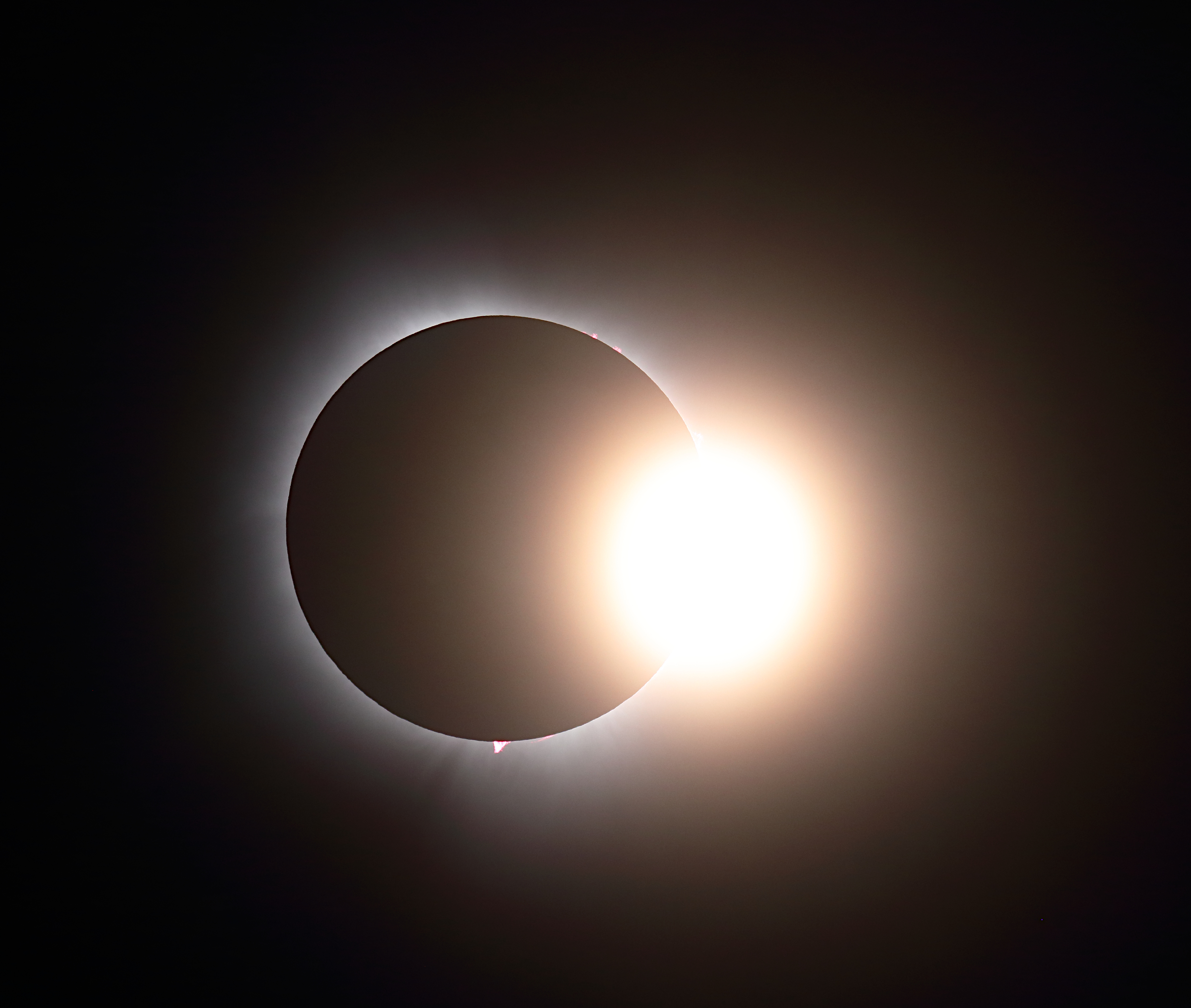
I had photographed partial eclipses in the past, so seeing the Moon creep in front of the sun was interesting but not spectacular. That all changed when the eclipse became total and I was able to remove the solar filter from the telescope and really appreciate the show.

Total Eclipse – 08 April 2024, Montreal, Canada – Benoit Guertin

The total eclipse was surreal and freaky, I now understood why many people chase the next eclipse. I may not have made it to my friend’s cottage in Sutton and experience this with a bunch of other people. Instead I was able to give 100% of my focus to my equipment to capture the beauty of a total eclipse.

If you have a fun and interesting story around your experience of the eclipse, please do comment below.

Moon’s shadow passing over Earth

Video

On April 8, 2024 a total solar eclipse will be visible for people in Mexico, USA and Canada. The Moon will pass between Earth and the Sun, and those in the path’s of Moon’s shadow will be able to see an eclipse. I created the video below using Stellarium to show the shadow’s trajectory from west to east.

Safe Eclipse Viewing with Solar Filters

NASA – August 21, 2017 above Madras, Oregon

This coming April 8, 2024 a total solar eclipse will happen over much of the USA, including portions of Canada and Mexico. If you are planning to view or photograph the solar eclipse, you need to use the right solar filter to protect your eyes and your equipment. A solar filter is a special device that blocks most of the Sun’s light, allowing only a very small fraction to pass through. Without a solar filter, the intense brightness of the Sun can damage your retina, causing permanent blindness. It can also damage your camera sensor, lens, or telescope. I’m sure you’ve all seen or even experimented with burning or meting things using a magnifying glass and sunlight. I don’t need any further explanation.

There are different types of solar filters, such as glass, film, or foil filters. They have different advantages and disadvantages, depending on their cost, durability, optical quality, and ease of use. You should choose a solar filter that fits your budget, your equipment, and your viewing preferences. Some filters are designed to be attached to the front of your camera lens or telescope, while others are meant to be held in front of your eyes or mounted on a cardboard frame.

The simplest are cardboard glasses which have a solar film. They are cheap, you can get a dozen for less than $40 and anybody can use them to view the eclipse.

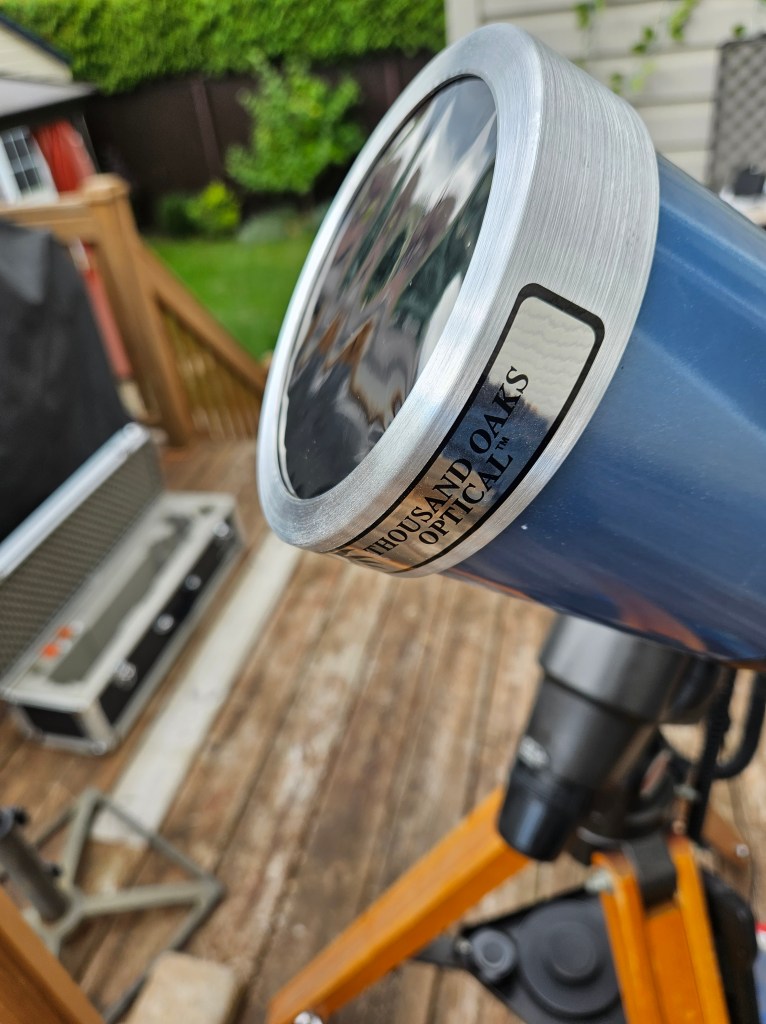
Photo: Thousand Oaks Optical

If you have equipment like a camera or a telescope, you can get the same solar film in a cell that can be mounted ahead of the optical body. These are a little more expensive but ensure a good fit and won’t fall off. Because they use a thin solar film, you must be careful when manipulating and storing them to avoid a tear or puncture. Don’t worry about the “ripples” in the film, it doesn’t affect the optical properties as the thickness is uniform.

What I use on my Skywatcher 80ED telescope

Film type solar filters can also be ordered as a sheet and then cut/mounted to size for your specific application. It’s often the simplest and cheapest way to protect your equipment.

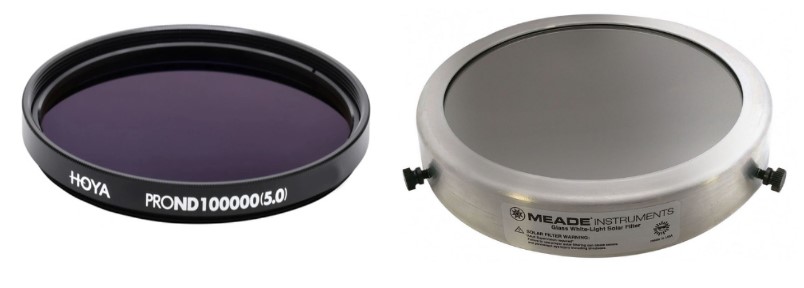
Glass solar filters are also available for both DSLR and telescope use, but the price climbs quickly with increased size. So their application tends to be limited to DSLR lenses and will screw to the end of the lens body like your regular ND or UV filter.

Glass solar filters for DSLR and telescopes

When choosing a solar filter, you should look for one that has a certified rating of ND5 or higher. This means that it blocks 99.999% of the Sun’s light, leaving only 0.001% or less to reach your eyes or camera. You should also check that the filter is in good condition, with no scratches, holes, or cracks. A damaged filter can let in harmful rays that can hurt your eyes or equipment, not to mention mess up that once in a lifetime photo. I’ll put a link to Thousand Oaks Optical below, as I’ve been really happy with the quality and performance of the filter for my telescope.

A solar filter is essential for viewing or photographing a solar eclipse safely and effectively. It will allow you to see the Sun’s corona, the thin ring of light that surrounds the dark disk of the Moon. It will also help you capture stunning images of this beautiful phenomenon. Remember to use the right solar filter for your needs and enjoy the show!

Thousand Oaks Optical
B&H Photo

October 14, 2023 Partial Solar Eclipse

Taking photos of a partial solar eclipse wasn’t high on my TO DO list on this past Saturday. Experiencing a solar eclipse is about location, and my city (Montreal) was not in the best path of the Moon’s shadow that day. At the maximum eclipse, the sun would be at best 17% covered from my viewing location. People in the south-west of the United States were the lucky ones to see the show.

As you may know, a partial solar eclipse happens when the moon covers only a part of the sun, creating a crescent-shaped sun. It’s not as spectacular as a total solar eclipse, but still pretty amazing to see. The problem is, you need clear skies to see it well. And that’s where the challenge came in.

When I glanced out around 11am, one hour before the start of the eclipse, it didn’t look good, I was worried that I would miss the eclipse, and any attempt to take photos ruined by clouds. The forecast was for partly cloudy and I could see patches of blue sky in the distant, so I decided to give it a try anyways and setup the equipment hoping for a few lucky minutes. Best to be ready for the few minutes that I may have. At worse case, if the clouds were thin I could still view it with an eyepiece.

I grabbed by Vixen Great Polaris motorized mount, got it installed in a rough polar alignment and gave it some power to track the sun. The telescope of was my Skywatcher 80ED (600mm f/7.5) simply because it’s the one that I have a solar filter that will fit. My DSLR, a Canon 80D is coupled to the telescope to capture the moment. A longer focal length would have been nice, but that will do. Now all I had to do is wait for a break in the clouds.

Clouds obscuring the solar eclipse
Clouds obscuring the solar eclipse, but a patch of blue sky kept my hopes up

And that break arrived at 12:50pm a few minutes before maximum eclipse (1:18pm). I had to be quick, center the image, adjust the focus and have the camera on the right setting. I settled with ISO 100 and 1/1000s to not over expose and reduce the blurring effect of the atmosphere.

When taking astronomy photos, don’t trust the light-meter of your camera, always check the histogram to ensure the peak image intensity doesn’t pass the 80% mark. You want to be sure you’re working within the dynamic range of your sensor and not getting some clipping.

Intensity histogram to control exposure
Adjust the exposure time to have the light intensity peak below 80% of the range

With that short 15 minute break in the clouds I was able make efficient use by letting my kids view the eclipse with an eye-piece, nothing like an unassisted live view, and then switched the setup to the DSLR for some photos.

Photo of Partial Solar Eclipse, October 14, 2023 (Montreal, QC)
Partial Solar Eclipse, October 14, 2023 (Montreal, QC)

As we are nearing another solar maximum, there’s no surprises in seeing a few sunspots in the photo. I find the sunspots add to the dynamic nature of our sun, that it’s not a steady and static source of light. There are 6 visible active solar regions in the photo, AR3464 and AR3465 being the most visible ones in the middle.

Sunspots 14-oct-2023
The view of 6 active solar regions.

Even though I didn’t have ideal conditions I was happy how the photos turned out and the opportunity to witness this really cool event.

A reminder for all solar observation, the proper filter is required to protect your eyesight and the equipment. If you’ve ever played with a magnifying glass outdoors, you know that focusing the sun’s rays will melt or burn anything. The Thousand Oaks optical solar filter cuts out 99.999% of the sunlight such that observation an photography can be done safely.

Solar filter for safe viewing of the sun and eclipse

Solar Eclipse – Post Processing

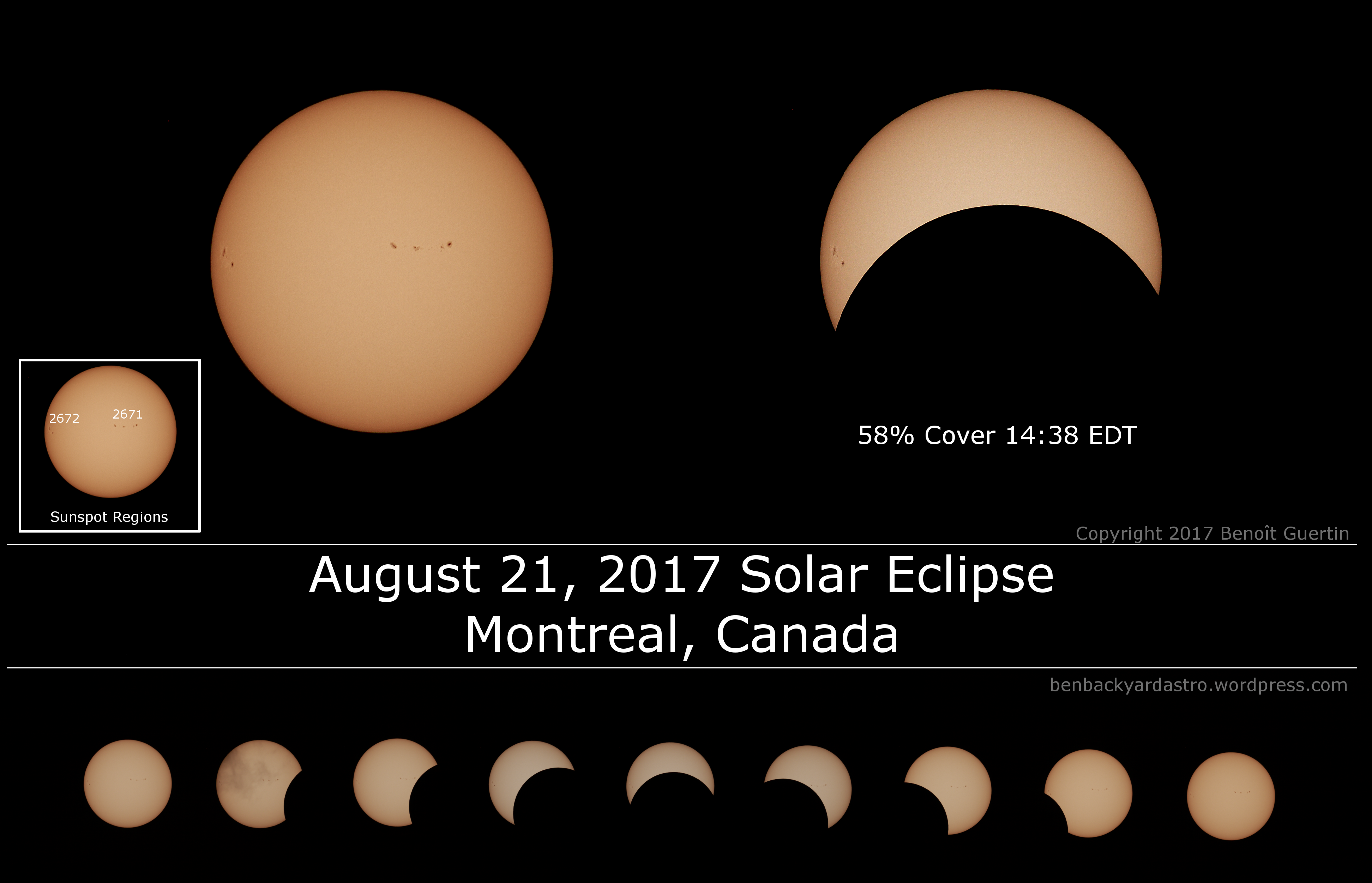
With the eclipse behind us, and all the gear put away it’s time to transfer and process the images to create something memorable.  I decided to make a mosaic with some of the photos of the eclipse, as well as the visible sun spots. Click on the image below for a high-resolution version.

August 21, 2017 Solar Eclipse

August 21, 2017 Solar Eclipse

The weather cooperated and I had the right gear to get some decent photos. Before the start of the eclipse, the sun presented two observable active sun spot regions: 2671 and 2672. This helped in achieving a proper focus and gave something to observe prior to the start of the eclipse.

Sunspot Region 2671 (right) and 2672 (left)

Sunspot Region 2671 (right) and 2672 (left)

As I had installed and aligned my Vixen equatorial mount the night before, once I had proper focus with the camera, it was child’s play to start an automatic sequence of images every 60 seconds. Hence for the entire solar eclipse, it was hands-off and automated. I could simply glance once in a while at the screen or grab one of the hand-held solar viewers to look up.

58% Cover from the Montreal, Canada Location.

58% Cover from the Montreal, Canada Location.

While the effect was nowhere near that of those in the path of totality, the light level and heat did drop at the peak of the eclipse. The brightness was lower, not like when there are high altitude clouds as the shadows were still sharp and well-defined. And the sun’s rays did feel cooler, a welcomed relief from standing under the sun for the last hour.

In the end, it was a fun experience, especially with the kids. And with over 150 images taken I decided to compile them into two formats. A time-lapse video and a mosaic as seen above.

The video was actually the quickest thing done. With Microsoft Movie Maker, it takes the Canon CR2 RAW files directly and stitches them together into a video. It actually took me longer to find a suitable soundtrack to the clip.

With that experience under my belt, I’m looking forward to April 8th 2024 total solar eclipse that will pass close to home.

Telescope: Skywatcher 80ED with Thousand Oaks R-G solar film
Camera: Canon Rebel XTi (450D)
Setting: 1/1000s at ISO 100

Partial eclipse and sunspots

As the moon moves out of the path of the sun, it exposes the sunspots AR2671 adding some interest to the show as it comes to an end.

With over 150 photos taken during the eclipse, time to create a time lapse video.

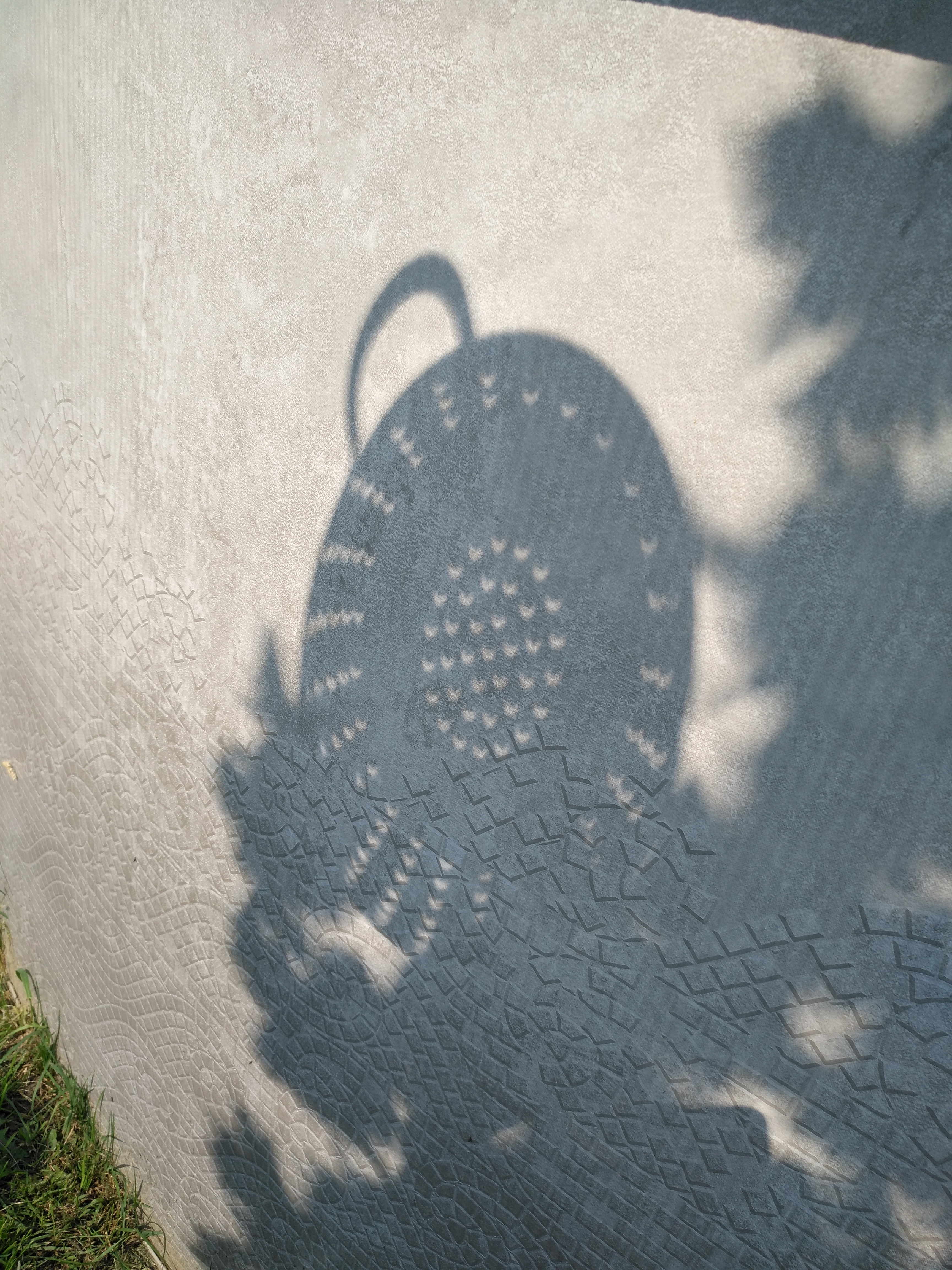
Eclipse viewing with a pasta strainer.

Image

Multiple projections of the eclipse.


Something is taking a bite out of the sun!

Image

What could it be?

Getting Prepared for the Eclipse

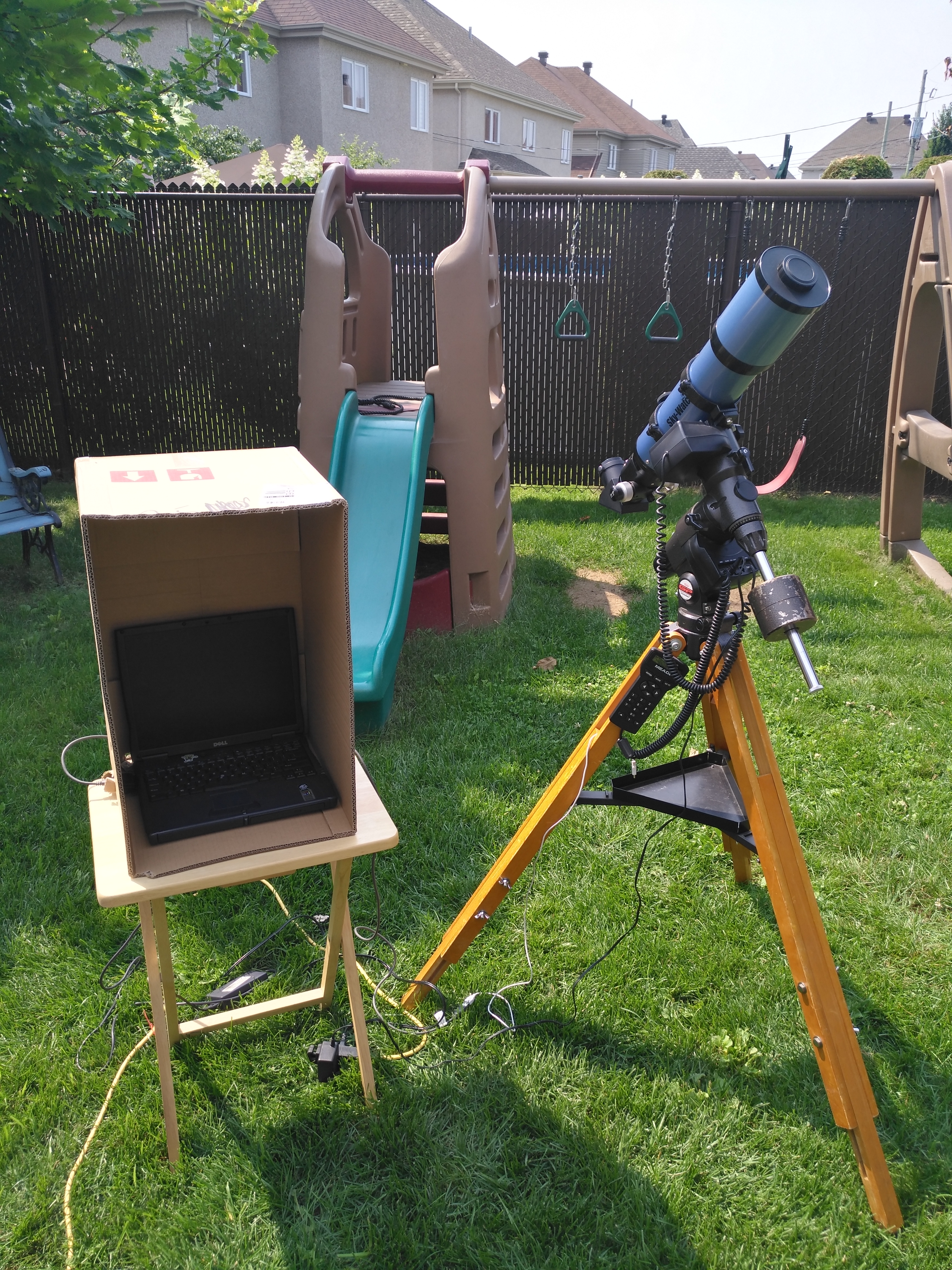
With the time approaching, I installed the telescope such that it can get up to temperature under the sun. I used an old cardboard box as a sun shield around the laptop for better viewing. I still have a good hour before it starts, so might as well have lunch and then set-up the camera.

SW80ED on Vixen GP mount.

SW80ED on Vixen GP mount.

Thin high altitude clouds and high humidity will muddy the view a bit, but other than that looking good.

For the Montreal area the maximum coverage will be 58%.

Polar Align the Night Before the Eclipse

The telescope mount is aligned and ready for tomorrow. While you may think that you’ll have plenty of time to setup your telescope gear in the morning before the solar eclipse starts. If you are using an equatorial mount, you need to polar align the night before.

Polar alignment in the daytime is possible, however it’s much easier to set-up the night before with the help of Polaris. No rain in the forecast tonight and the sky was clear enough to align the mount.

Don’t forget to charge your camera and check that you have enough storage space for the images. And lucky for us, there are sun spots which will help get the focus right. Not always obvious when all you see is a bright disk over a dark background.