Mineral Moon

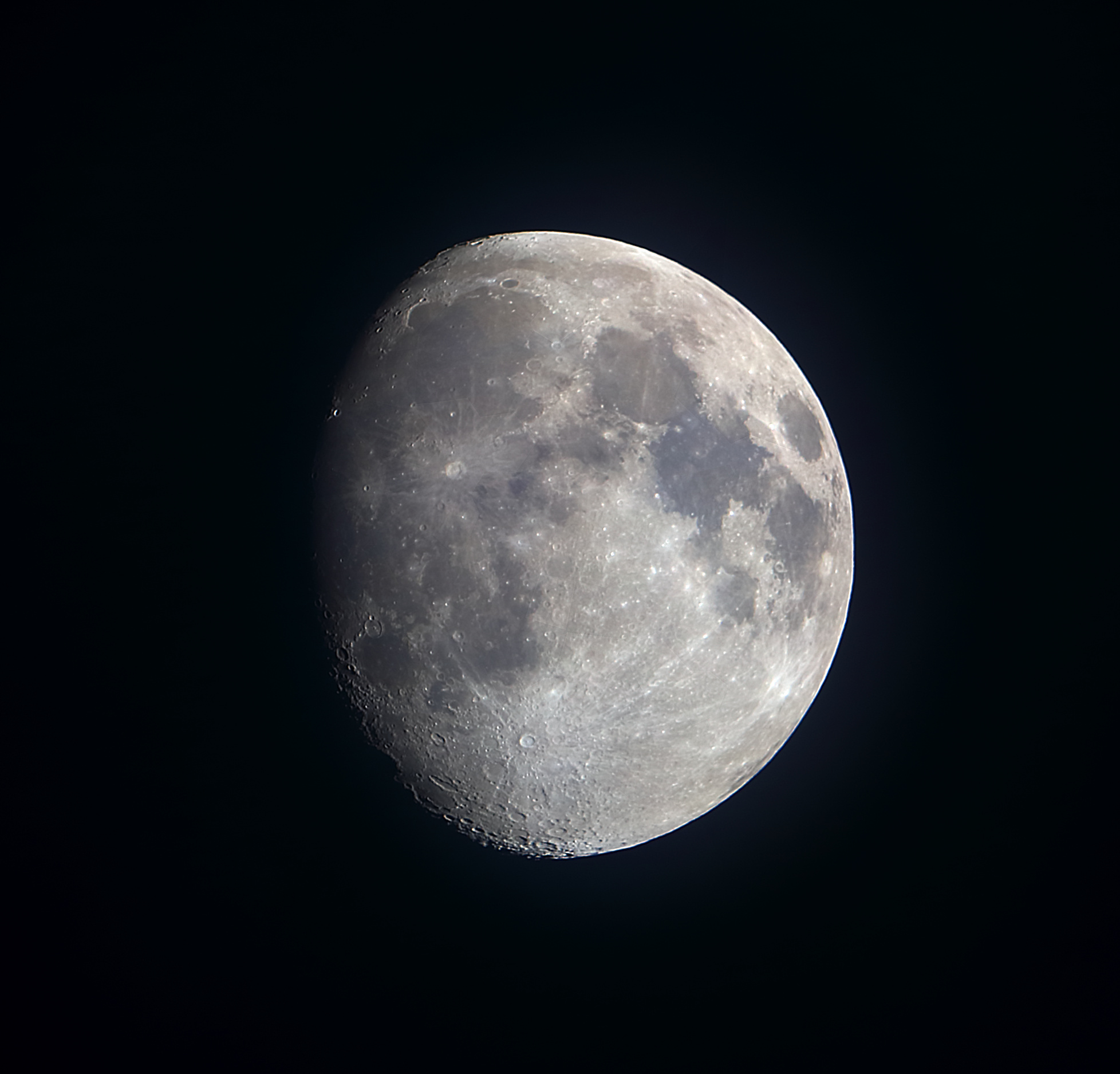
Back in 2017 I color enhanced one of my photos of the moon to see if I could pick up the subtle hues due to the different minerals as I had seen some posts in forums. I decided to redo this experiment, but this time with a photo of the Super Blue Moon from August last year. I figured starting off with a brighter and sharper photo will yield better results.
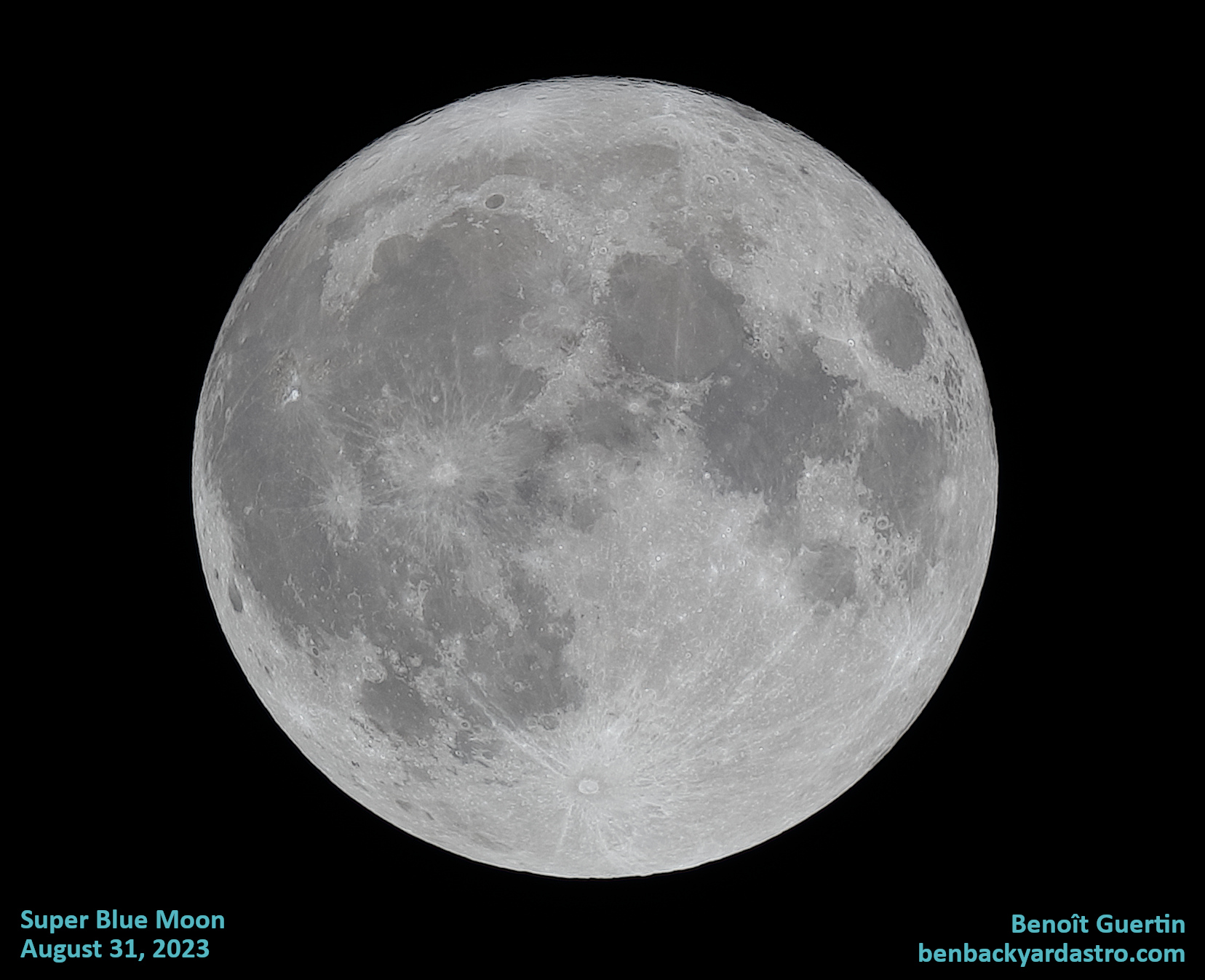
Super Blue Moon - 31 August 2023
Benoit Guertin

Using a photo editor I duplicated the layer and boosted the color saturation. Then I blended both layers together to get a nice result. The reason why I don’t simply boost the saturation in the original image is that doing so also increases the “noise” in the image. Keeping a grayscale and a color layer separate preserves the details while enhancing colors.

Mineral Moon
August 31, 2023 - Benoit Guertin

The result is often referred to as the Mineral Moon because the difference in orange and blue hues are due to the different concentration of minerals in the regolith. Blueish areas are high in titanium, possibly as high as 10%, compared to on Earth where titanium is approximately 1% of the soil content. The orange, brown areas have higher iron content.

The newer and brighter impact craters are even more contrasting over the dark areas formed by old lava flow during the early formation of the Moon.

Who knew that with nothing more than a DSLR and small telescope from a backyard you can map the geology, age and minerals on the Moon. If you have a good photo of the Moon on your computer, give it a try!
Forest Fires and a Red Moon

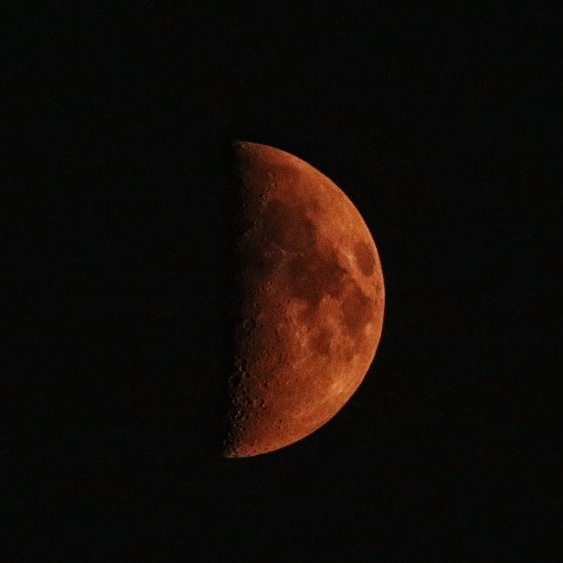
Most people are used to seeing or reading about a Blood Moon during a lunar eclipse. But other atmospheric conditions can cause the Moon to turn red, forest fire smoke being one of them. Due to large uncontrolled forest fires in Northern Quebec and dominant northwestern winds, vaste quantities of smoke made it’s way south to the Montreal area on June 25th creating this eerie blood red moon in the evening.

Red Crescent Moon due to forest fires on June 25, 2023

To comprehend why the moon turns red, we must first delve into the concept of atmospheric scattering. When sunlight reaches the Earth’s atmosphere, it interacts with particles and gases, scattering its various wavelengths. The shorter blue and green wavelengths disperse more easily, giving the sky its typical blue appearance during the day. On the other hand, the longer red wavelengths have a tendency to linger and scatter less, leading to a reddish hue during sunrise or sunset.

When forests experience wildfires or controlled burns, vast quantities of smoke are released into the atmosphere. This smoke consists of numerous particles, such as ash, soot, and other microscopic compounds. These particles can have a profound impact on the scattering of sunlight, resulting in unique atmospheric phenomena, including the red moon.

The particles present in forest smoke, especially those from larger fires, can scatter sunlight more effectively due to their small size and composition. When smoke particles disperse in the atmosphere, they cause the scattering of shorter wavelengths, such as blue and green, while allowing the longer red wavelengths to pass through with less interference. As a result, the moon, which reflects sunlight, takes on a reddish hue when viewed through the smoke-filled atmosphere.

This interplay between the scattered light and the moon’s reflection creates a visually stunning spectacle, where the moon seems to glow with an ethereal crimson radiance.

While the red moon phenomenon caused by forest smoke is undoubtedly mesmerizing, it serves as a stark reminder of the importance of forest conservation and proper fire management. Uncontrolled wildfires can have devastating consequences for ecosystems, wildlife, and humans. Through responsible land management practices, including controlled burns and fire prevention measures, the likelihood of large-scale forest fires can be minimized.

The above photo is a single shot, hand-held, taken with my William Optics Gran Turismo 71 f5.9 triplet with Canon80D. ISO6400 and 1/60s

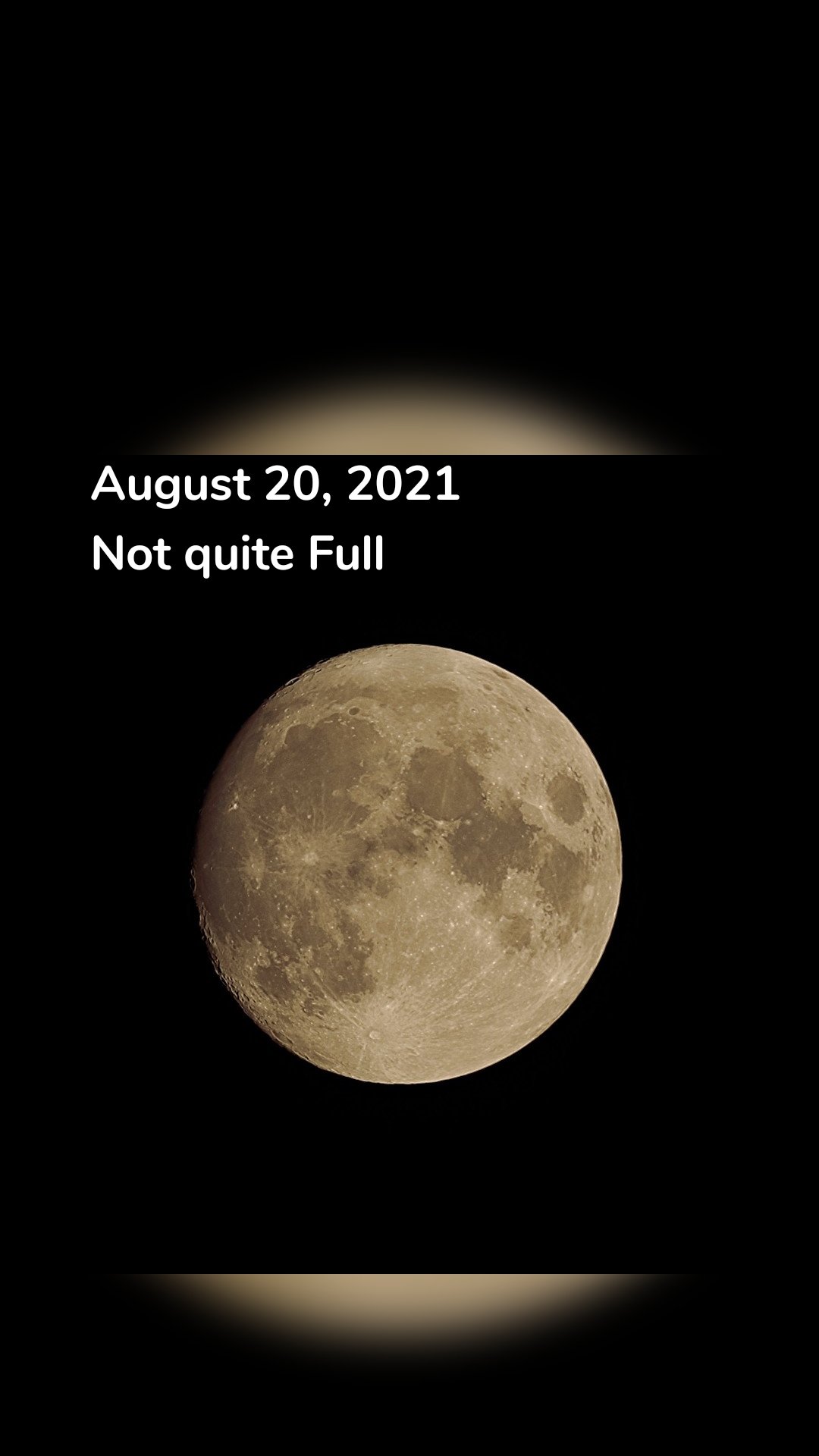
August 20, 2021 Not Quite Full

August 20, 2021
Not quite Full

2021 Snow Moon

February’s Snow Moon

There’s been lots of attention over Mars this past week. I can’t really blame all the media coverage, the Mars 2020 Perseverance EDL to the Martian surface was really cool and a great feat for NASA. I enjoyed watching it live on the NASA YouTube feed. But this weekend let’s turn our attention to the Snow Moon; the only full moon in February.

The full moon will occur at 3:17am Saturday, so tomorrow evening will be the best time to catch it. There’s nothing particularly special about this full moon, not a Blue Moon (second Full Moon in the month) or “Super Moon”. The name Snow Moon comes from the Farmer’s Almanac as February is normally the month that receives the most snow in North America.

The great thing about full moons is that you don’t need to stay up all night and wait outside in the frigid cold to see it. At this time of year, in the Northern hemisphere, the Moon is visible for more that 12 hours a day.

If you’re tempted to photograph the Snow Moon, leave the mobile phone behind, it’ll just give poor results and you’ll end up frustrated with frozen fingers. Instead just enjoy the view, paying close attention to the various dark “seas” spanning the lunar surface.

If you do try taking a picture, grab a DSLR or compact camera with manual mode. Set the ISO around 200 and the focus to manual. Your shutter speed should be high, around 1/800s; a full moon is surprisingly bright. You’re get better results by slightly under-exposing your shot. If you have a tripod, use it, else try to steady yourself on something (railing, chair, car roof, etc..) Subtle movement can easily ruin the details in you photos.

Clear skies!

My First Photoshopped Moon

Ever since Photoshop (and other editing software) allowed user to manually manipulate pixels there has been edited pictures. And with the computing power available at our fingertips and some built-in tools it’s surprisingly simple to “stich” together two photos. So full disclosure, the image below is “Photoshopped”.

I decided as an exercise to see how to insert into a nighttime skyline a photo of the Moon photo taken with my telescope.

The New York city skyline was taken by me a visiti of the Empire State Building in October last year (pre-pandemic) with a Canon 80D, 17mm F4.0 lens at 1/50s ISO 6400. The Moon is with the same camera body, but paired to a Skywatcher 80ED and I had the settings at ISO 200 and 1/20s. There is no software scaling of either photos, they are stitched “as is”.

This image was done with GIMP, I also inserted 2 “blurred” layers to create a small amount of haze around the moon to make it look a little more natural. The Moon was purposely placed “behind” a skyscraper to give it an element of depth and lowered the color temperature.

So dig through some of your old photos and start experimenting…

A Crater Named Tycho

10 Days old Moon (April 04, 2020) - Benoit Guertin

10 Days old Moon (April 04, 2020) – Benoit Guertin

The photo above is of a 10-day old Moon taken a few days ago. After the darker “seas” of old lava flow, one particularly bright crater in the southern hemisphere stands out, especially with the rays that appear to emanate from it. That is Tycho, a 85km wide and 5km deep crater and one of the more “recent” ones if you consider 109 million years the not-to-distant past. The Moon is 4.5 billion years old after all… having formed just 60 million years after the solar system. On the Moon, “fresh” material have a higher albedo and hence appear brighter, whiter.

The bright rays surrounding Tycho are made of material ejected (up to 1500km away) from the impact of a 8-10km wide body. In time these rays will disappear as the Moon continues to be bombarded by micro meteorites, which stirs the material on the surface. The rays are more present on the eastern side, as would be expected from a oblique impact.

Tycho is names after the Danish astronomer Tycho Brahe.

The Surveyor 7 space craft landed about 25km north of the crater on January 10, 1968.

Ever wondered how mosaic space photos were done before the invention of powerful software algorithm to stitch them together?  Take a look at the series of Surveyor 7 mosaic photos.  Someone had to painfully print each photo and lay them on a grid in a specific pattern matching optical field and geometry.

For the Moon, leave the tripod behind

Most people don’t plan to take photos of the Moon, they just happen. You are outside doing something else and then you spot it over the horizon or high in the sky: “Hey that’s a pretty Moon tonight Maybe I should take a photo!”

I find that normal camera lens, even telephoto don’t do it justice. The setting and focus can be very tricky. The multi-lens setup of telephoto can also cause internal reflections or chromatic aberrations making the resulting photo less appealing.

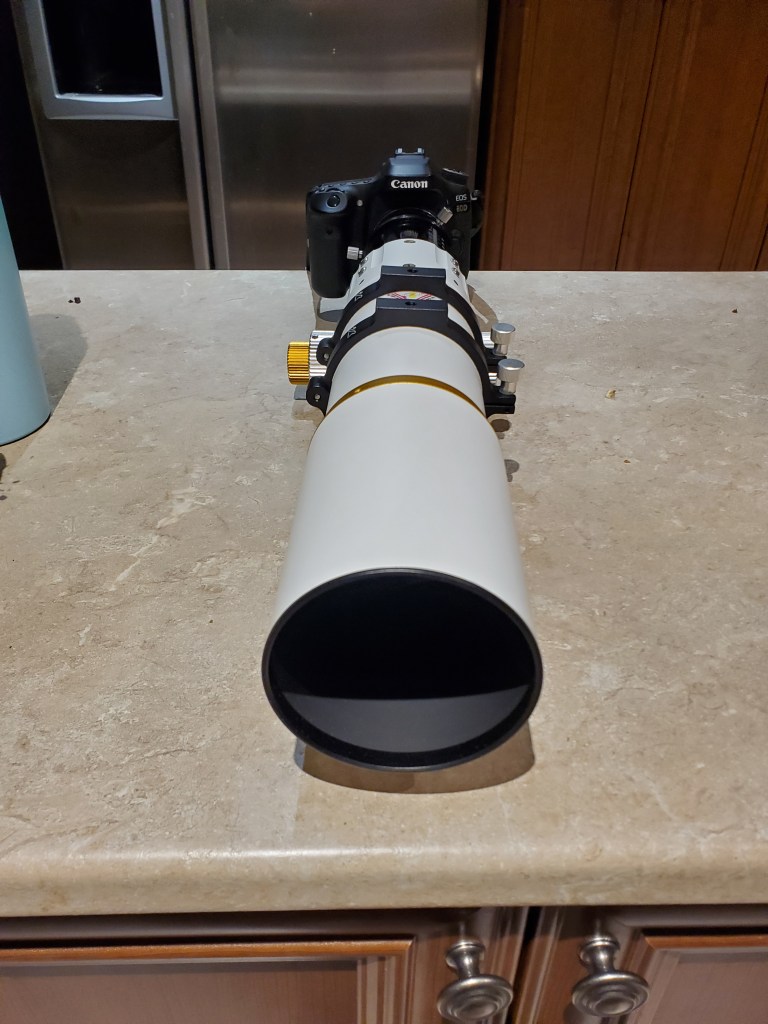
So just grab the telescope tube and leave the tripod behind.  If you have a small APO refractor you can simply hold the tube, but for anything heavier you’ll need to prop yourself up on something like a railing or a car roof.

The photo below is a single shot at 1/250sec and ISO400 with Canon 80D and William Optics Gran Turismo 71 held on the end of my arms.

2018-08-31

80% Illuminated Moon on August 31, 2018 [Benoit Guertin]

The setup takes only a few minutes and the results are always worth it.

In case you missed the Venus-Moon close encounter

Last Saturday evening, if you happened to look outside and had a clear view there is no way you could miss the Venus-Moon close encounter in the dark blue sky. But just in case it was cloudy, or you weren’t paying attention here it is.

Moon and Venus within 8 degrees on June 16, 2018

Moon and Venus within 8 degrees on June 16, 2018

For those curious on the camera setting, the above is cropped from a single frame at 33mm f/4.5 1/30sec and ISO800 with Canon 80D.

Moving up to 85mm gives you the image below, also at 1/30sec and ISO800.  Both images were hand-held from a bedroom window. Could a tripod have helped? Sure, but I figured I could do just fine , especially with image stabilization enabled on the lens.

Moon and Venus within 8 degrees on June 16, 2018

Moon and Venus within 8 degrees on June 16, 2018

To put a bit of perspective on the distance of these two heavenly bodies and their apparent size in the sky I’ve added a bit of information on the above image. While Venus may be nearly 4 times larger in diameter, it looks quite small next to the Moon in the sky.

Moon and Jupiter Through the Clouds

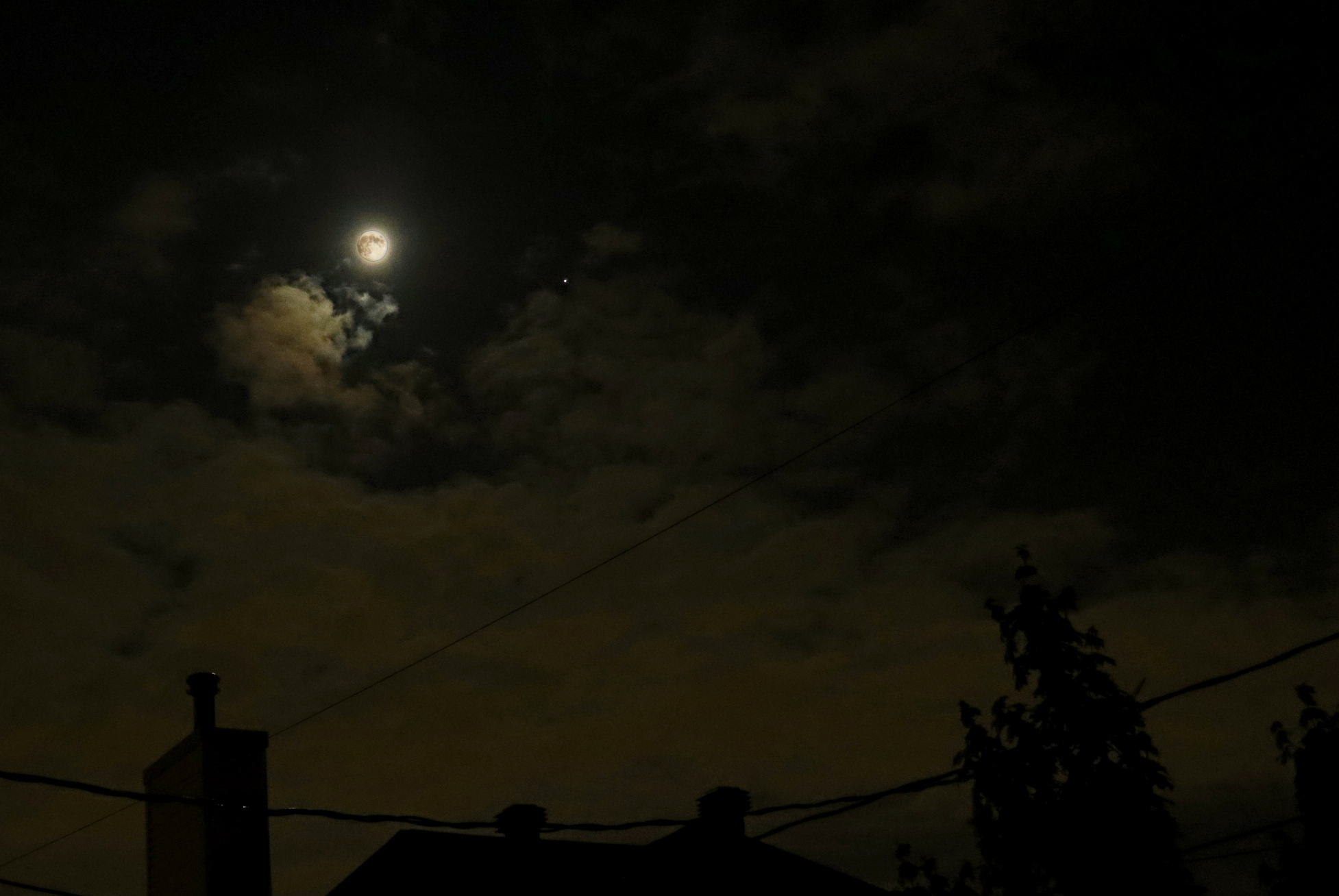
After yesterday’s photo with the smart phone, I decided to go for a more professional shot and grabbed the Canon 80D and capture once again the Moon and Jupiter through the clouds. However this time around took two exposures, and stitched the together.

Moon and Jupiter Through the Cloud - May 27, 2018

Moon and Jupiter Through the Cloud – May 27, 2018

The wide-angle was 24mm F4.0 1/10s ISO-1600. This was to pick up the clouds against a night sky as well as Jupiter. Then a close-up of the Moon, with a shorter exposure and lowered ISO to pick up details of the lunar surface (85mm F5.6 1/250s ISO-200).

Opened them both in GIMP and played with layers, masks and curves to get the desired image.  The close-up Moon photo was scaled down to match the 24mm wide-angle photo to avoid having gigantic moon.