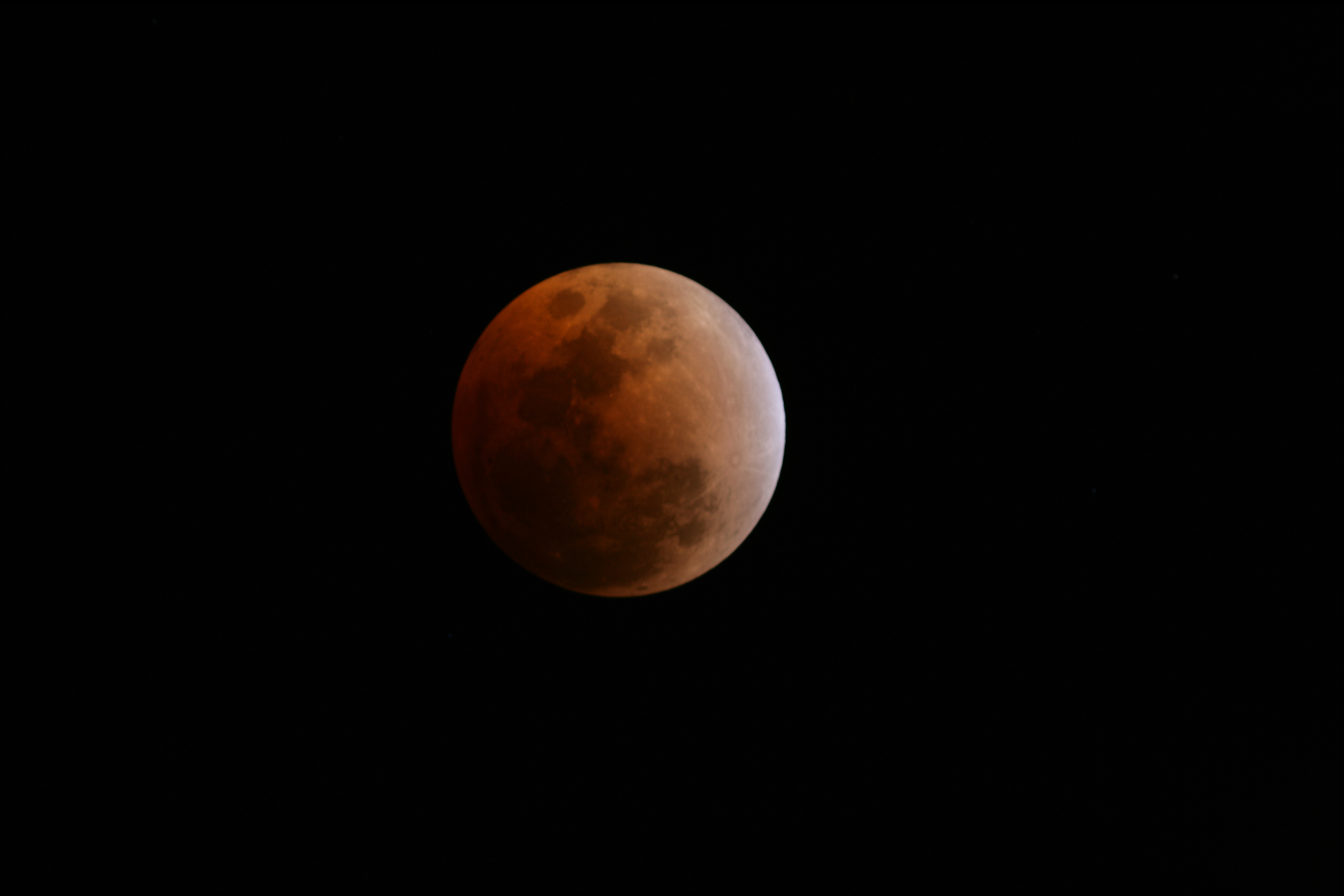
SuperMoon Lunar Eclipse This Sunday

Aside

I quick reminder of the SuperMoon lunar eclipse this Sunday.  The next time that a lunar eclipse coincides with the Moon’s closest approach will be 2033.  So recharge your camera and get your tripod out of the closet to record the event.

CBC News has provided the viewing times for different parts of Canada.

http://www.cbc.ca/news/technology/look-up-sunday-night-supermoon-plus-total-lunar-eclipse-equals-rare-sky-show-1.3241767


September 27th 2015 – Don’t Miss it: Superbloodmoon

A total lunar eclipse is sometimes referred as a Blood Moon due to the reddish-brown hue the Moon takes when passing in Earth’s shadow.  So why “Super“?  The Moon has an elliptical orbit around Earth, with the distance varying by 20,000km between the closest (perigee) and farther (apogee) approaches.  When there is a full Moon during its closest approach it’s called a Supermoon.  The result is a Moon that is 14% larger in area and 30% brighter than at apogee.

September 27th 2015 happens to be special because both events will take place at the same time: a total lunar eclipse at perigee.  Last time that happened was nearly 30 years ago!

Total Lunar Eclipse 20-Feb-2008 - Benoit Guertin

Total Lunar Eclipse
20-Feb-2008 – Benoit Guertin

Link

Missing the April 4th lunar eclipse?  No problem, NASA has posted on YouTube the entire event, all 45 minutes.

Today at Sunset – Partial Solar Eclipse

Aside

Weather permitting, North America will have a partial solar eclipse today October 23rd.  The eclipse will take place at sunset

Information available at the NASA Eclipse web site.

People located west and north will be at a better location to see a greater portion of the eclipse.  In the east, the eclipse will start around 5:40pm EDT, but will end after sunset.

Various methods of viewing the eclipse safely is listed in a CBC News article

Creating GIF Animation with Lunar Eclipse Photos

Eclipses happen in a relatively short time span and the change can be dramatic, therefore they are great candidate for GIF animations.  Below is a sequence of 24 individual photos taken with a Skywatcher 80ED telescope and Canon XTi camera from the February 2008 Lunar Eclipse.

Feb 2008 Lunar Eclipse - Benoit Guertin

Feb 2008 Lunar Eclipse – Benoit Guertin

To create the GIF animation I used two software packages:

  1. Registax – astro-imaging processing software used to align the individual images in order to ensure the Moon remains centered.
  2. GIMP – image processing software used to create the GIF animation

In GIMP, GIF animation is done by assigning individual images to a layer.  The animation is therefore build frame-by-frame as it cycles through the layers.  A simple animation tutorial is available to step you through the process.

On the other hand, if you prefer to make a movie, Picasa is capable of creating a video from a series of photos.

Link

Good article from CBC News on the October Lunar Eclipse.  Includes photos and videos.

http://www.cbc.ca/news/technology/lunar-eclipse-left-moon-glowing-blood-red-1.2792098


Total Lunar Eclipse – Only a few hours

Aside

Only a few hours left before the start of the Total Lunar Eclipse of October 2014.  Unfortunately the weather won’t be cooperating as the forecast calls for cloud and rain in my parts of the woods.  But no worries, the SLOOH telescope will be broadcasting the event live!  Event starts October 8th 5:00AM EDT .

live.slooh.com

Stargazers worldwide are invited to watch the spectacular Total Lunar Eclipse, sometimes known as the “Blood Moon,” unfold live on Slooh. The free, real-time broadcast will begin on October 8th starting at 2:00 AM PDT / 5:00 AM EDT / 0900 UTC with live feeds from multiple locations located in Australia and North America. This eclipse will be difficult to view for most of the planet as it mainly takes place over the Pacific Ocean. As such, the eclipse will only be visible in its entirety from parts of eastern Australia, New Zealand, eastern Asia, most of Japan, Hawaiian Islands, and the western part of North America. But fear not – Slooh will have strategic sites in these locations allowing the world to view the eclipse live on Slooh.com


Another webcast is available over at the Coca Cola Space Science Center.


Total Lunar Eclipse – Wednesday October 8th, 2014

In North America, not long before sunrise on Wednesday, a Total Lunar Eclipse will take place.  The fun thing is that you don’t require any special equipment to enjoy.  However if you do plan on taking a photo with a telescope or long focal length lens, an equatorial mount will be required to get a sharp image of the moon.

February 20th, 2008

February 20th, 2008 Benoit Guertin

On the east coast, the event will start around 6:35am EDT with the Moon low in the West.  This will be a great photographic opportunity, as with the Moon low on the horizon, the optical illusion will exaggerate the size of the Moon, making it look much larger than in reality.

Further west on the continent, the Moon will be higher in the sky and therefore better positioned to enjoy the entire event.  No need to rush out in your pajamas, a Lunar Eclipse is a slow event; Totality lasts for nearly one hour!

See NASA News website for more information: http://science.nasa.gov/science-news/science-at-nasa/2014/18sep_lunareclipse/

Ref: NASA News