NASA Juno Mission Trailer: JOI

Video

Space-thriller themed mission trailer

Secrets lie deep within Jupiter, shrouded in the solar system’s strongest magnetic field and most lethal radiation belts. On July 4, 2016, NASA’s Juno spacecraft will plunge into uncharted territory, entering orbit around the gas giant and passing closer than any spacecraft before. Juno will see Jupiter for what it really is, but first it must pass the trial of orbit insertion. For more information: http://www.nasa.gov/juno and http://missionjuno.swri.edu

Messier 53

Image

In a telescope globular clusters are more interesting to observe than your open cluster because they have a distinctive shape.  Globular clusters are odd stellar objects; they are spherical clumps of stars that actually orbit our galaxy’s core.  But not the way you might think; they don’t orbit in the galactic plane, but often perpendicular to it!  This is not unique to the Milky Way, most nearby galaxies have their share of globular clusters.

Messier 53 is a nice example of a globular cluster located in the Coma Berenices constellation.  It also happens to be one of the more distant globular clusters from the Milky Way.

Globular Cluster Messier 53

Globular Cluster Messier 53

Skywatcher 80ED
Canon 400D (ISO 800)
19 x 60sec

For this one I decided to try my luck at 60sec of exposure time, and the results aren’t too bad.  I did have to throw out a few shots due to periodic error causing elongation in the stars.   Also during the stacking a used a sigma 2.3 value to discard anything that fell out of standard distribution to reduce the impact of the few bad images.

Moon – Not Waiting for Dark Skies

Image

There’s no need to wait for dark skies to observe and photograph the Moon.  Actually most backyard astronomer don’t like the Moon as it just adds to the light pollution and prefer observing when it’s not around.

But as the Sun is setting and you’re getting your gear out, it’s hard not to take a few moments to swing the telescope over and observe the Moon.  I find the Moon so bright during the night that it almost blinds at the telescope, hence observing it under still blue skies is a great way to observe details without having to squint under darkness.  The photo below as taken at 7pm, still not under dark sky conditions.

April 15th, 2016 Moon - Benoit Guertin

April 15th, 2016 Moon – Benoit Guertin

Skywatcher 80ED
Canon 400D (ISO 400) 1/800sec
Processing with Registax6
Adding wavelet and non-wavelet layers with GIMP

The wavelet processing in Registax greatly increased the finer details on the Moon, however it also increased the noise in the blue sky background.  Therefore I opened both the pre and post wavelet pictures in GIMP and created a mask such that on the wavelet layer, only the lunar surface passed.  This was done by creating a mask based on alpha (luminance) and using BLUR to flag the entire Moon as my area of interest that I wanted to pass through.

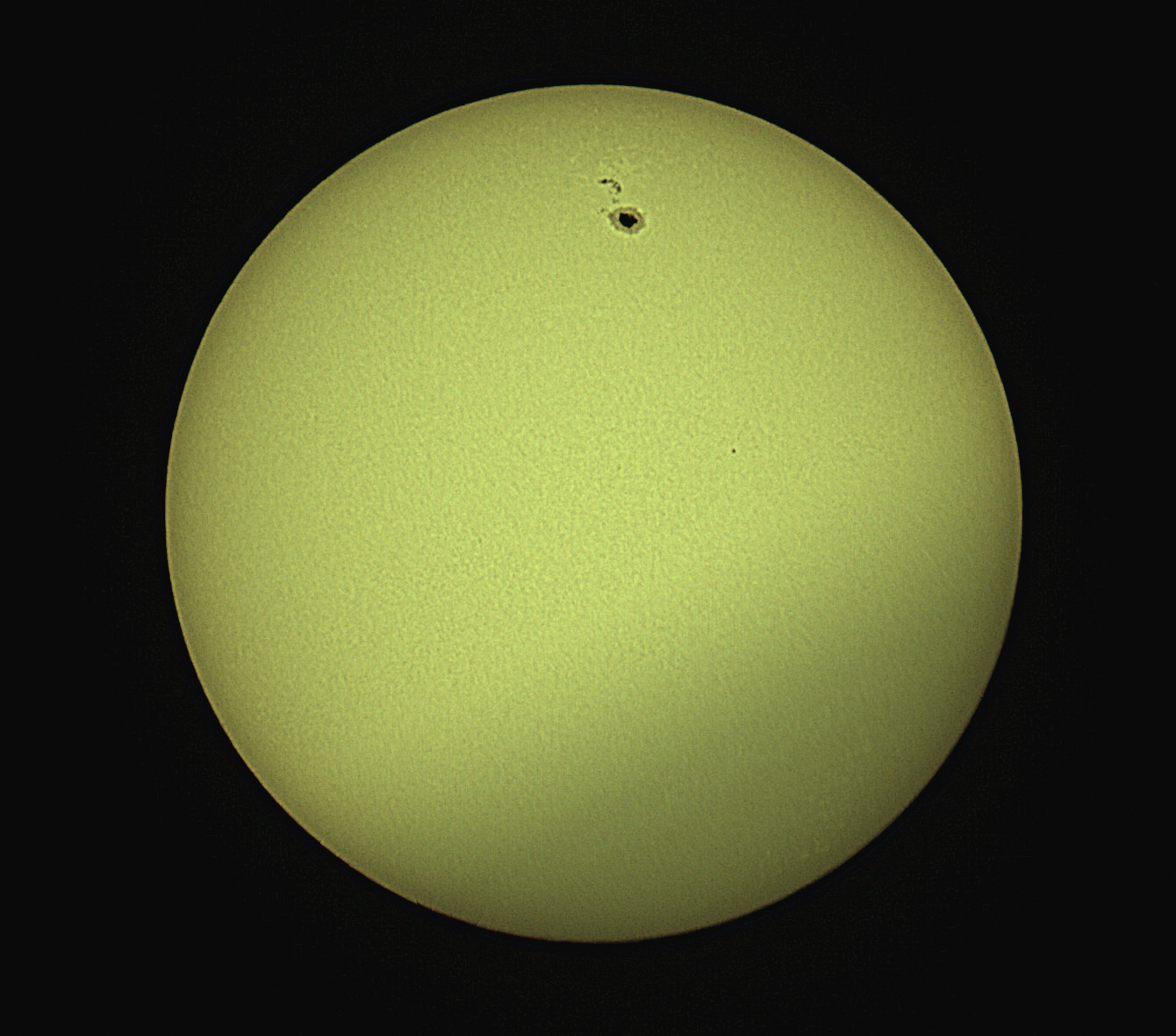
Sunspot 2529

Sunspots on the sun come and go.  Count them for many years and you’ll soon find out that there is an 11 year periodic cycle when the solar magnetic activity peaks.  We are presently in Solar Cycle 24 and on the tail end of the double peak of 2011 and 2014.  So why would I want a solar filter when the Sun is heading into a quiet period?

Number of sunspots observed and predicted for 1995 to 2020

Number of sunspots observed and predicted for 1995 to 2020

Well, just because the number of sunspots goes down doesn’t mean that there’s not good some great observing opportunities.  Sunspot 2529 provided that perfect occasion to finally try out my new solar filter.
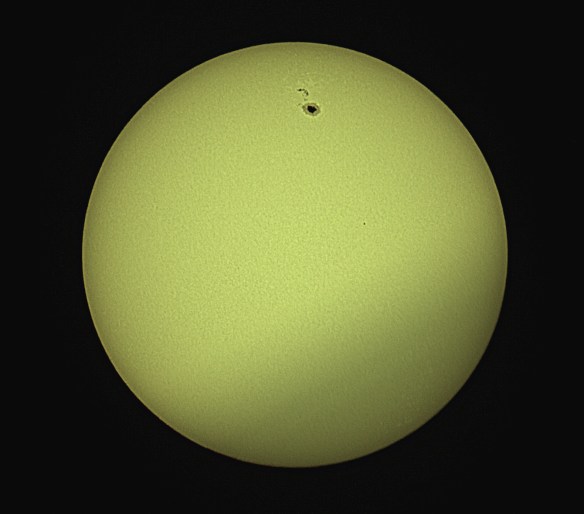
Sunspot 2529 (April 10, 2016) - Benoit Guertin

Sunspot 2529 (April 10, 2016) – Benoit Guertin

The above image was captured on April 10th, 2016 with on my Skywatcher 80ED with Canon 400D at ISO 200 and 1/500s.  19 frames were processed with Registax6.  Sunspot 2529 is still visible today and may be there for another week as readings indicate that it’s quite stable.

There are various types of solar filter out there.  They all essentially do the same thing which is to permit only a small percentage (roughly 0.001%) of the white light to pass through.  Solar filters are not designed to allow observation of prominence and flares, special hydrogen-alpha narrow-band pass filters are required for that,  but they do allow a view of sunspots and granulation if you happen to have sufficient focal length.  By blocking out most of the sunlight, you can then safely observer or photograph the sun.  Remember not to install your finderscope, and move the telescope away from the sun before removing the solar filter.  Your telescope is a MIGHTY strong magnifying glass.

Shopping around there are generally two types of solar filter: glass and film.  While the glass are more durable, the films offer just as good optical performance at a lower price, especially for larger aperture.

Thousand Oaks Optical R-G Solar Filter

Thousand Oaks Optical R-G Solar Filter

Normally for anything in the optical path, especially filters, backyard astronomers are always looking for the smoothest and most parallel surfaces, but for solar film, it appears that the ripples from the loose film have no effect on the image quality.

The filter that I selected is the R-G Solar Filter from Thousand Oaks Optical.  It provides a light yellow pleasant view of the sun, and works very well both visually and with the DSLR.  I enhanced the yellow in the photo of the sun above, but it’s quite close to what can be seen and photographed.

Mark your calendars for May 9th 14:57UT, Mercury will transit in front of the Sun.  The last time that happened was 2006.

Auriga and Its Three Bright Open Clusters

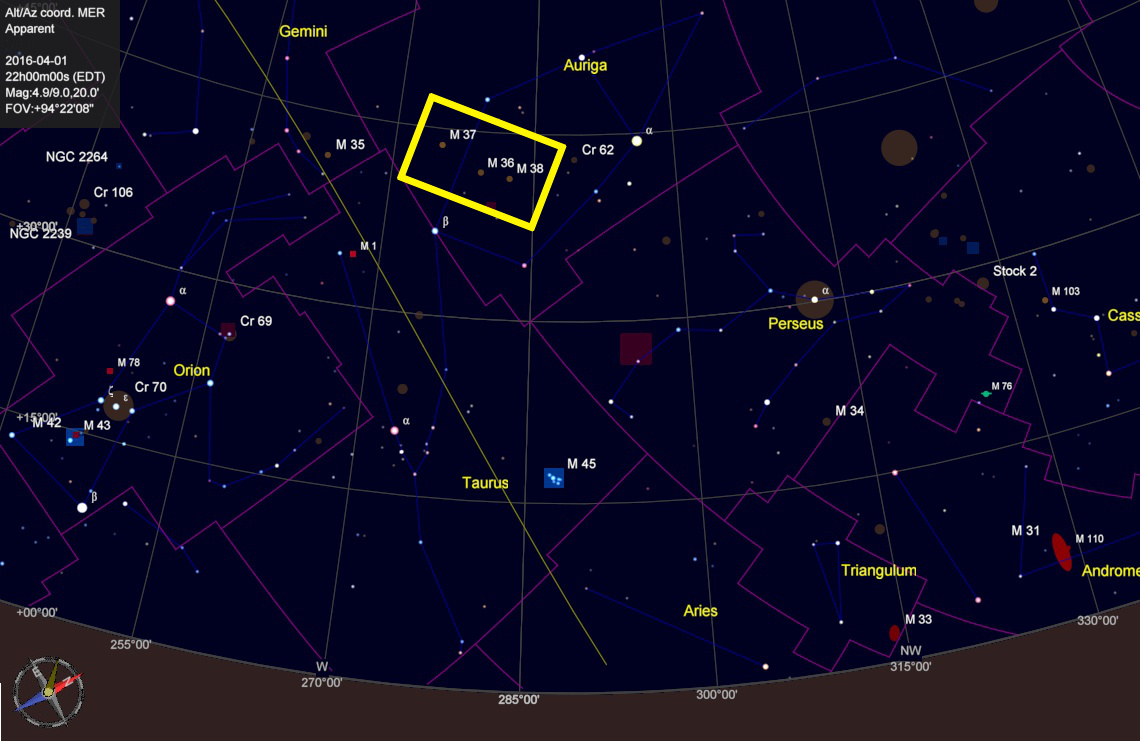
An easy target for anyone is the constellation Auriga and it’s three bright open star clusters.  It may be considered a winter constellation, but there is still plenty of time for some decent observation.  In the early April evenings , Auriga lies west about 45 degrees over the horizon.  It’s brightest star, Capella,  the sixth brightest in the night sky can easily be located.  Therefore these open clusters are easy targets for a quick star-hopping observation for anyone with a small telescope or binoculars.

Auriga in April with three bright open clusters (boxed)

Auriga in April with three bright open clusters (boxed)

My last few posts have been the photos that I’ve captured of these three Messier objects: M36, M37 and M38.  Below is a view if the boxed area from above but with the photos of the open clusters inserted at their correct location.

M37, M36 and M38 (respectively) in Auriga

M37, M36 and M38 (respectively) in Auriga

To see larger images of the open clusters, refer to my following blogs:

Messier 36 – Open Cluster in Auriga
Messier 37 – Brightest Open Cluster in Auriga
Messier 38 and NGC1907 – Open Clusters in Auriga


Messier 37 – Brightest Open Cluster in Auriga

Image

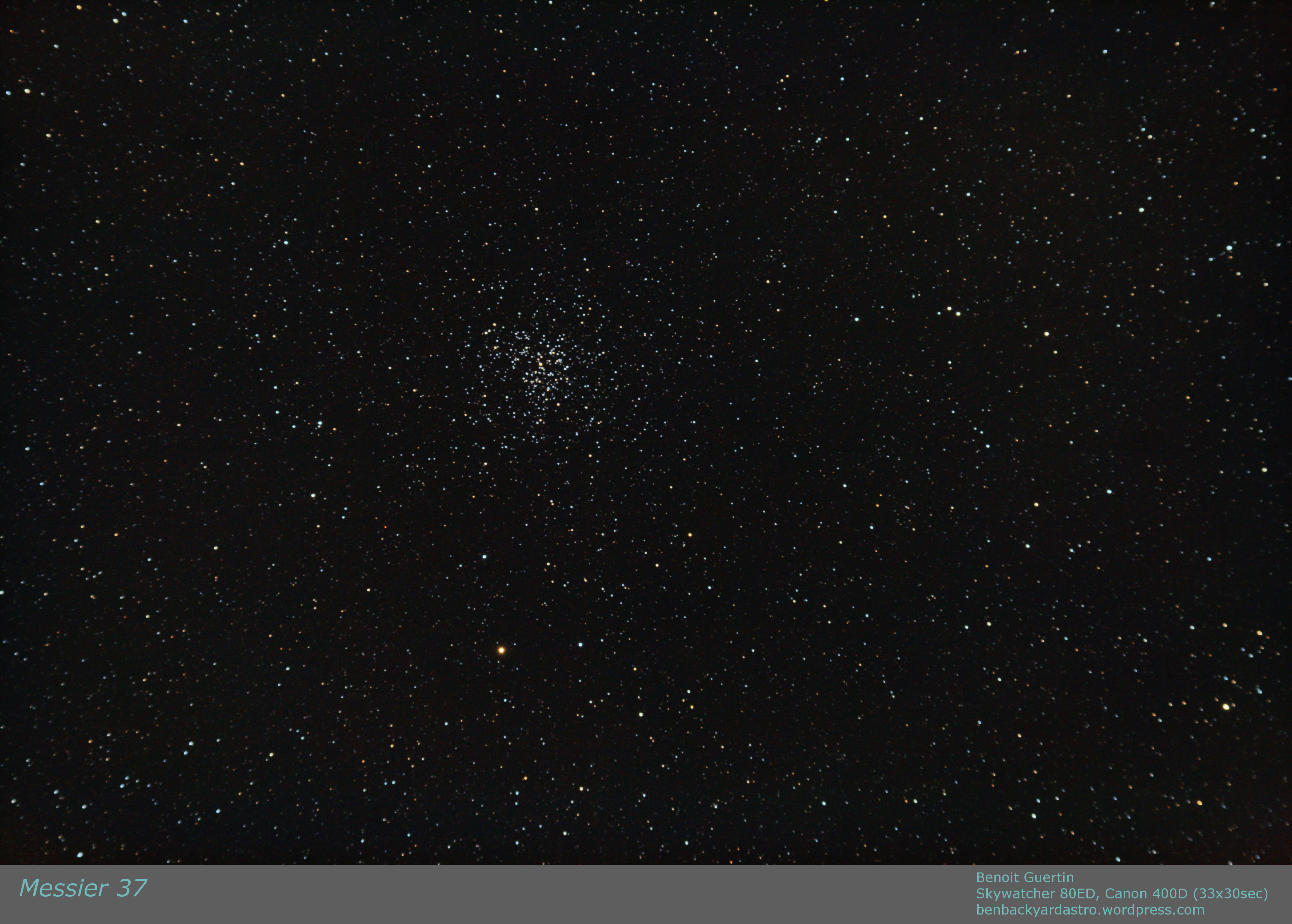
A few weeks ago I spent some time imaging the three bright open clusters in Auriga.  After Messier 36 and 38, I now bring you Messier 37.

Surveys indicated the cluster contains about 1,500 solar masses and about 500 identified stars.  As with M36 and M38 it is located about 4,500 light years from Earth.

Messier 37 - Open Cluster in Auriga

Messier 37 – Open Cluster in Auriga – Benoit Guertin

Large research telescopes often have too narrow field of view to capture open star clusters.  This is where us backyard astronomers with our gear can shine.

Skywatcher 80ED
Canon 400D
33 x 30sec (ISO 800)

Backyard Astronomers Capture Impact on Jupiter

Video

With Earth having passed between Jupiter and the Sun on March 8th, we have some of the finest observations of the Jovian planet.  It’s only normal to have a few backyard astronomers setting their sights on the largest planet (myself included, still got unprocessed videos from March 27th).  However Gerrit Kernbauer was lucky enough to record an unusual event: something slammed into Jupiter!

Phil Plait of Bad Astronomy reported that Gerrit Kernbauer with his 20cm telescope in Austria, captured on March 17th what appeared to be an impact of sort.

The issue was to confirm that it was an actual impact, and not some other natural effect or electronic noise in his setup.  What better than to have a second independent observation, and that came from John McKeon with a 28cm telescope in Ireland.

Maybe I should go take a look at my videos on Jupiter from March 27th just in case…  Actually with my 80mm telescope,  I don’t think it would have picked up such an impact.

[SLATE]

Messier 38 and NGC1907 – Open Clusters in Auriga

Image

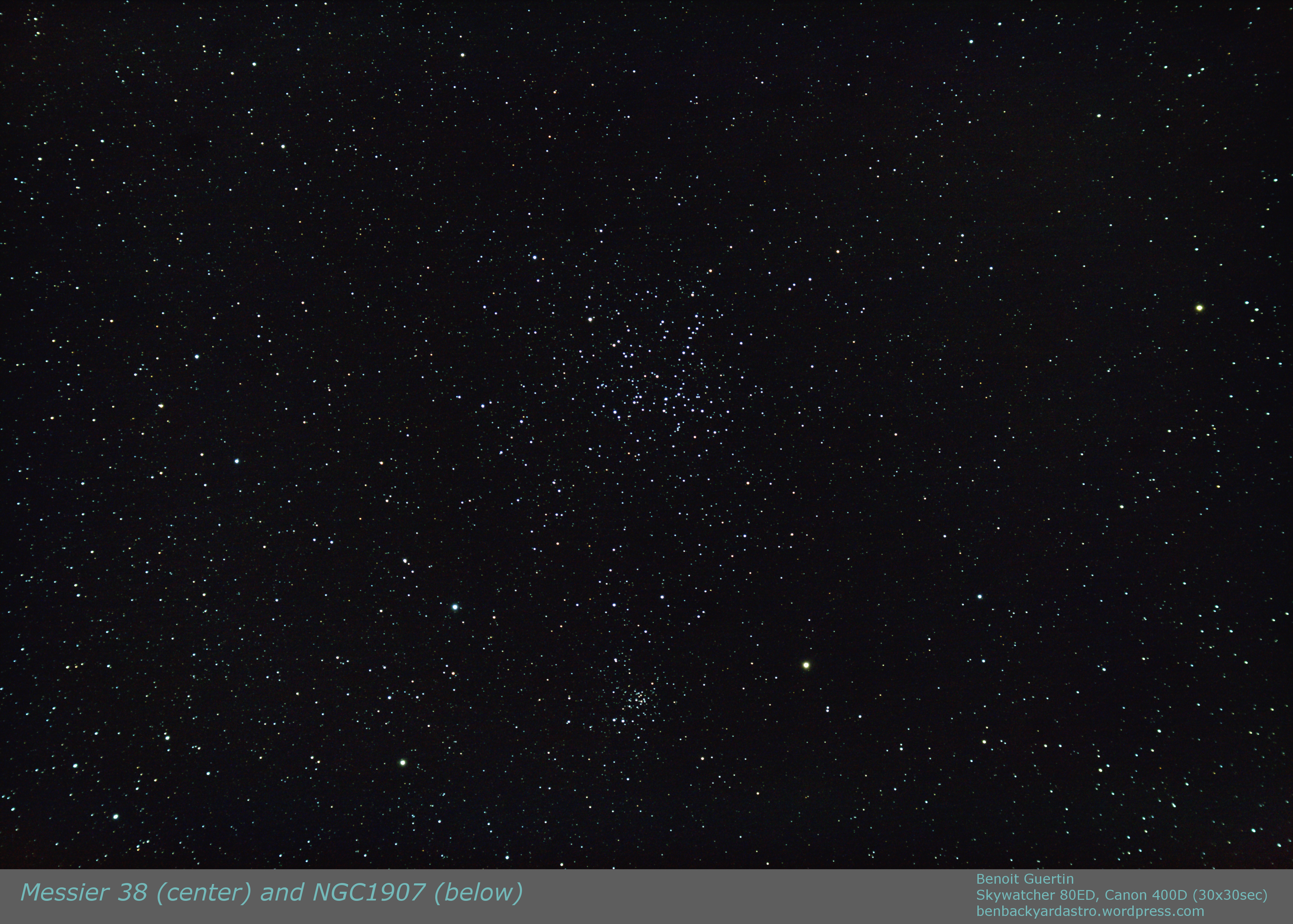
Following my previous post on Messier 36, a simple 2 degree slew of the telescope and I was centered on Messier 38 (NGC1912).  This open cluster measures 21 light years across ( 21′ apparent) or twice the size of M36.  It is also much older than M36 which is why you’ll find less hot blue stars within the group if you compare with M36.

Just half a degree below is an older and smaller open cluster NGC1907.  While some have speculated that they are locked together (a binary cluster?) this cluster is 500 million years old, almost twice the age of M38, hence were formed at different periods and most likely from different molecular gas.  This is just a chanced fly-by with no interactions.

Open Clusters Messier 38 and NGC1907

Open Clusters Messier 38 and NGC1907

Skywatcher 80ED
Canon Digital Rebel XTi (400D)
30 x 30sec (ISO 800)
Registration with IRIS
Post-Processing with GIMP

Messier 36 – Open Cluster in Auriga

Image

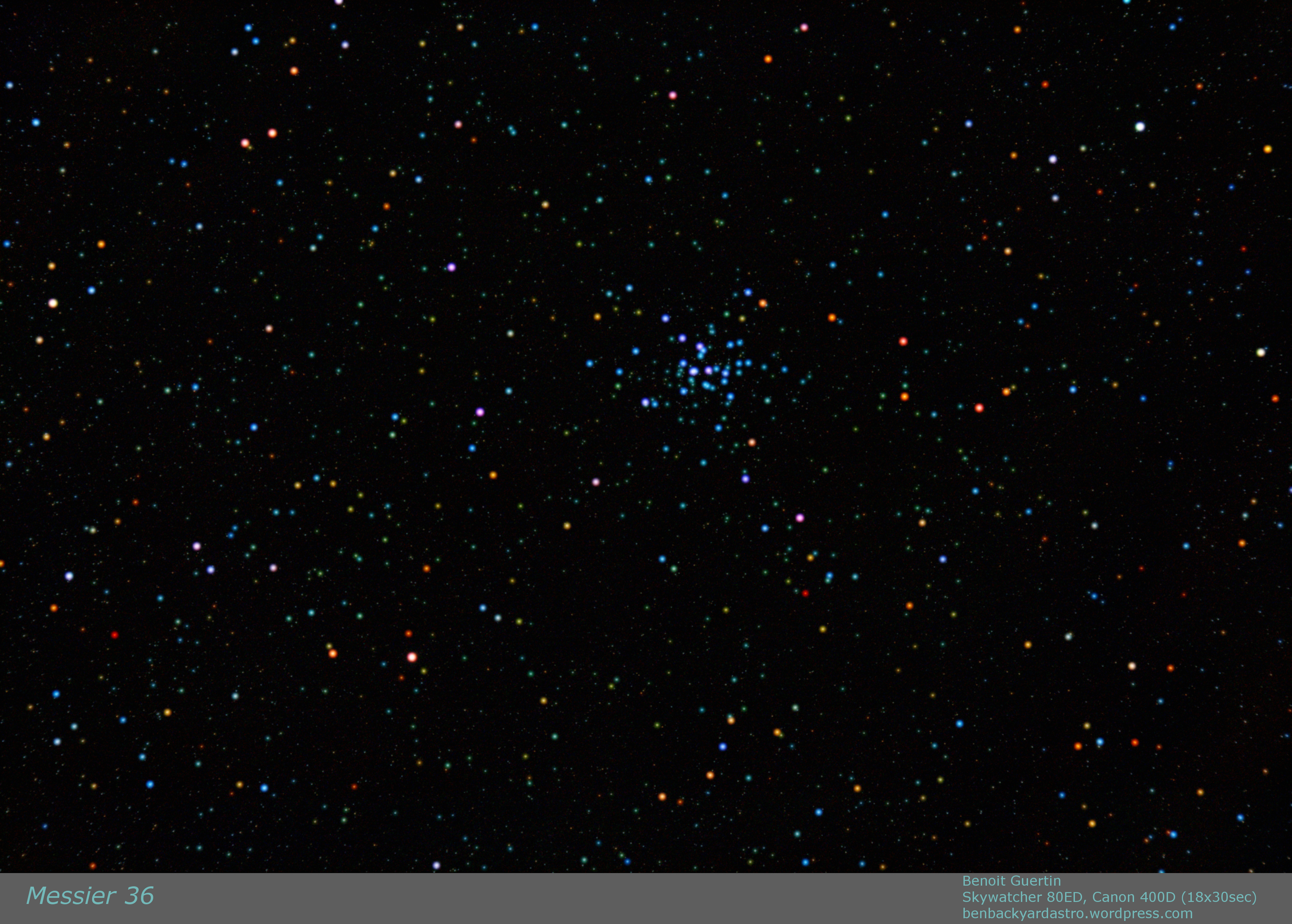
Open Cluster Messier 36 (NGC 1960) is located in the Auriga constellation.  Located about 4,100 light years from Earth, and 14 light years across, it has at least 60 members.  It is very similar to the Pleiades (M45) and if M36 was at the same distance (M45 is 10 times closer) it would be of similar magnitude.  Two other open clusters from Messier’s catalog are located nearby: M37 and M38.  The stars in the cluster are of spectral type B2, and fairly young: 25 million years.

Open Cluster Messier 36. Skywatcher 80ED, Canon 400D 18x30sec

Open Cluster Messier 36. Skywatcher 80ED, Canon 400D 18x30sec

The blue-ish stars contrast with the older yellow and orange stars in the background.  This can be further enhanced by using the SBLUR function in IRIS to selectively blur and enhance the colors of bright stars.  While the colors are exaggerated in the image below, it is nevertheless interesting to see the vast diversity of stars and their color.

Open Cluster Messier 36. Skywatcher 80ED, Canon 400D 18x30sec

Open Cluster Messier 36. Skywatcher 80ED, Canon 400D 18x30sec (SBLUR for colour)

Telescope: Skywatcher 80ED
Camera: Canon Digital Rebel XTi (400D)
Exposure: 18 x 30sec (ISO 800)
Date: 18Mar2016

Changes in Lunar Size

Image

While doing some organization in my astrophotos I came across a picture composition that I created back in September 2015 following the Super Moon Lunar Eclipse, but which I never posted.

I had selected two Lunar Eclipse photos that I had taken with the exact same equipment, but on different year and wanted to see the difference in size with this “Super Moon”.  Was it really that much bigger…

Lunar Size Comparison Between February 2008 and September 2015 Lunar Eclipse

Lunar Size Comparison Between February 2008 and September 2015 Lunar Eclipse
– Benoit Guertin

The Moon’s orbit is elliptical and eccentric which causes the Moon’s distance to vary by 50,200km from perigee (closest) to apogee (furthest).  The end result is a 12% change in apparent diameter as viewed from Earth.  The above image only shows a 7% difference as while the background Moon was taken at perigee (famed Super Moon) the foreground was an arbitrary reference of the February 2008 lunar eclipse.

Telescope: Skywatcher 80ED (600mm)