2017 Event : Total Solar Eclipse for North America

Every given year there are between two and five solar eclipses, this upcoming one for August 21st will be special.  The last total solar eclipse for North America goes back to 2008.  As Earth is largely covered by water, many of the eclipses are over the ocean where the number of viewers are limited.  But this one will pass over millions of people, all with access to equipment and social media to share their experience.  Hence this one has lots of people planning and getting ready.  The eclipse is most impressive when you’re located in the path of totality; where the Moon completely blocks out the Sun.  Hence if you are able to travel to such a location along its path, it will be worth it.  I also suggest finding a local astronomy group or association as they will most-likely have telescopes and other special observing gear out for everyone to use.

August 2017 Total Solar Eclipse.

The total solar eclipse will only be viewed in the narrow path crossing the middle of the USA. North and south of that will get a partial eclipse. The green vertical lines indicate the time of maximum eclipse. Courtesy Michael Zeiler, GreatAmericanEclipse.com.

Observing the solar eclipse requires protective eye-wear and solar filters for any observing or photographic equipment.  For my telescope it’s a film solar filter, now branded SolarLite by Thousand Oaks Optical.  These can be purchased already mounted in an aluminium cell or in sheets for your own custom application.

Thousand Oaks Optical R-G Solar Filter

Thousand Oaks Optical R-G Solar Filter

The American Astronomical Society has created a web site just for the event with plenty of information on safe observation and suppliers of necessary optical filters.

Stay tuned…
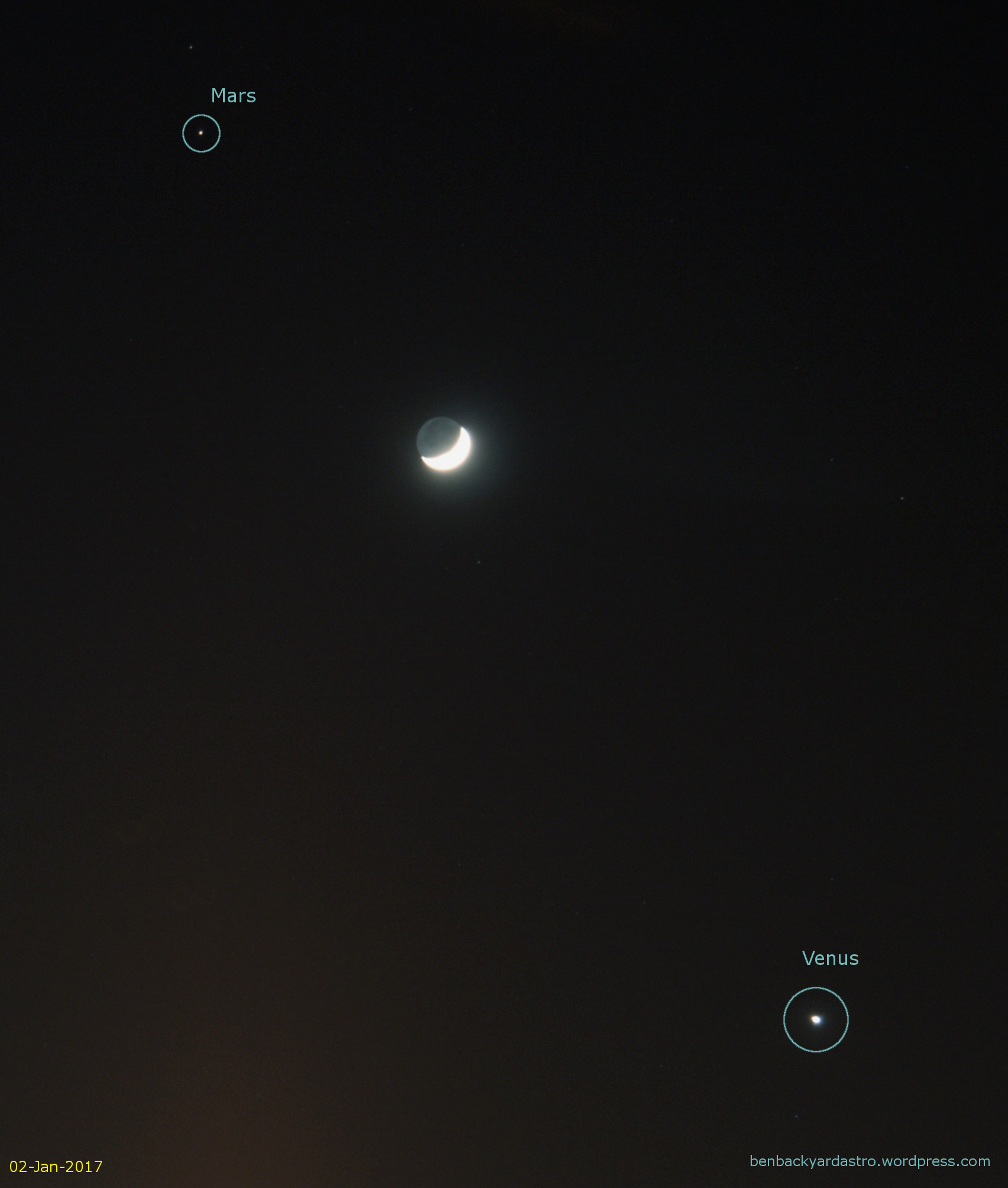
The Moon, Mars and Venus

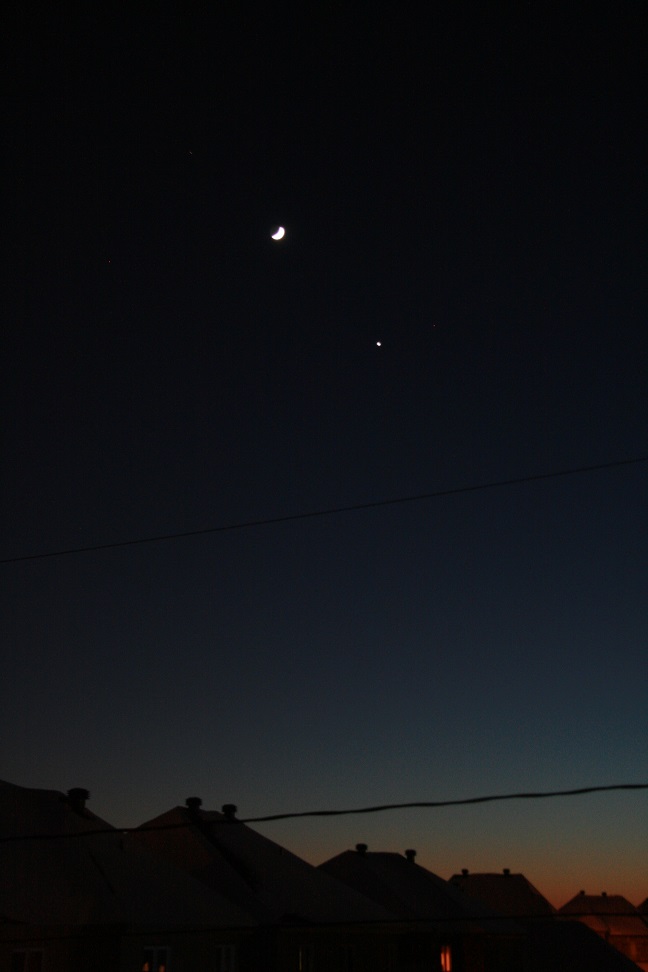
It’s not often that the Moon finds itself between two planets nicely lined up and within a 12 degree field of view.  Just yesterday at around the same time, the Moon was located below Venus.  The image below is a two second exposure at ISO 800 with 53mm lens at f/5.6 on a tripod. I cropped the image to remove a street lamp and light pillars from other light sources further in the distance.

02-Jan-2017: The crescent Moon between Mars and Venus

02-Jan-2017: The crescent Moon between Mars and Venus

The toughest part was actually finding a spot around my block where there was less glare from street lights or annoying power and utility lines in view.  Luckily I found a spot with two extinguished street lamps and setup in between.

A little earlier I quickly snapped the image below from the bedroom window on the 2nd floor.  The sky wasn’t dark yet, and as the camera was hand-held, 1/4sec was the lowest I could go.  Nevertheless with the rooftops in the foreground, it provides for a sense of scale and location in the sky.  The orange-red horizon from the setting sun is a nice touch.

Moon with Venus and Mars in the evening sky

Moon with Venus and Mars in the evening sky


Venus and Crescent Moon

After three days of cloud cover and a good 20cm of snow, it was nice to see a clear and crisp sky throughout the day and into the evening.  With the sun set and the sky still dark blue a crescent Moon and Venus made for a fine pair in the south-west sky for the first evening of 2017.

New Years 2017 Moon and Venus

New Years 2017 Moon and Venus

The Moon will continue to travel towards Mars, located higher up and to the left (East) with a good photo opportunity on the 2nd (tomorrow) with the Moon between both planets.  For the rest of January, Venus will gently move closer to Mars to within 6 degrees at the end of the month.

Photo Details:
Canon XTi (450D)
17mm F4 (1/10sec ISO400)
inset: 85mm F5.6 (1/10sec ISO800)

Easily Locate Neptune on December 31st

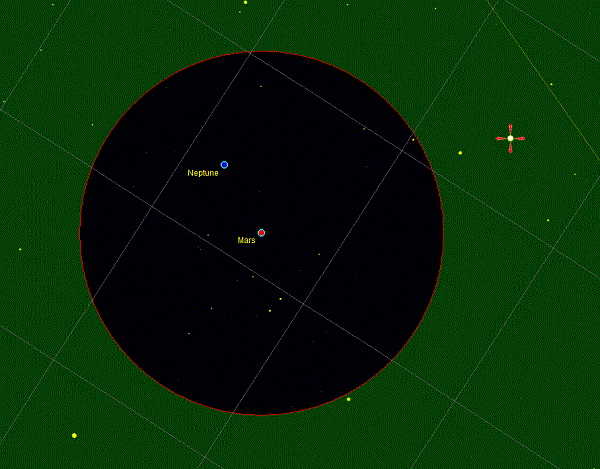
December 31st will be your opportunity to easily locate and observe Neptune with a telescope as it will be within 1/3 degree of Mars low in the western part of the Sky.  Mars will present a reddish magnitude 1 disk while Neptune will be much smaller, essentially a dimmer magnitude 7.8 dot.  Large telescopes should reveal the blueish hue of Neptune when placed slightly out of focus.

Neptune and Mars 1/3 degree - December 31

Neptune and Mars 1/3 degree – December 31 (1 degree circle)

In the image above I’ve marked magnitude 7.9 star just outside the 1 degree circle to assist in the orientation.

However don’t wait too late in the evening, best may be shortly after 7pm once the Moon is below the horizon.  Starting from the horizon you’ll able to easily locate bright Venus and about 10 degrees above will be Mars and Neptune.  Bright stars Fomalhaut and Altair will be located east and west along the horizon.

Neptune Mars and Venus setting in the West - December 31

Neptune Mars and Venus setting in the West – December 31 (7pm)

Comets for 2017 [updated 16-APR-2017]

Below are some of the comets to keep a watch for in 2017 as they should be observable with small scopes and even binoculars.

45P/Honda-Mrkos-Pajdusakova
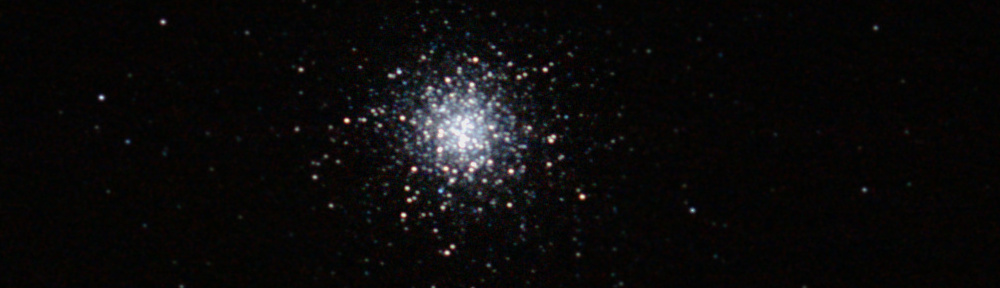
Currently observable low in the evening at around magnitude 8 and will continue to brighten to magnitude 7 in January and then fade rapidly, including a approach to within 0.08AU of Earth on February 11th, as well as passing within a few degrees of globular cluster M3 shortly after.
  Photo from January 6th.

C/2016 U1 ( NEOWISE )
Currently observable at magnitude 9 and predicted to brighten to magnitude 7 in mid January.  Discovered on October 21, 2016.  Not visible in the southern hemisphere.

C/2015 V2 ( Johnson )
Faint at magnitude 12, and will continue to brighten until mid 2017, with good chances of observation.

C/2015 ER61 ( PanSTARRS )
Should brighten to magnitude 7 spring of 2017, unfortunately not very visible to the northern latitudes.  However it will cross many NGC and Messier objects throughout the first half of the year.

2P/Encke
Expected to brighten to magnitude 6-7 around at the start of March, overall visible for about 45 days.  For those in the northern hemisphere, best observations will be the end of February.

41P/Tuttle-Giacobini-Kresak
Expected to brighten to better than magnitude 6 in early April.  A good opportunity for wide-field photo as it passes 5° of M92 at the end of April.
Photo from April 13th.

References:
Comet Chasing
Seiichi Yoshida’s Bright Comet Listing (and future listing)
Paper by the British Astronomical Association

December 25th – No Sunspots

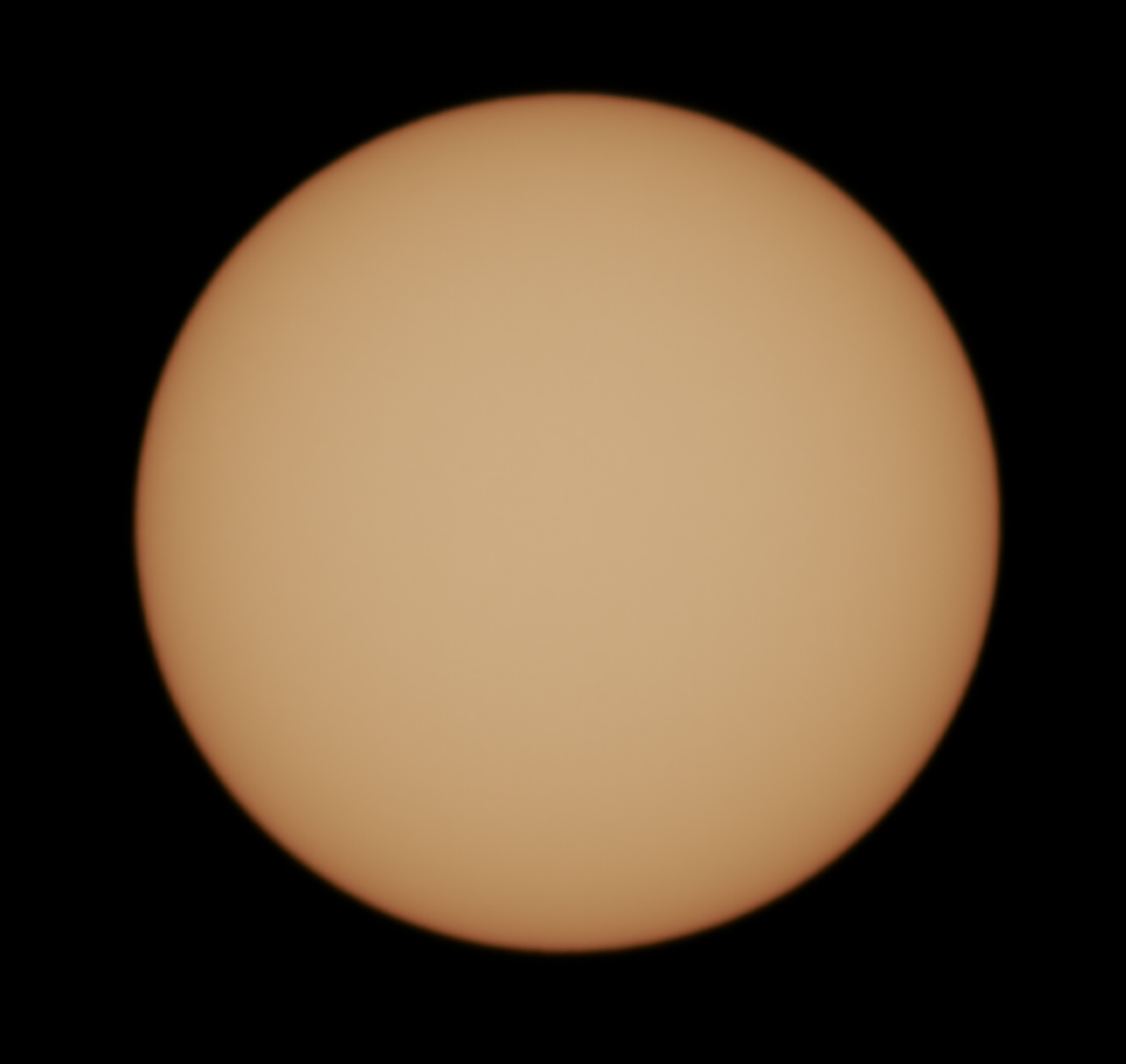
The sun has been without sunspots for two days, but that is expected as we are heading to a minimum in the 11-year cycle.

Cycle 24 Sunspot Number

Cycle 24 Sunspot Number (NASA)

Nevertheless as it was a nice afternoon grabbed the scope and did some observation of the sun.  A little of a challenge to focus when there is no contrasting details to base yourself on.

December 25th 2016 - No Sunspots

December 25th 2016 – No Sunspots

Skywatcher 80ED
Canon XTi (450D) ISO 100 – 1/800sec
Thousand Oaks R-G Solar Film

JunoCam – Revealing Jupiter from New Angles

JunoCam onboard the Juno spacecraft is providing us with some great pictures of the Jupiter cloud top, but from the rarely seen polar angle.  Pretty much all spacecrafts that have visited Jupiter did so with a fly by along the equatorial plane, which is also the same plane we observe Jupiter here on Earth.  However with the Juno spacecraft, we now have a chance to enter into a polar orbit and take pictures of the polar regions.

Part of the reason behind JunoCam is to get the amateur astronomer community participating in selecting what parts of Jupiter the camera should be snapping pictures, and of processing the raw images.  The image below was captured by JunoCam during Juno’s 3rd swing around Jupiter at a distance of about 37,000km.  The south polar region is on the left.

Jupiter - December 11, 2016 JunoCam - Juno Spacecraft

NASA, JPL-Caltech, SwRI, MSSS; Processing: Damian Peach

The above was the PeriJove3 encounter (3rd pass), and voting on the next PeriJove4 will take place between January 19th and 23rd 2017.  This is where the community can propose and vote for Points of Interest to photograph with JunoCam during the rather quick (2 hours) close pass with Juno.  You can even submit images of Jupiter taken with your equipment to help plan the Points of Interest.

Ref: JunoMission

Link

TIME  magazine has released what their editors consider the best space photos of 2016.

P Crowther, University of Sheffield/NASA/ESA

http://time.com/4510266/best-space-photos-2016
Ref: TIME

November 13, Nearly Full Moon

Image

Making diner and notice that it’s getting dark outside and there’s not a cloud in the sky.  Wait! What time does the Moon rise? 4:54pm it should already be 5 degrees in the sky.  Run to the front of the house and look out the door, but no Moon.  Hmmm… maybe I’m too low and the houses across the street are blocking the view.  Head up one floor and look out the bedroom window!  Ah there it is.  OK kids, who wants to go see the SuperMoon!  I grab my camera as my kids run for their boots and jacket.  I figure that from the street corner I should have a good line of sight.  Once there I ask my son to hold his arms up in the air as if grabbing the moon.  I need to get down pretty low on my knees to get everything lined up.  After a few repeated instructions to open or close his hands, to which he responds with a “Are you done yet!”  I take a few long exposures under the street lamps. No tripod so 1/8sec and ISO 800 it is.  Then took a few more of just the Moon with shorter exposures to avoid causing the Moon to become saturated (1/200sec ISO200)

A bit of photo editing and the end result.

November 13th 2016 Full Moon - just ahead of the Super Moon.

November 13th 2016 Full Moon – just ahead of the Super Moon.

Novembre 14th SuperMoon

Status

Benoit Guertin's avatar

Lots of talk in the last week about the upcoming SuperMoon on November 14th.  While it will be the closest and largest Full Moon since 1948, the differences won’t be that significant.  It’ll look just like any other Full Moon, one that happens every month.  Nothing special will happen to the solar system or the Earth.

However it’s a good opportunity to experiment with your camera and composition as the Moon is rising over the Horizon.  Play around with different settings and different lens.  You can even spend the day before scouting a good spot with view to the East.

Don’t need dark skies.  Don’t need a special mount or stand. This is astro-photography accessible to all.