Perseid Peaking Tonight

Aside

The Perseid meteor shower is scheduled to peak tonight, but a large Moon will ruin the show. The best time is tonight (August 12) after 11pm, looking north-east.

While the sky directly overhead may look darker, it’s better to look 45degrees over the horizon to see a thicker “slice” of the atmosphere.

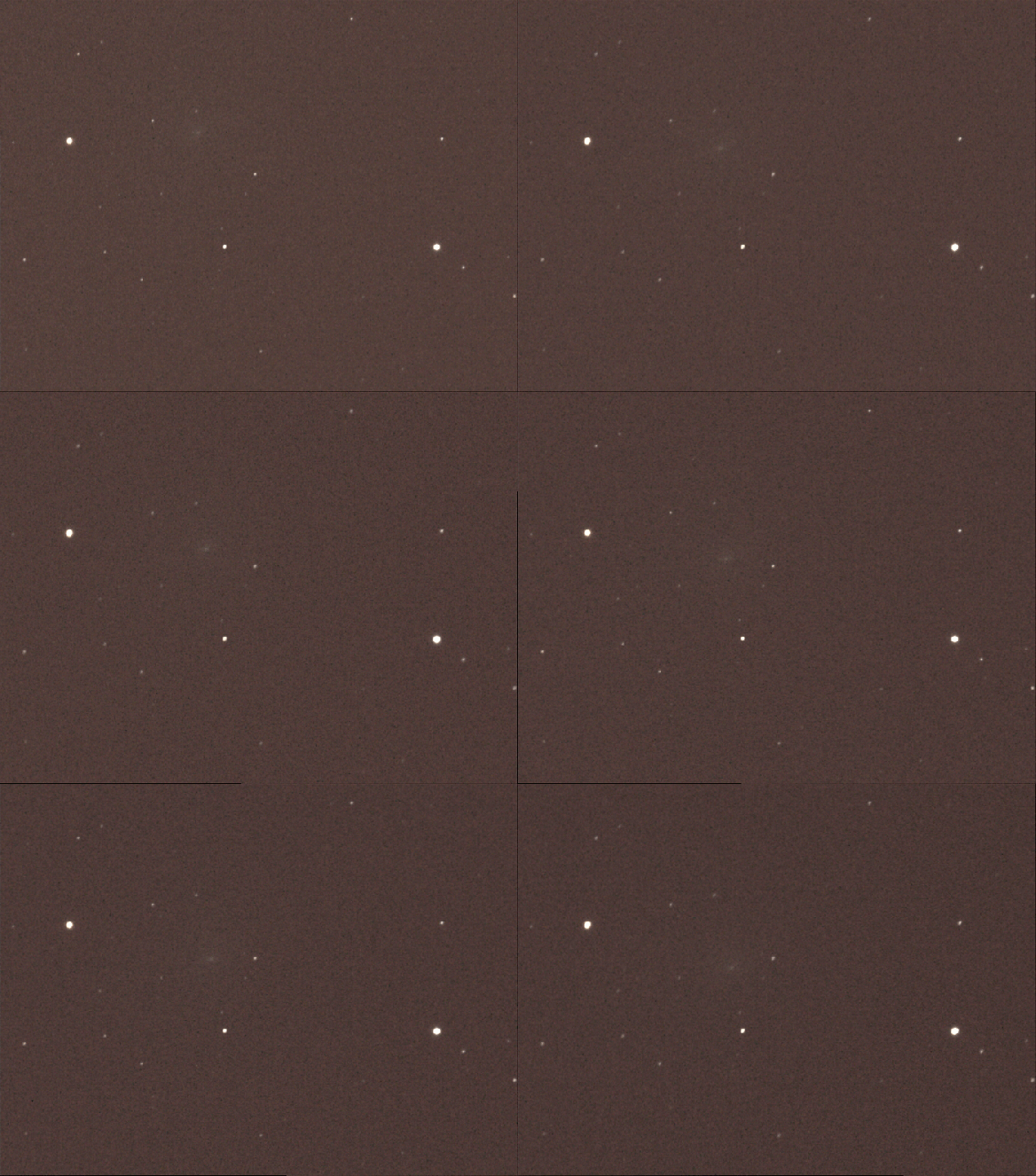
Animation – Movement of Comet 41P

The word “planet” comes from the Greek work “planan” which means to wander. Early star gazers noticed that some bright stars moved with respect to other fixed stars.  Those bright stars are our closest planets: Mercury, Venus, Mars, Jupiter and Saturn. Comets also move a fair bit across the sky, but the origin of the word has more to do about stars “with long hair” than it’s traveling behavior.

Last weekend I managed to photograph comet 41P//Tuttle–Giacobini–Kresák, and I identified in my blog that it’s movement was visible frame to frame. Well I’ve finally gotten around to create a small animation of that movement. For those wondering what’s the comet’s velocity, it’s currently travelling at 37.4 km/s.

Animation of comet 41P/Tuttle–Giacobini–Kresák (45 minutes)

Animation of comet 41P/Tuttle–Giacobini–Kresák (41 minutes)

The above is composed of 32 frames, each a 1 minute exposure spanning a time of 41 minutes. You are probably thinking “it should be 32 minutes, not 41!”. That is because I have a delay between each frame to allow the camera to send the photo to the computer. Hence between the first and last frame, 41 minutes have elapsed.

Large Asteroid to Pass Near Earth

On April 19th a considerable sized asteroid will pass about 4.6 lunar distances (1.8 million km) from Earth.  While there is no chance of it impacting our planet, this 650m asteroid was only discovered three years ago, and it will be the closest encounter of a large asteroid since asteroid Toutatis in September 2004. The next predicted fly-by of a large asteroid is 2027 with 800m wide 1990 AN10.

The expected magnitude could reach up to 11 during the close approach, hence a decent sized scope will be required, and due to the rapid movement may be hard to locate and track.

Sky chart for asteroid 2014 JO25 covering April 18th to 20th 2017

And as a bonus, comet PanSTARRS (C/2015 ER61) will also make its closest approach to Earth on the 19th, but 10 times farther away as the asteroid.  I should be visible with small telescopes or binoculars in the constellation Aquarius in the dawn sky.

Source: NASA/JPL

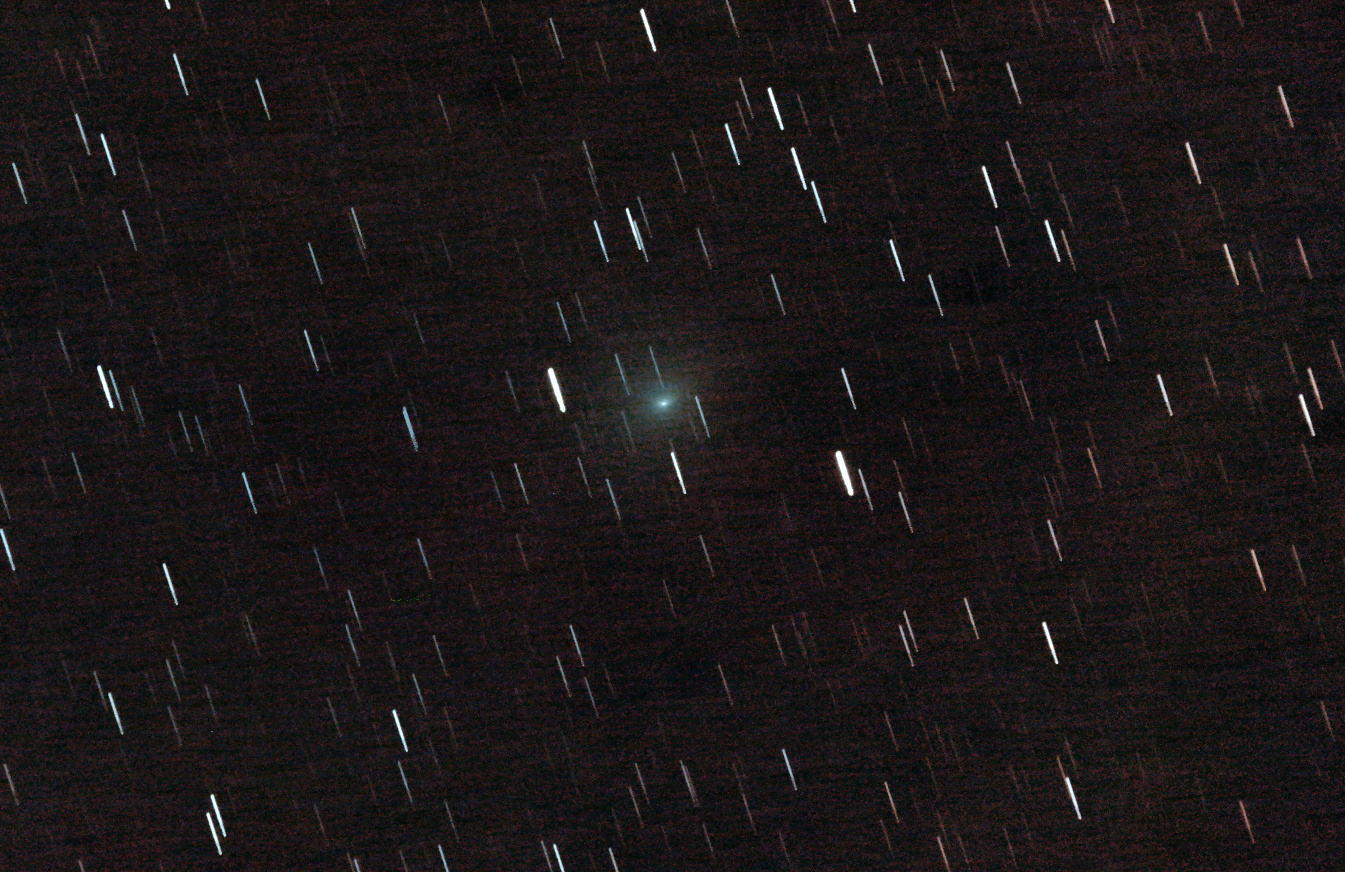
Comet 41P/Tuttle-Giacobini-Kresak

Periodic comet 41P/Tuttle-Giacobini-Kresak is currently a magnitude 8 object for telescopes and unlike many other current bright comets like C/2015 ER61 (PANSTARRS) and C/2017 E4 (Lovejoy) it is visible for a good portion of the night while the other two are only visible in the morning twilight for those like me in the northern hemisphere.

On April 13th comet 41P was in the constellation Drago, which is where I managed to photograph it.

Comet 41P/Tuttle-Giacobini-Kresak (13-Apr-2017) - Benoit Guertin

Comet 41P/Tuttle-Giacobini-Kresak (13-Apr-2017) – Benoit Guertin

Not much of a tail on this comet, and I’ve checked other photos taken with larger scopes and the result is also just a coma around the nucleus.

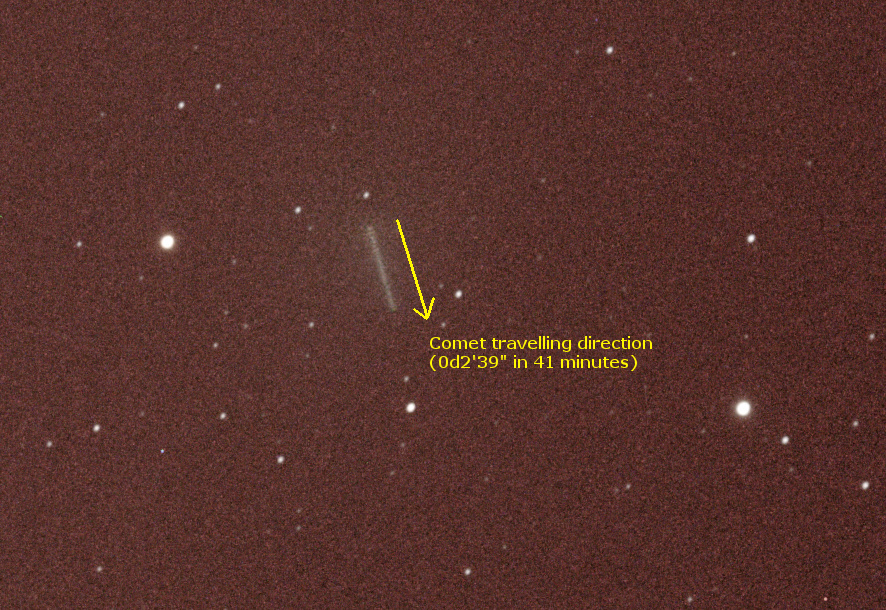
Because it is passing near Earth, its movement in the sky is quite noticeable frame-to-frame in the captured images. For the registration and stacking with comets, this is done by alignment on the comet and not the stars, hence the star trails in the above image. I performed another stacking, this time using the stars to align, and the comet’s movement becomes obvious. The displacement measures 2.6 arc-minutes in the 41 minutes that elapsed between first to last exposure.

UPDATE: Created a short video showing the comet’s movement
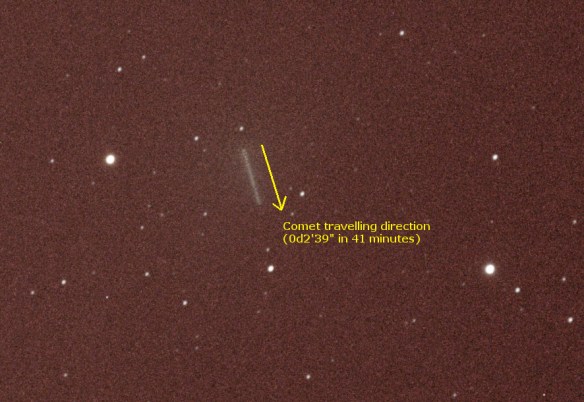
Distance traveled by the comet in 41 minutes

Distance traveled by the comet in 41 minutes

My setup was less than ideal, as the constellation was only visible from the front of my house.  Yes that is a lovely street-light shining right across the street.  Luckily the telescope was pointing a little to the right, and a rolled piece of cardboard help act as an dew-shield extension to block the glare.  But on the good side I had a nice solid concrete surface and got a very good polar alignment with 1 minutes exposures giving me nice round stars.  Hmmm, might explore this setup a little more often…

Setup in the garage to image comet in constellation Drago

Setup in the garage to image comet in constellation Drago

Telescope: SW80ED
Camera: Canon XTi (450D)
Exposure: 32 x 60sec ISO 800
DeepSkyStacker, IRIS, GIMP

Other comets of interest for 2017

Jupiter and Three Moons

Started processing some of the images taken on April 8th, the only evening with a clear night. I spend a good hour in the near freezing air to capture Jupiter with various settings. The one below was taken with a 2X barlow and a simple webcam. This is a mosaic of two frames as not all moons fit into the rather narrow 640×480 CCD sensor. Unfortunately the fourth moon, Callisto, is just out of the frame to the right.

Jupiter - 2017 opposition - SW80ED and 2x barlow

Jupiter – 2017 opposition – SW80ED and 2x barlow

Telescope: Skywatcher 80ED with 2x barlow lens
Sensor: Philips Vesta webcam with IR-UR cut filter
Processing: Registax and GIMP

Took 40 seconds of video at 20 images/sec which produced a 351MB AVI file. The video is then analysed, registered and stacked with Registax.  Color saturation and light levels where then adjusted in GIMP.

I also took many more video with a 3x barlow, but getting the focus right was a challenge. And I’m afraid the end result is just a “bigger” Jupiter, no additional details. I will need a few nights to process those and see which one turned out well. I will also try using the drizzle algorithm on the image above to see if I can get a larger and better image.

This Weekend – Best Time to See Jupiter

This weekend is the best time to see Jupiter of all 2017, because the planet is at opposition, meaning it is exactly opposite to the Sun and the Earth-Jupiter separation is also at its closest.

The photo below was taken during the September 2010 event and I happened to fall upon a fantastic low turbulence window in the atmosphere. Look closely and you’ll see the shadow of one of those moons on the Jupiter’s surface.

Jupiter_17sep2010

Jupiter – Benoit Guertin

Photos of Jupiter with the moons are a little tricky. Capturing the smaller moons require more exposure or gain, but at the risk of over-exposing the planet and turning Jupiter with those wonderful cloud bands into nothing more than a white sphere. It is always better to take a series of images or videos with different settings and review them at a later time on the computer.  Some information on planetary imaging and processing is provided in my blog on imaging with a webcam.

Planetary imaging is all about controlling turbulence.  Air turbulence whether within the optics, telescope, near the ground or high atmosphere will give you a blurry view. Hence some simple tips are:

  1. Allow your equipment to cool down a few minutes such that the equipment temperature can stabilize and match the outdoors.
  2. Past midnight is better as this allows time for the ground to cool especially after a sunny afternoon, reducing convective currents.
  3. Wait until Jupiter is high in the sky, that way there is less atmosphere between you and Jupiter. By looking straight up, you will be looking through a smaller “air column”.

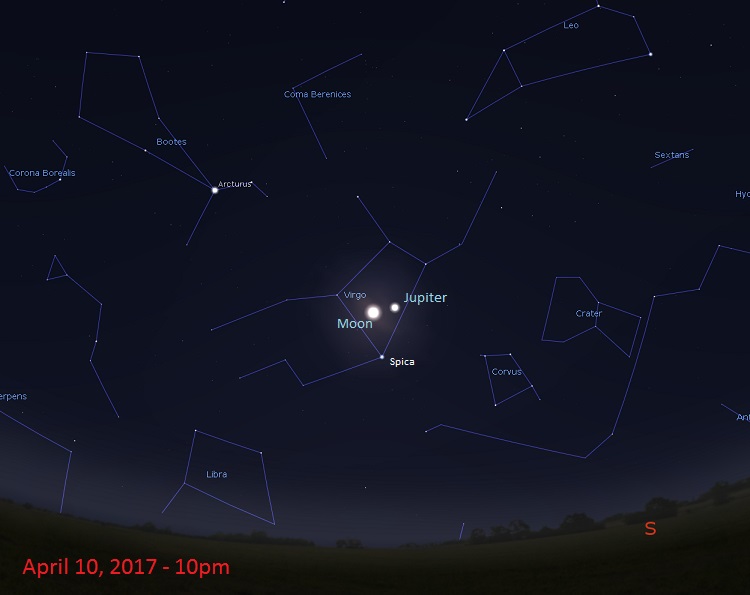
A good time will be on April 10th when the Moon will next to Jupiter.  See the sky chart below showing the southern part of the sky at 10pm EDT.  The planet will track west as the night advances.

April 10th 2017 Sky Chart

April 10th 2017 Sky Chart


Fast Moving Comet Before Sunrise

If you are able to get out of bed early and the sky is clear, equipped with binoculars you should be able to catch a fast-moving comet as it swings by Earth at about 32 lunar distances over the next few days.  The best time is just prior to sunrise as the comet will be higher in the sky in the East.  Use Jupiter as well as bright stars Vega and Arcturus to get your bearings.  With each day the comet will rise earlier and will appear higher in the sky as the chart below shows; comet position at 5am for the next week.  However it will diminish in brightness as it moves away from Earth on after February 11th.

Comet 45P over the next few days starting Feb 10th.

Comet 45P over the next few days starting Feb 10th.

This isn’t the closest a recording of a comet passing near Earth, but it does make it to the 8th spot since modern observation and have been keeping track of near Earth objects (1950).  Back in August 15 2011, it happen to pass even closer, only 23 lunar distances, making it also the 5th closest comet approach.

With a storm system moving up the eastern edge US and Canada, my chances of getting any clear morning sky is pretty slim…

Downloadable PDF Sky Chart: 45p_feb2017_chart

Tomorrow Evening: Moon, Mars and Venus

Great photo opportunity tomorrow evening, January 31st, with a thin crescent Moon in a close formation with Mars and Venus.  As the sky darkens simply look between South-West and West and you won’t miss them.  However don’t wait too late, by 9pm they will have disappeared below the horizon.

Early Evening Sky (7pm) - Look WSW for this close formation

Early Evening Sky (7pm) – Look WSW for this close formation

The Moon will be a thin crescent.  Here it is as photographed of the Moon tonight at 5:40pm just a little less than 3 days old.

Crescent Moon - 30-JAN-2017 (5:40pm)

Crescent Moon – 30-JAN-2017 (5:40pm)

No high-resolution photo for this one.  Took it quickly through an open window simply by hand-holding the telescope, and using Venus to quickly find focus through the camera view-finder.

Skywatcher 80ED
Canon XTi (1/50s at ISO400)
Registax6 to align, stack and wavelet on the best 3 frames (out of a dozen)

Comet 45P/Honda-Mrkos-Pajdusakova

It wasn’t easy but on Friday the weather cooperated and I was able to capture a glimpse of comet 45P/Honda-Mrkos-Pajdusakova.  That’s if you consider -10°C outside temperature to set-up a telescope and operate a laptop cooperation from Mother Nature.

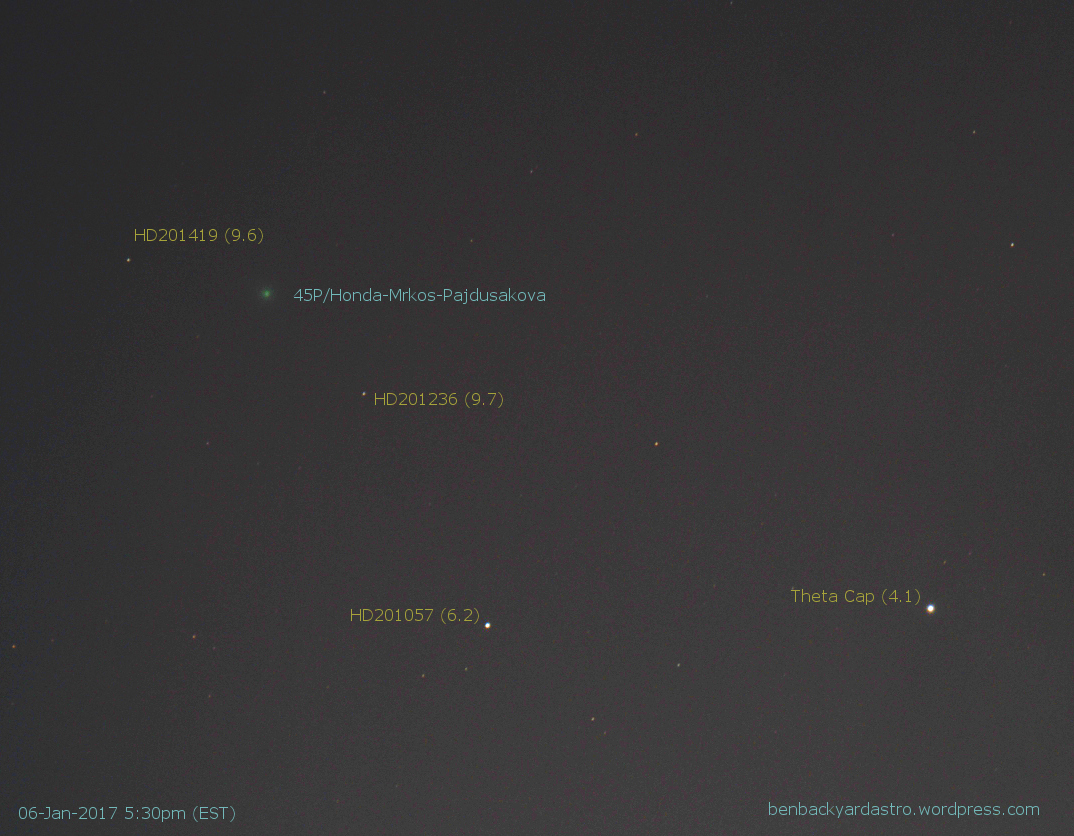
In my previous post I gave myself a 2-day challenge to capture this comet as it was essentially the last few days at a decent magnitude 7 brightness before becoming non-observable as it swings around the sun over the coming weeks.  And when it returns to the northern latitude sky in mid-to-late February it will be dimer at magnitude 10.  In the image below, I labeled some of the brighter stars with their visual magnitude as reported by the Tycho-2 catalog.

Comet 45P/Honda-Mrkos-Pajdusakova

Comet 45P/Honda-Mrkos-Pajdusakova – around magnitude 7 on January 6th, 2017

I had a very small window of about 30 minutes to make any observation and photograph it.  The challenge started with setting up without polar alignment; the sky was still too bright to locate Polaris,  and instead relied on the position of Venus to align the mount.  As it was still twilight, I was limited to short exposures to keep the histogram on the left half on the camera and to make out a star from the background sky.  I actually started at ISO 400 with only 1 second exposure while adjusting the focus around Theta Cap (magnitude 4).  And as the minutes ticked by I was able to slowly increase my exposure as the twilight darkness permitted.  With neighboring trees, and rooftops coming into view I had to grab as many frames as possible. In the end I got 14 images with 6 seconds exposure at ISO 800 before calling it quits.

With such short exposures no chance of capturing any comet tail, but the green halo is unmistakable comet.

I hope to capture a few more comets this year.

Skywatcher 80ED
Canon XTi (450D)
14 x 6sec (ISO 800)
Registered and stacked with DeepSkyStacker.  Post-processing with GIMP.

Challenge for the next 2 days: Comet

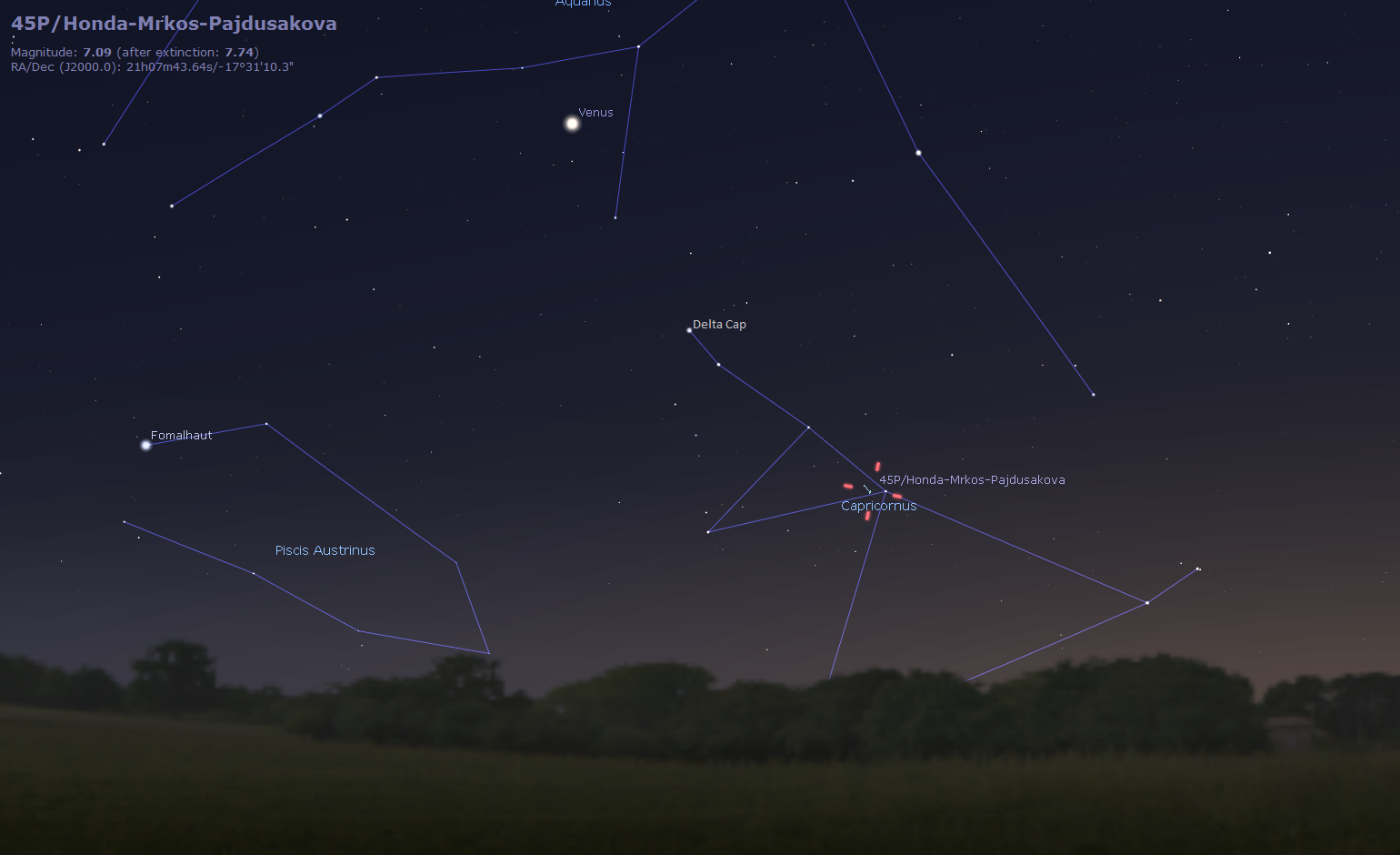
My challenge for the next two days (Clear Sky Chart is predicting clear skies) is to observe and capture comet 45P/Honda-Mrkos-Pajdusakova.  It should be relatively easy to locate by hopping from Venus then down the bright stars of Capricorn starting with Delta, Gamma, Iota and ending with Theta.  Then half a degree to the left of Theta Cap is magnitude 6 star HD201057.  Comet 45P at magnitude 7 should be just next to that star.

The challenge will be its position low near the horizon, I may have obstructions before it sets.  And the twilight may not be dark enough for a magnitude 7 object.  The viewing time window will be quite small…wait for darkness and it will fall out of view.

Location of comet for January 5th 5:30pm EST

Location of comet for January 5th 5:30pm EST

No need for telescope, it’s also a binocular object.

45P is the 45th periodic comet (Halley being the 1st identified periodic comet) with a 5.3 year period.  Its orbit swings from just past Jupiter to in between Mercury and Venus.