Headlamps -Free Your Hands

As much as we avoid any type of light source when doing nighttime observations, there are moments when a bit of extra light helps locate the right eyepiece, make those small adjustments, read a sky chart or operate the laptop/camera.  For the longest time I’ve been fumbling about with a hand-held flashlight (red film equipped), often resorting to holding it in my teeth to keep my hands free.

A short while ago, while over at a friend’s observatory he handed me a headlamp for the evening.  Wow what a difference that made!  No wondering where I had left the flashlight, and both hands free when changing eyepieces, or checking sky charts.

Headlamp with white and red LED

Headlamp with white and red LED


There are plenty of models on the market, but be sure to have one that has a red night-vision mode.  The Black Diamond Spot that Santa placed under my tree can be dimmed in both in white and red light.
New Years Eve Aurora Borealis

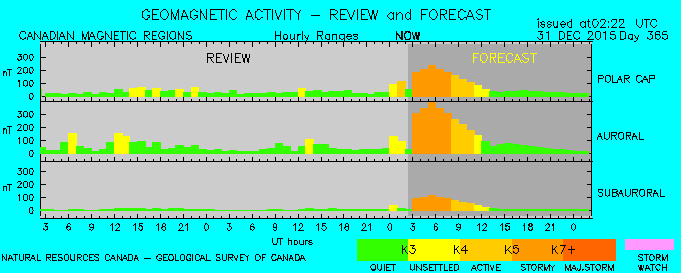
After the Christmas Full Moon, our beloved Sun has unleashed a CME (coronal mass ejection) towards Earth on December 28th, and those charged particles are predicted to reach us on the 31st (NOAA predicts G3-Strong Geomagnetic Storm).  Below is the snap-shot of the past and forecasted geomagnetic activity from Natural Resources Canada as provided at 9:22pm EST.

Geomagnetic Activity Review and Forecast 31Dec2015

Geomagnetic Activity Review and Forecast 31Dec2015 – Canada.ca

Based on their prediction model the peak of the activity will happen the night of 30th to 31st.  Therefore if you live outside of the city and in northern latitudes (north of 50 degrees latitude) you may be surprised by a wonderful light show tonight and tomorrow. Because Earth magnetic field is “springy” it will “ring” for some time and auroras should be present until New Year’s Eve.

Other effects that you may notice is larger GPS errors or longer time to get a “lock”.  Mobile phones won’t be affected by this type of storm.  You need a snow storm to affect your mobile phone signal.  Snow flakes are just the right size and their density in the sky to scatter the signals in the frequency range used by mobile phones.

2015 in review

The WordPress.com stats helper monkeys prepared a 2015 annual report for this blog.

Here’s an excerpt:

A San Francisco cable car holds 60 people. This blog was viewed about 2,200 times in 2015. If it were a cable car, it would take about 37 trips to carry that many people.

Click here to see the complete report.

Christmas 2015 Full Moon

Image

After sneaking the kids’ gifts under the tree while they were sound asleep, I decided to see if the Christmas 2015 Full Moon was visible.

A thin cloud lightly obscured the view, and I wasn`t sure if the early morning sky would yield any better weather.  A few quick shots at 17 and 85mm on the Canon EFS lens to record the event as the next Christmas full Moon will be in roughly 30 years.

Christmas Full Moon of 2015

Aside

If you get up early on Christmas morning, don’t open your presents, or shake that box right away.  Head towards the window and glance west at the sky.  There over the horizon you’ll see the last full Moon of 2015.

The last time that full Moon happened on December 25th was 1977.  Disco was all the rage and “Saturday Night Fever” starring John Travolta, premiered in NYC.  So yeah, a long time ago…

I’m guessing with the full Moon to light the way, Rudolf might get a bit of a rest this year. 🙂

The Sun in Like You’ve Never Seen Before

Video

A few weeks ago NASA released a video in stunning 4K quality showcasing some of the sharpest and most detailed views of the Sun at different wavelengths. These images were captured by NASA’S Solar Dynamic Observatory launched in space in 2010.

As stated in the introduction,  each minute of video takes 10hrs in the hands of specialists to process. Not too bad considering that I’ve sometimes spent hours to produce a single image.

Reference :NASA

Missile Launch Over San Francisco – Not Astronomy, but Cool Results

Video

Not a UFO!  Last weekend the US Navy launched a Trident II D5 strategic ballistic missile from USS Kentucky (a Ohio class SSNB) off the southern coast of California.  Justin Majeczky and a friend were lucky enough to be shooting a time-lapse video over the Golden Gate bridge when they noticed the missile launch.

https://vimeo.com/145029572

While not an astronomy target, capturing missile or rocket launches, especially at night lends itself very well to astro-photo gear, setup and software.  And nighttime launches often provide nice results, especially after sunset as the exhaust plume reflects sunlight high up on the atmosphere.  Can also trigger the formation of noctilucent clouds.

If you live in near a spaceport, or near a naval war exercise, tracking and capturing a missile or rocket launch with your gear can be rewarding.

Taurid Meteor Shower Already Producing Some Fireballs

Video

While the Taurid Meteor Shower is expected to peak on November 11th and 12th for the Northern Hemisphere, some fireballs have already been observed and recorded.

The following video was recorded in Bangkok Thailand just before 9pm local time November 2nd

https://www.youtube.com/watch?v=RfWozVsMOsY

And a few days prior to that the following was captured in Poland on October 31st.

https://www.youtube.com/watch?v=_PG3Bszho-c

These fireballs as they streak across the sky often produce color due their chemical composition and the heat generating entering the atmosphere.  Some may even leave behind a smoke trail that will persist for some time.

The Taurid Meteor Shower are remnants of a large comet that probably got broken up by repeated close encounters with Earth and other planets 20,000 to 30,000 years ago.

Cassini’s 48km Close Approach to Saturn’s Moon Enceladus

Video

Today the Cassini spacecraft made a close approach and dive through the plume of icy spray from Enceladus, Saturn’s sixth largest moon.  What surprised me was the low altitude flyby: just 48km from the moon’s surface.

OK, by aircraft standard a 48km altitude is still way up there as commercial aircraft operate at an altitude of 10km, and even the famed U2 and SR-71 spy planes designed to fly above surface or air launched missiles top out at 20 and 25km altitude respectively.  But for a multi-billion dollar spacecraft this is quite low due to the high risk.  Low Lunar Orbit used during the Apollo missions were at a 100km altitude, and all the hype on New Horizons Pluto flyby, it was at a distant 12,500km pass.  OK ESA’s Rosetta spacecraft was maneuvered down to 29km around comet 69P, but has since moved out to a safer 300km orbit.

Looking forward to seeing what comes out of Cassini’s E-21 flyby.

Source: JPL’s Cassini E-21 Flyby Page