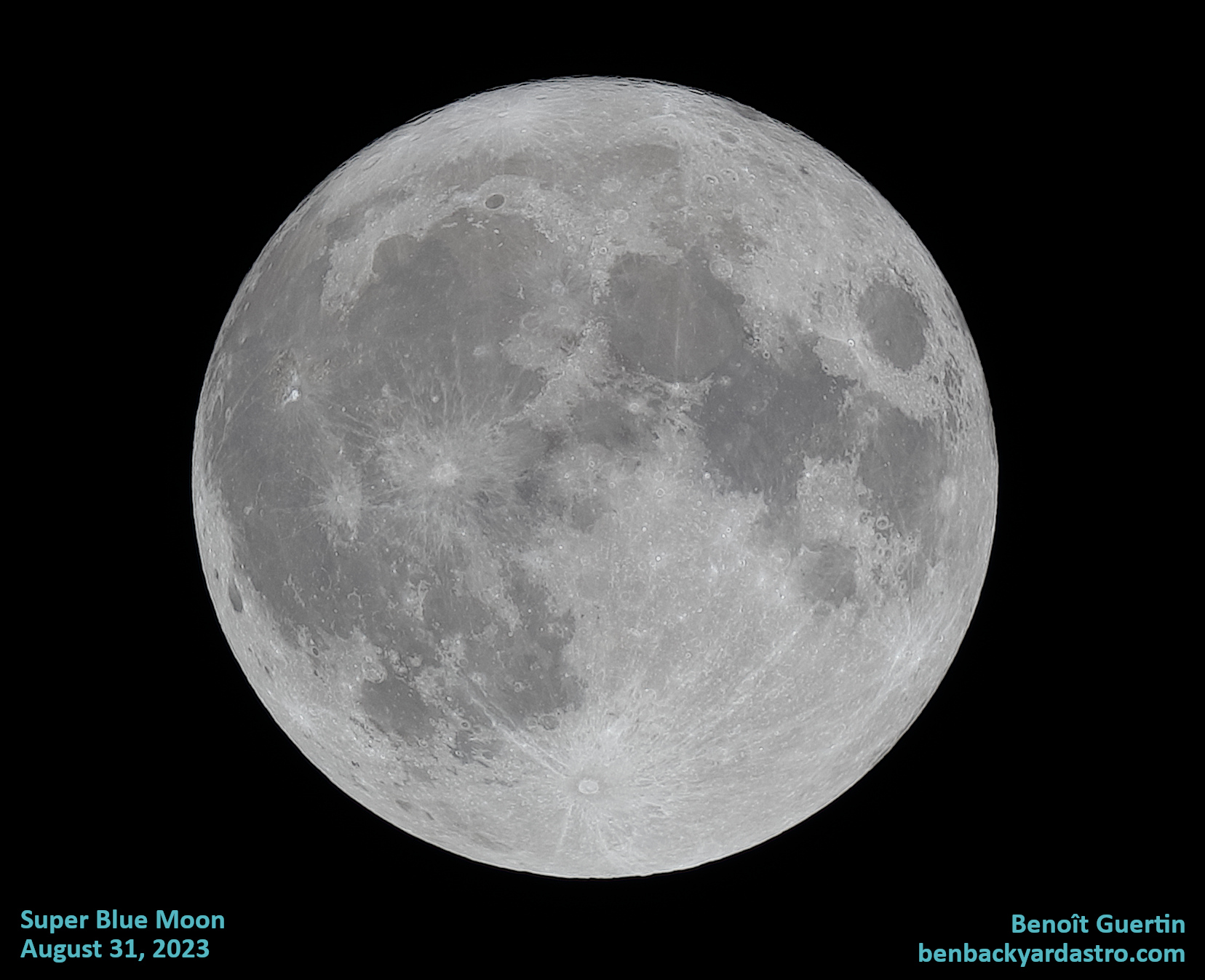
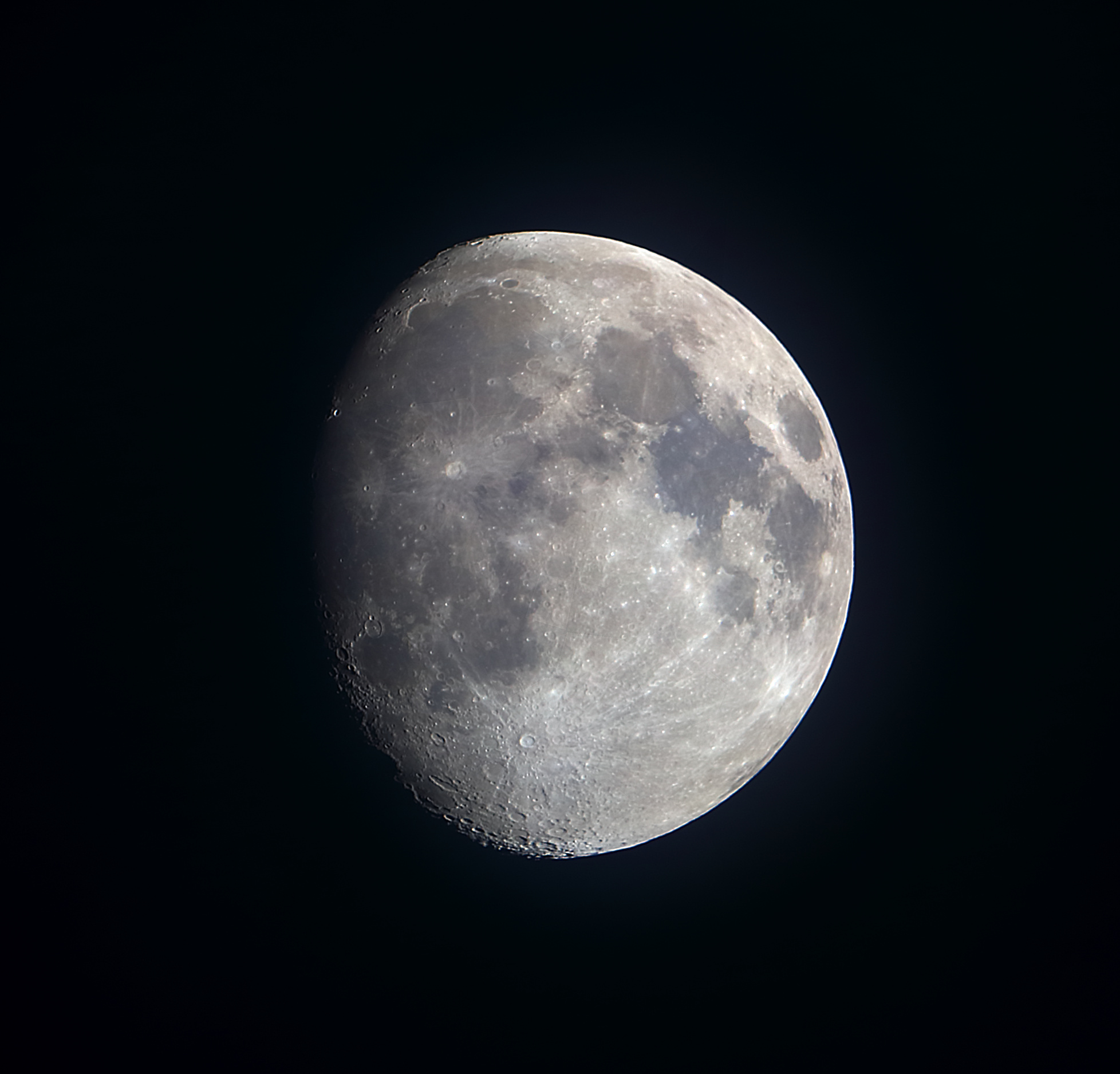
Back in 2017 I color enhanced one of my photos of the moon to see if I could pick up the subtle hues due to the different minerals as I had seen some posts in forums. I decided to redo this experiment, but this time with a photo of the Super Blue Moon from August last year. I figured starting off with a brighter and sharper photo will yield better results.
Using a photo editor I duplicated the layer and boosted the color saturation. Then I blended both layers together to get a nice result. The reason why I don’t simply boost the saturation in the original image is that doing so also increases the “noise” in the image. Keeping a grayscale and a color layer separate preserves the details while enhancing colors.
The result is often referred to as the Mineral Moon because the difference in orange and blue hues are due to the different concentration of minerals in the regolith. Blueish areas are high in titanium, possibly as high as 10%, compared to on Earth where titanium is approximately 1% of the soil content. The orange, brown areas have higher iron content.
The newer and brighter impact craters are even more contrasting over the dark areas formed by old lava flow during the early formation of the Moon.
Who knew that with nothing more than a DSLR and small telescope from a backyard you can map the geology, age and minerals on the Moon. If you have a good photo of the Moon on your computer, give it a try!
On April 8, 2024 a total solar eclipse will be visible for people in Mexico, USA and Canada. The Moon will pass between Earth and the Sun, and those in the path’s of Moon’s shadow will be able to see an eclipse. I created the video below using Stellarium to show the shadow’s trajectory from west to east.
A once in a century astronomical event took placed on in the evening of December 11, when the bright red star Betelgeuse briefly winked out of the night sky for a few seconds. It wasn’t the talked about great dimming that is expected to preclude the explosive supernova ending of this red supergiant. It was caused by passing asteroid Leona. This is a rare and exciting opportunity for scientists to observe both objects in detail, as well as to test our knowledge of their sizes, shapes and orbits.
Betelgeuse Red Super Giant in Orion (Benoit Guertin)
We are all used to eclipses, when the Moon or Earth occults the other heavenly body and passes in the shadows. Asteroid-star occultations are actually very common, about half a dozen happen every day. However being able to observe one to the naked eye is extremely rare.
Betelgeuse is one of the largest and most luminous stars in the sky, located about 650 light-years away in the constellation of Orion. It is a red supergiant, if it were placed at the center of our solar system, it would engulf the orbits of Mercury, Venus, Earth and Mars. It is also a variable star, changing its brightness and color over time due to pulsations, convection and dust formation.
Asteroid Leona is a much smaller and fainter object, orbiting the Sun between Mars and Jupiter and originated from the outer asteroid belt. Leona is about 66 kilometers in diameter and has an irregular shape, but just large enough to block out a bright star such as Betelgeuse. Leona is a dark reddish high carbon asteroid making it a challenge to observe even with an amateur telescope at a magnitude 14 brightness, so only large telescopes will be able to capture the momentary dimming.
The occultation of Betelgeuse by Leona was visible from a narrow path across the Earth, stretching from southern Europe, Turkey, Greece, Italy, the tip of Florida and Mexico. The occultation is expected reduce the brightness by 3 magnitudes, making it disappear to the naked eye.
The occultation of Betelgeuse by Leona is a rare and valuable opportunity for both amateur and professional astronomers. It will allow us to measure the diameters and shapes of both objects with unprecedented precision, as well as to study their atmospheres and surfaces. It will also help us to refine our models of their orbits and motions, which are affected by various factors such as gravity, radiation pressure and thermal effects. Moreover, to the lucky few it was a sight that will not be repeated for many years to come.
The folks at JPL created a short film showcasing Perseverance’s critical descent phase for the Mars landing. If everything goes according to plan, we shall have a new rover on Mars at 3:40pm EST on February 18, 2021.
Perseverance is currently “cruising” at 84,600km/h through space with Mars as a target. To give you an idea of what kind of speed that is, here are a few benchmarks:
The fastest commercial jet: the Concord flying at Mach 2.04 is just under 2,200km/h
Space Shuttle re-entry speed: 28,100km/h
Voyager 1, leaving our solar system : 61,500 km/h
Parker Solar Probe (fastest man-made object) : +250,000km/h
Perseverance was launched on July 30th, 2020 from Cape Canaveral Air Force Station, Florida, on top of a Atlas V-541 rocket.
Animation of Mars 2020’s trajectory around Sun, Data source: HORIZONS System, JPL, NASA
The only way the rover will be able to decelerate from its current cruising speed is by plunging into the Martian atmosphere at the right angle and using the atmospheric friction to slow it down. That “7 minutes of terror” is the time the rover will spend on re-entry, from approaching Mars at the right angle, to landing in the desired spot on the Martian surface.
Lots of steps need to go right, timed correctly to have a successful landing. Only 22 of the 45 landers sent to Mars have survived a landing. The US is by far the country with the most success (sorry Russia, you’re space program is awesome, but you suck at landing on Mars)
Glancing up at the night sky that February 18, 2021 evening will be very easy to spot Mars, but also the Pleiades star cluster (Messier 45). Mars will be about 5 degrees north of a almost half-illuminated moon. And if you keep looking higher up by 10 degrees you’ll see the famous open star cluster nicknamed the Seven Sisters, also used as the Subaru emblem.
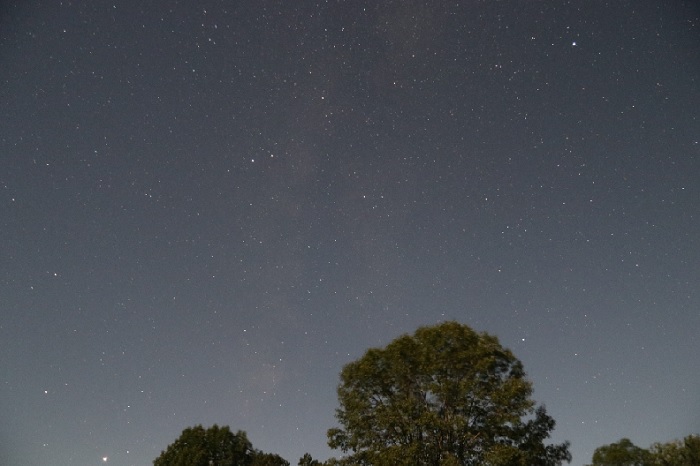
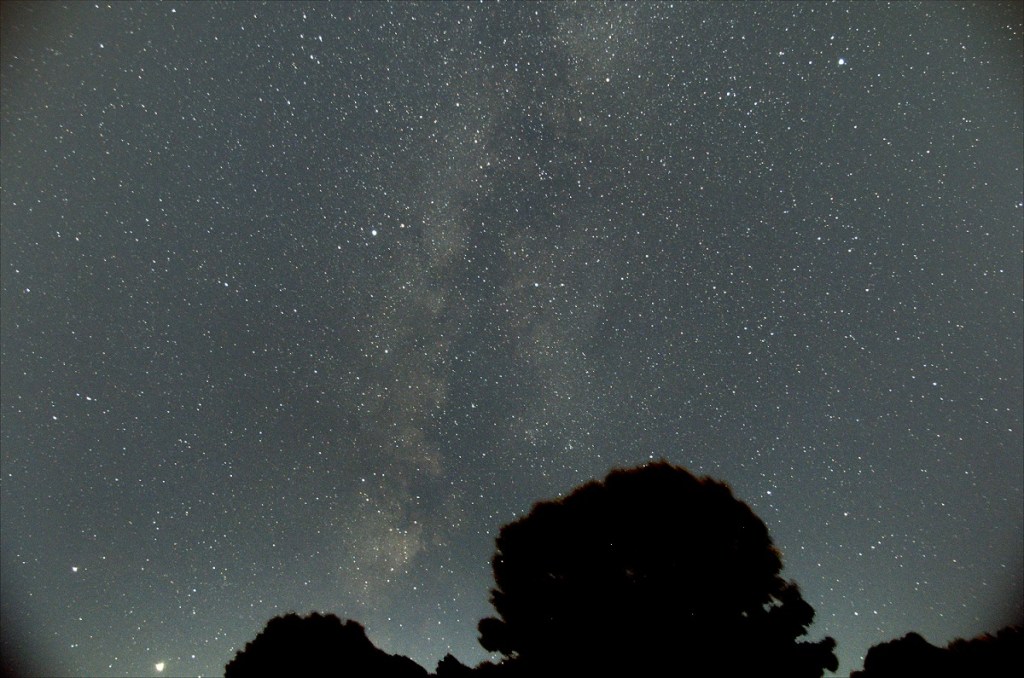
What makes it possible to be able to generate a photo of the Milkyway from what appears to be just a faint trace in the original shot?
The final image (left) and a single frame as obtained from the camera (right)
It all comes down to the signal vs noise. Whenever we record something, sound, motion, photons, etc… there is always the information you WANT to record (the signal) and various sources of noise.
Noise can have many sources:
background noise (light polution, a bright moon, sky glow, etc…)
electronic noise (sensor readout, amp glow, hot pixels)
sampling noise (quantization, randomized errors)
This noise can be random or steady/periodic in nature. A steady or periodic noise is easy to filter out as it can be identified and isolated because it will be the same in all the photos. However a random noise is more difficult to eliminate due to the random nature. This is where he signal to noise ratio becomes important.
In astrophotography we take not only the photos of the sky, but also bias, darks and flat frames: this is to isolate the various sources of noise. A bias shot is a short exposure to capture the electronic read-out noise of the sensor and electronics. The darks is a long exposure at the same setting as the astronomy photo to capture noise that appears during long exposures due to the sensor characteristics such as hot pixels and amplifier glow. Cooling the sensor is one way to reduce this noise, but that is not always possible. Finally the flat photo is taken to identify the optical noise caused by the characteristics of the lens or mirror as well as any dust that happens to be in the way.
But what can be done about random noise? That is where increasing the number of samples has a large impact. For a random noise, increasing the number of sample points improves the signal to noise ratio by the square root of the number of samples. Hence averaging 4 images will be 2 times improvement than a single photo. Going to 9 will be 3 times better. Etc…
You might be thinking: “Yeah but you are averaging, so the signal is still the same strength.” That is correct, however because my signal to noise ratio is improved I can be much more aggressive on how the image is processed. I can boost the levels that much more before the noise becomes a distraction.
But can’t I just simply duplicate my image and add them together? No that won’t work because we want the noise to be random, and if you duplicate your image, the noise is identical in both.
So even if you are limited to just taking 30-second, even 5-second shots of the night sky and can barely make out what you want to photogram, don’t despair, just take LOTS of them and you’ll be surprised what can come out of your photos.
When observing a comet, what we see is the outer coma; the dust and vapor outgassing from the nucleus as it gets heated from the Sun.
So I decided to take one of my photos taken with my Skywatcher 80ED telescope (600mm focal length) and see if I could process the image to spot where the nucleus is located.
This can be achieved by using the MODULO command in IRIS and viewing the result in false color. The results are better if you do a logarithmic stretch of the image before the MODULO command. It took some trial-and-error to get the right parameters, but the end results isn’t so bad.
Studying the internal structure of comet C/2020 F3 NEOWISE (Benoit Guertin)
For the fun of it I tried to see if I could calculate the size of the comet nucleus using the image. At the most narrow the nucleus on the photo spans 5 pixels. Based on a previous plate-solve result I know that my setup (Canon 80D and Skywatcher 80ED telescope) results in scale of 1.278 pixels per arc-second. Then I used Stellarium to get the Earth-coment distance on July 23rd (103.278 M km)
When I plugged in all the numbers I get a comet nucleus size of approximately 2000 km, which to me seamed a little on the BIG size.
I live in a heavily light polluted city, therefore unless it’s bright, I won’t see it. But boy was I ever happy with the outcome of this comet! In my books C/2020 F3 (NEOWISE) falls in the “Great Comet” category, and it’s by far the most photographed comet in history because it was visible for so long to folks on both sides of the globe.
My last encounter with a bright comet was in 2007 with periodic 17P/Holmes when it brightened by a factor half a million in 42 hours with this spectacular outburst to become visible to the naked eye. It was the largest outburst ever observed with the corona becoming temporarily the biggest visible object in the solar system. Even bigger than the Sun!.
Comet 17P/Holmes November 2, 2007 (Benoit Guertin)
So when the community was feverishly sharing pictures of the “NEOWISE” I had to try my luck; I wasn’t about to miss out on this chance of a lifetime.
I have to say that my first attempt was a complete failure. Reading up when it was the best time to try to photograph this comet most indicated one hour before sunrise was the right time. So I checked on Google Maps where I could setup for an un-obstructed view of the eastern horizon (my house was no good) and in the early morning with my gear ready at 4am I set off. To my disappointment and the “get-back-to-bed-you-idiot” voice in me, it didn’t work out. By the time I got to the spot and had the camera ready, the sky was already too bright. No comet in sight, and try as I might with the DSRL, nothing.
Two evenings later and another cloudless overnight sky I decided to try again, but this time I would make it happen by setting the alarm one hour earlier: 3am. That is all that it took! I was able to set-up before the sky could brighten, and then CLICK! I had this great comet recorded on my Canon SD memory card.
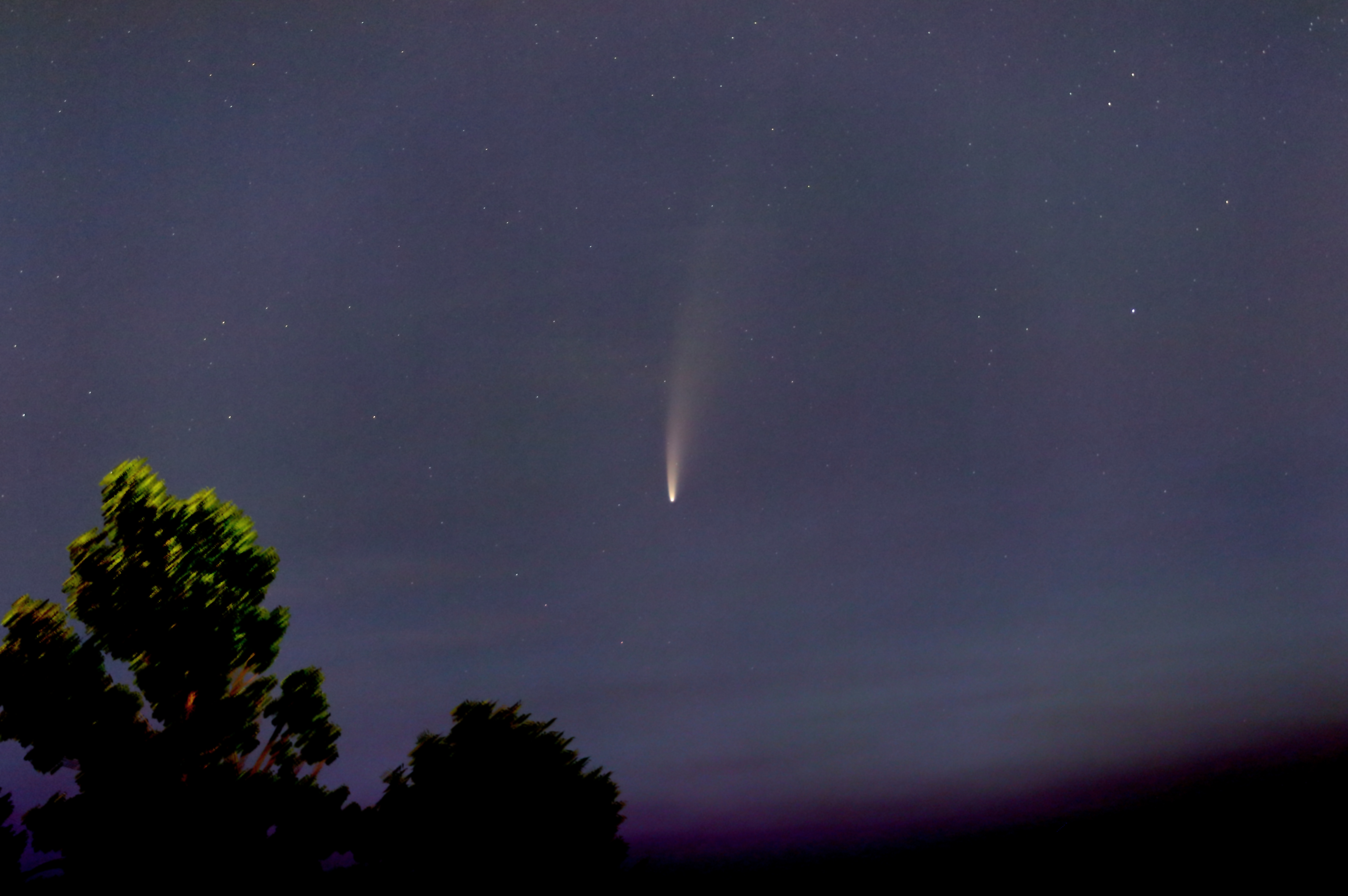
Comet C/2020 F3 (NEOWISE) in the dawn sky on July 9th. (Benoit Guertin)
I didn’t need any specialized gear. All it took was a DSLR, a lens set to manual focus, a tripod and 5 seconds of exposure and there was the comet. I snapped a bunch of frames at different settings and then headed back home to catch the last hour of sleep before starting another day of work. Lying in bed I felt like I had accomplished something important.
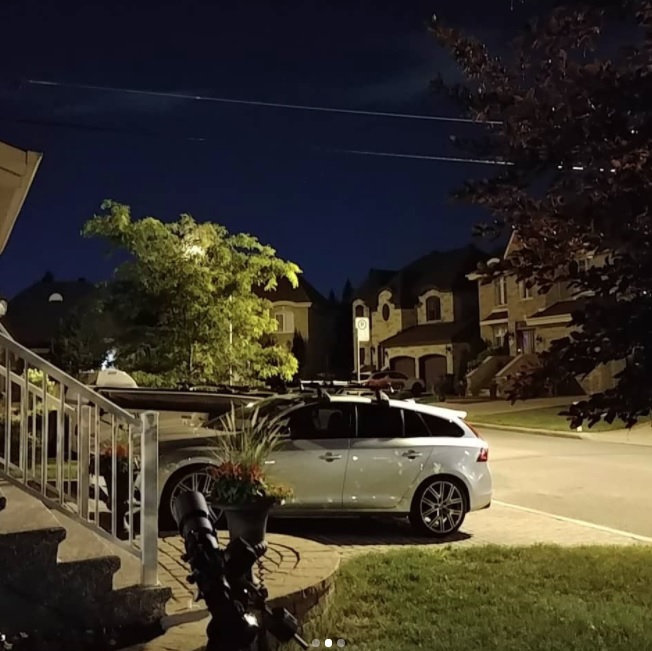
As the comet swung around our Sun and flipped from a dawn to a dusk object I decided I should try to photograph it once again, but this time with the Skywatcher 80ED telescope. At that point, the comet was dimming so every day that passed would be more difficult. It was only visible in the North-West horizon at sunset, which meant setting up in the front the the house, fully exposed to street lights. Not ideal, but I had nothing to loose trying.
Setup in front of the house, fully exposed to street lights to catch the comet.
I used our tree in the front yard to act as a screen and was able to locate and photograph this great comet. Polar alignment wasn’t easy, and when I had the comet finally centered and focused with the camera, overhead power lines were in the field of view. I decided to wait out 30 minutes and let the sky rotate to the lines out of the view. Besides, it will get darker anyways which should help which the photo. But I also realized that my “window” of opportunity was small before houses would start obscuring the view as the comet would dip to a lower angle with the horizon.
I’m sure in the years to come people will debate if this was a “Great Comet”, but it my books it’s definitely one to remember. It cemented with me the concept that comets are chucks of “dirty ice” that swing around the sun. Flipping from a dawn to dusk observable object after a pass around the Sun is a great demonstration of the elliptical nature of objects moving in our solar system.
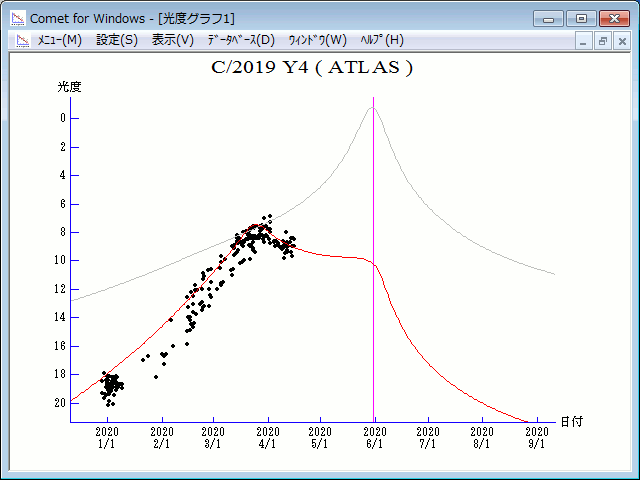
Back in March, the astronomy crowd was buzzing about a possible”naked-eye” comet expected in late May 2020. Comet C/2019 Y4 (ATLAS) was first detected at the tail end of December as a very dim magnitude 19.6 object and by mid-March it had brighten to an easy telescope target magnitude of 8. Those not familiar with the magnitude scale, going from 19.6 to 8 is not a doubling in brightness, but around a 4000 times increase!
That dramatic increase in brightness help fuel the hype for the Great Comet of 2020, and there were two other factors that got people excited:
It would be visible at dusk from the Norther Hemisphere, hence within easy viewing to much of the world population.
It was following a similar orbital path as the “Great Comet of 1843“, suggesting that it was from the same original body and could potentially provide the same viewing spectacle. That 1843 comet was visible in daytime!
Well all that went south when the comet’s breakup was observed in late March after peaking momentarily at magnitude 7. It began to dim, along with any hopes of a Great Comet repeat. Below is a graph showing the the original (grey line) and revised (red) comet brightness forecast (dots being observed measurements) on this chart created by Seiichi Yoshida (comet@aerith.net)
Comet C/2019 Y4 (ATLAS) Brightness – Copyright(C) Seiichi Yoshida
Comet C/2019 Y4 is expected to make its closest approach to the sun on May 31st, however most experts believe it will disappear (disintegrate) before that date. Seeing that I had a small window of opportunity to capture the comet I decided to try my luck last Saturday evening.
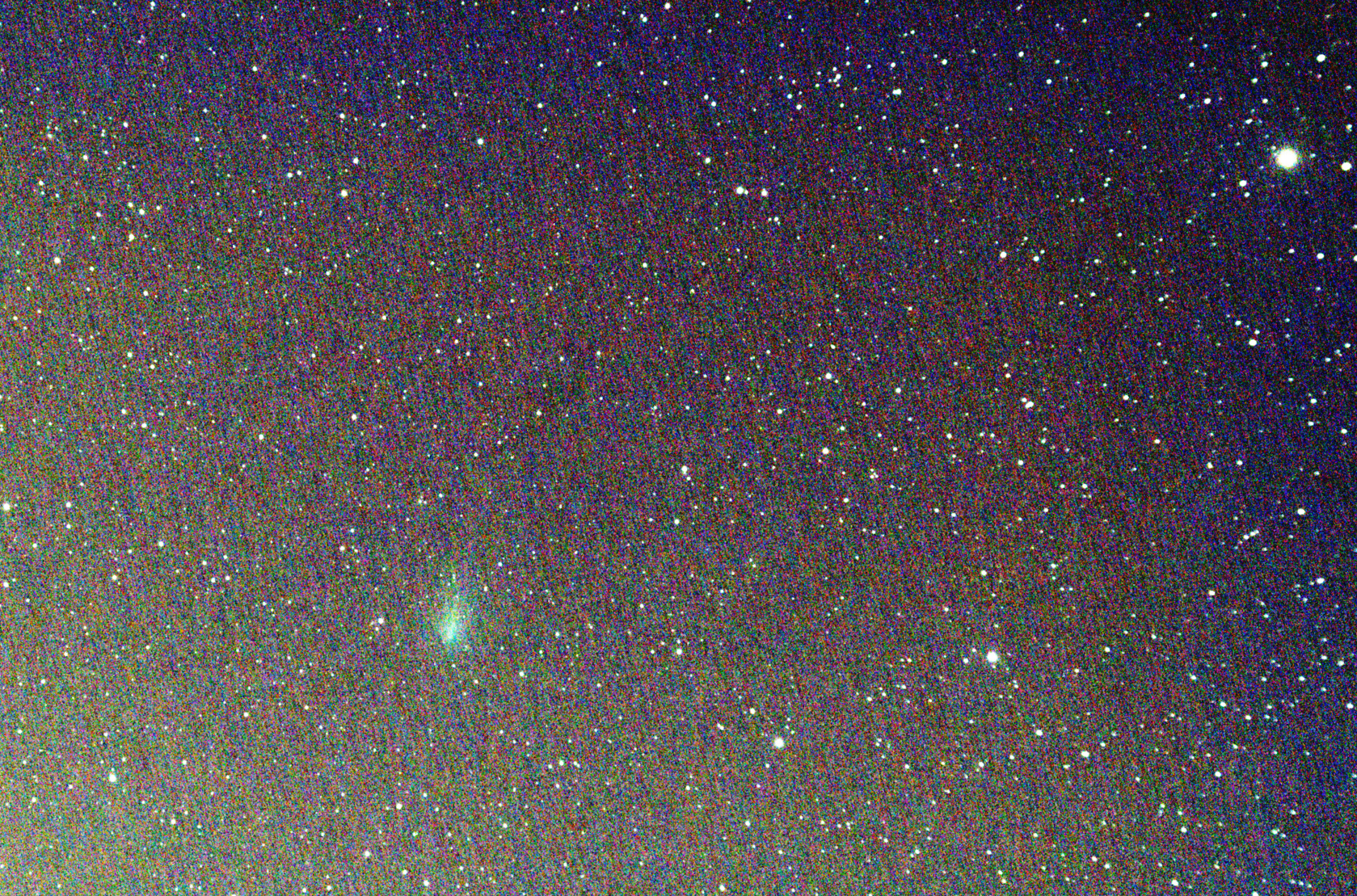
Below is an extremely processed (and ugly) image that I got by combining 25 photos (15 seconds each at ISO 3200) using my Skywatcher 80ED scope. The photo just about makes out the distinctive blue-green hue and elongated shape of a comet. It is around magnitude 10, very diffuse and about 147 million km away from us the day this photo was taken.
Comet C/2019 Y4 (ATLAS) on April 18, 2020 – Very faint at about magnitude 10. Imaged with 80ED telescope 25 x 15sec
I pushed the image processing so hard that I was able to pick up faint magnitude 13 galaxies!
On to the next comet!
Telescope: Skywatcher 80ED
Camera: Canon 80D
Image: 25 x 15sec at ISO3200 (6 minutes)
10 Days old Moon (April 04, 2020) – Benoit Guertin
The photo above is of a 10-day old Moon taken a few days ago. After the darker “seas” of old lava flow, one particularly bright crater in the southern hemisphere stands out, especially with the rays that appear to emanate from it. That is Tycho, a 85km wide and 5km deep crater and one of the more “recent” ones if you consider 109 million years the not-to-distant past. The Moon is 4.5 billion years old after all… having formed just 60 million years after the solar system. On the Moon, “fresh” material have a higher albedo and hence appear brighter, whiter.
The bright rays surrounding Tycho are made of material ejected (up to 1500km away) from the impact of a 8-10km wide body. In time these rays will disappear as the Moon continues to be bombarded by micro meteorites, which stirs the material on the surface. The rays are more present on the eastern side, as would be expected from a oblique impact.
Tycho is names after the Danish astronomer Tycho Brahe.
The Surveyor 7 space craft landed about 25km north of the crater on January 10, 1968.
Ever wondered how mosaic space photos were done before the invention of powerful software algorithm to stitch them together? Take a look at the series of Surveyor 7 mosaic photos. Someone had to painfully print each photo and lay them on a grid in a specific pattern matching optical field and geometry.
A few days prior to the holiday break there was news of Betelgeuse dimming to an all-time low, potentially signaling the start of the process that will transform this star into a Supernova. What? Wait a minute… A star in our own galaxy exploding? But that hasn’t been observed since 1604!
Remnant of SN1604 – last galactic nova (NASA)
There are plenty of novas at any point in time, they just happen to be in galaxies far away (cue Star Wars intro). During those few days or weeks of otherworldly explosions these stars become the brightest object in their host galaxies.
SN2018ivc in galaxy NGC 1068 (Credit: Bostroem et al., 2019.)
So if we can see them when they are millions of light years away, what would an exploding star just 700 light years away, like Betelgeuse, look like?
Well if we base ourselves on SN1604 it will be visible to the naked in eye for three weeks, including during daytime. SN1604 was 20,000 light years away, while Betelgeuse is at a fraction of that, so most experts anticipates that it would be as bright as a full Moon.
Now before we go crazy anticipating when Betelgeuse, a red super-giant, will explode, let me present some information to put everything in perspective.
Betelgeuse is a red super-giant of class M1-2 in the constellation Orion, 2nd in brightness just after Rigel. Betelgeuse is one of the largest start we can see when glancing up at the night sky. If Betelgeuse was our Sun, it would engulfed all planets up to Jupiter. Stars of that size aren’t like the nice Smith Ball of fire we imagine our Sun to be. They are more like a loose ball of foam, constantly bubbling and bloating from the incredible heat created in the inner core. If you are starting to think unstable, you are partly right.
Betelgeuse is also a well documented variable star, meaning it periodically varies in brightness.
Recorded Brightness of Betelgeuse Over the Years (credit: AAVSO)
So while it is at an all-time low compared to its known ~425 day cycle, it also has a ~5.9 year cycle, and this episode just happens to be a combination of both lows. So no need to panic… for now.
Betelgeuse will one day end as a type II supernovae, probably not for another 100,000 years. Until then we can all glance up during these cold winter nights at how easily the Orion constellation can be spotted and enjoyed. The three bright stars marking the belt and the hour-glass figure is easy to find. Take a few moments to look at Betelgeuse as on a galactic scale it will be gone tomorrow.
Betelgeuse Red Super Giant in Orion (Benoit Guertin)
Welcome to a journey into our Universe with Dr Dave, amateur astronomer and astrophotographer for over 40 years. Astro-imaging, image processing, space science, solar astronomy and public outreach are some of the stops in this journey!








 Ben Backyard Astronomy