If you are able to get out of bed early before sunrise and the sky is clear, you can catch a view of our three closest planets, and if you include Earth that makes 4. Mercury was at the greatest elongation on September 12th (furthest from the Sun when viewed from Earth) which makes it a good time to spot without the glare of the Sun. But it happens that Mars and Venus are also on that same side of the Sun, making a chanced planetary alignment.
The sky map below [click for larger] shows the position of Mercury, Mars and Venus for the morning of the 16 to the 19 of September. Bright star Regulus and our Moon are also there to make this a worth-while event, especially on Monday the 18th.
Mars and Mercury will be closest on the 16th, while the 18th will probably be the most photogenic as the Moon will be a thin crescent in the middle of this alignment.
With the eclipse behind us, and all the gear put away it’s time to transfer and process the images to create something memorable. I decided to make a mosaic with some of the photos of the eclipse, as well as the visible sun spots. Click on the image below for a high-resolution version.
August 21, 2017 Solar Eclipse
The weather cooperated and I had the right gear to get some decent photos. Before the start of the eclipse, the sun presented two observable active sun spot regions: 2671 and 2672. This helped in achieving a proper focus and gave something to observe prior to the start of the eclipse.
Sunspot Region 2671 (right) and 2672 (left)
As I had installed and aligned my Vixen equatorial mount the night before, once I had proper focus with the camera, it was child’s play to start an automatic sequence of images every 60 seconds. Hence for the entire solar eclipse, it was hands-off and automated. I could simply glance once in a while at the screen or grab one of the hand-held solar viewers to look up.
58% Cover from the Montreal, Canada Location.
While the effect was nowhere near that of those in the path of totality, the light level and heat did drop at the peak of the eclipse. The brightness was lower, not like when there are high altitude clouds as the shadows were still sharp and well-defined. And the sun’s rays did feel cooler, a welcomed relief from standing under the sun for the last hour.
In the end, it was a fun experience, especially with the kids. And with over 150 images taken I decided to compile them into two formats. A time-lapse video and a mosaic as seen above.
The video was actually the quickest thing done. With Microsoft Movie Maker, it takes the Canon CR2 RAW files directly and stitches them together into a video. It actually took me longer to find a suitable soundtrack to the clip.
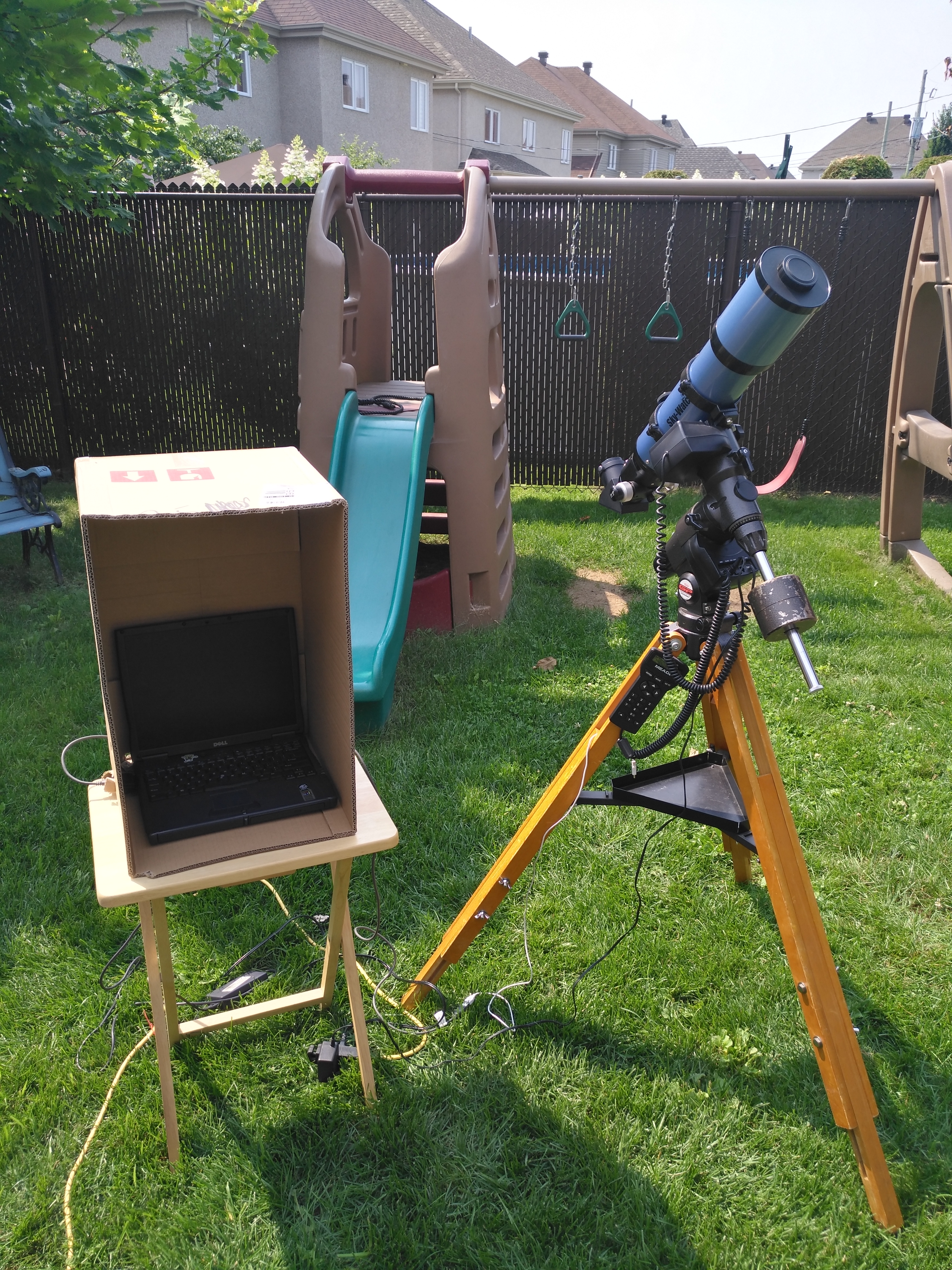
With the time approaching, I installed the telescope such that it can get up to temperature under the sun. I used an old cardboard box as a sun shield around the laptop for better viewing. I still have a good hour before it starts, so might as well have lunch and then set-up the camera.
SW80ED on Vixen GP mount.
Thin high altitude clouds and high humidity will muddy the view a bit, but other than that looking good.
For the Montreal area the maximum coverage will be 58%.
With a week left before the August 21st solar eclipse, some of you may be scrambling to find eclipse viewers to safely view the event. Stores appear to be running out of the necessary viewers and ordering online may not make it in your hands on time. Also there are reports of poor and unsafe gear being sold on the internet, so do the proper research before ordering. Both NASA and the American Astronomical Society (AAS) only recognize five manufacturers as meeting the necessary ISO standards for solar safety film, these are: Rainbow Symphony, American Paper Optics, Thousand Oaks Optical, TSE 17 and Baader Planetarium.
July/August SkyNews – includes eclipse viewer
One way to get your hands on eclipse viewers is to find a copy of the July/August SkyNews magazine. The issue not only has great articles how to prepare, observer and photograph the eclipse, but it comes with a free eclipse viewer.
Alternatively you can join one of the observation parties hosted by astronomy clubs, colleges, museums or stores. Here is a list from the Royal Astronomical Society of Canada of cities hosting observing events.
Yesterday, even if I’m located in the light polluted Montreal suburb, I decided to head out at quarter to midnight to see if I could by chance spot one or two bright meteors from the Perseids shower. As luck would have it in the 15 minutes doesn’t looking around Cassiopeia I spotted two before clouds and a rising moon sent me indoors.
But during that time scanning and waiting, it got me thinking… It took me a good minute to find a suitable spot in my backyard free of the light from the neighbours’ houses and street lights. If there was less light pollution we could have darker skies and everyone could enjoy the show.
During Earth Hour people are asked to turn off the lights for one hour to support the fight for climate change. But I always found that pretty pointless. If you want to fight climate change, it’s an every day affaire, in your daily routine and the choices you have as a consumer, not one hour in an entire year. So the one hour lights out is more of a gimmick, doesn’t really benefit anyone. But if we had an evening of lights out during the peak of the Perseids meteor shower wouldn’t that be great!
The Perseids falls in August when it’s warm and sitting outside past sunset in the cooling air is enjoyable. Kids don’t have school so they can stay up late. And the patio furniture is out, that’s all the required equipment.
So what do you say? Light out for the 2018 Perseids? I think that’s a worthwhile collective movement.
The Perseid meteor shower is scheduled to peak tonight, but a large Moon will ruin the show. The best time is tonight (August 12) after 11pm, looking north-east.
While the sky directly overhead may look darker, it’s better to look 45degrees over the horizon to see a thicker “slice” of the atmosphere.
I have to say with the wet and cloudy weather in the past two to three months I haven’t taken the telescope out for quite some time. The high humidity often produces clouds in the evening and into the night as the air cools. And with the wet spring and early summer, the mosquitoes are rather annoying.
Therefore I haven’t been actively taking part in my backyard astronomy hobby. However a few days ago, I noticed a crescent Moon through thin clouds, and what I thought to be Venus just below. Grabbed the camera and took a few photos at ISO 800 66mm F5.6 1/4sec to see what type of result I could get with that. I have to say it was hard to find the right setting, and my car’s roof was a poor tripod.
The photo below really doesn’t capture the range and subtle gradients in direct and diffused light around the Moon and the clouds, contrasting with the pin-point bright planet.
It was only a few days later when I downloaded the images on the computer and checked to confirm the planet that I was surprised that the it was Jupiter shinning so brightly.
Welcome to a journey into our Universe with Dr Dave, amateur astronomer and astrophotographer for over 40 years. Astro-imaging, image processing, space science, solar astronomy and public outreach are some of the stops in this journey!

 Mars and Mercury will be closest on the 16th, while the 18th will probably be the most photogenic as the Moon will be a thin crescent in the middle of this alignment.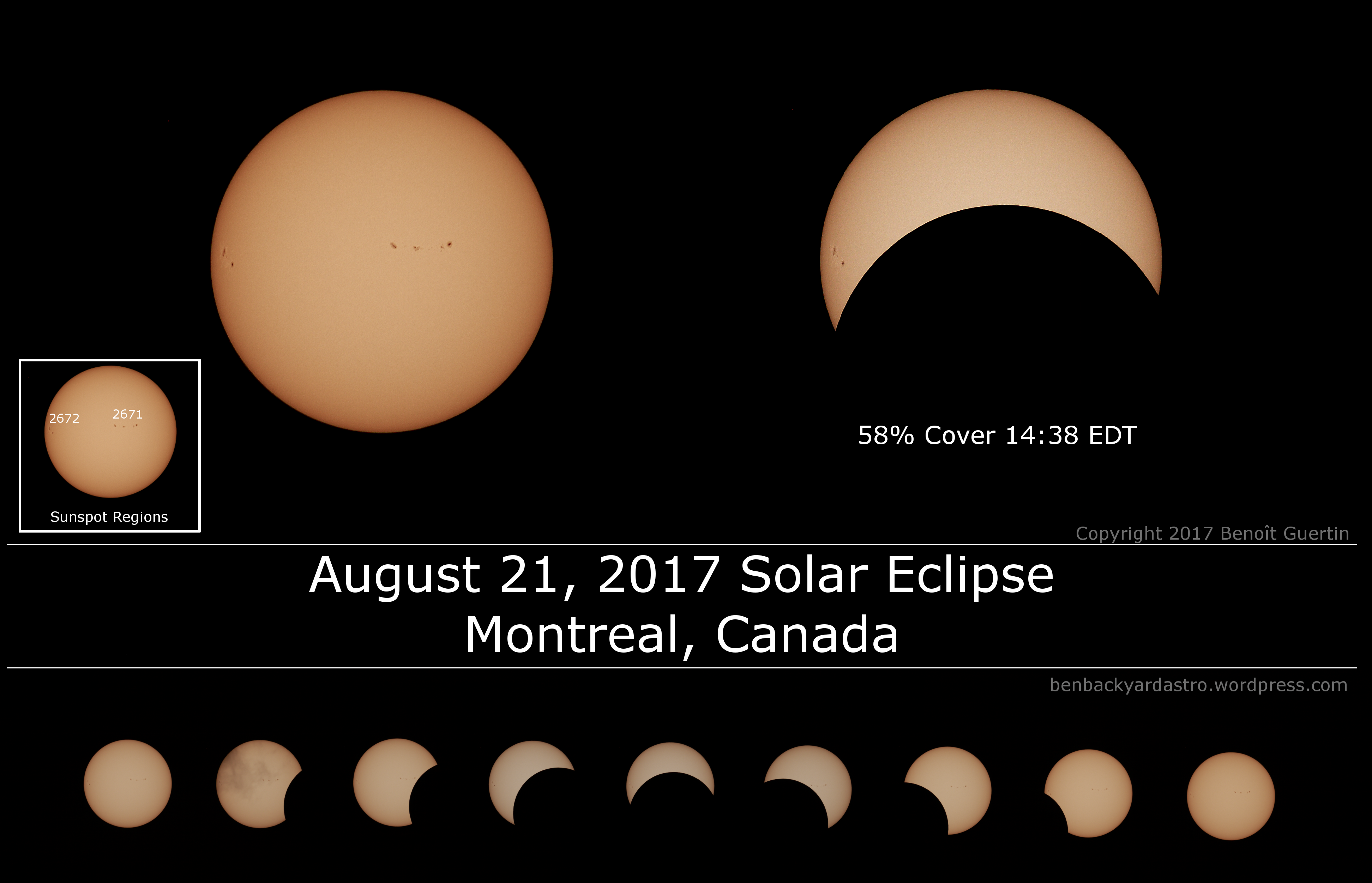






 Ben Backyard Astronomy