JunoCam – Revealing Jupiter from New Angles

JunoCam onboard the Juno spacecraft is providing us with some great pictures of the Jupiter cloud top, but from the rarely seen polar angle.  Pretty much all spacecrafts that have visited Jupiter did so with a fly by along the equatorial plane, which is also the same plane we observe Jupiter here on Earth.  However with the Juno spacecraft, we now have a chance to enter into a polar orbit and take pictures of the polar regions.

Part of the reason behind JunoCam is to get the amateur astronomer community participating in selecting what parts of Jupiter the camera should be snapping pictures, and of processing the raw images.  The image below was captured by JunoCam during Juno’s 3rd swing around Jupiter at a distance of about 37,000km.  The south polar region is on the left.

Jupiter - December 11, 2016 JunoCam - Juno Spacecraft

NASA, JPL-Caltech, SwRI, MSSS; Processing: Damian Peach

The above was the PeriJove3 encounter (3rd pass), and voting on the next PeriJove4 will take place between January 19th and 23rd 2017.  This is where the community can propose and vote for Points of Interest to photograph with JunoCam during the rather quick (2 hours) close pass with Juno.  You can even submit images of Jupiter taken with your equipment to help plan the Points of Interest.

Ref: JunoMission

Link

TIME  magazine has released what their editors consider the best space photos of 2016.

P Crowther, University of Sheffield/NASA/ESA

http://time.com/4510266/best-space-photos-2016
Ref: TIME

NASA Juno Mission Trailer: JOI

Video

Space-thriller themed mission trailer

Secrets lie deep within Jupiter, shrouded in the solar system’s strongest magnetic field and most lethal radiation belts. On July 4, 2016, NASA’s Juno spacecraft will plunge into uncharted territory, entering orbit around the gas giant and passing closer than any spacecraft before. Juno will see Jupiter for what it really is, but first it must pass the trial of orbit insertion. For more information: http://www.nasa.gov/juno and http://missionjuno.swri.edu

Backyard Astronomers Capture Impact on Jupiter

Video

With Earth having passed between Jupiter and the Sun on March 8th, we have some of the finest observations of the Jovian planet.  It’s only normal to have a few backyard astronomers setting their sights on the largest planet (myself included, still got unprocessed videos from March 27th).  However Gerrit Kernbauer was lucky enough to record an unusual event: something slammed into Jupiter!

Phil Plait of Bad Astronomy reported that Gerrit Kernbauer with his 20cm telescope in Austria, captured on March 17th what appeared to be an impact of sort.

The issue was to confirm that it was an actual impact, and not some other natural effect or electronic noise in his setup.  What better than to have a second independent observation, and that came from John McKeon with a 28cm telescope in Ireland.

Maybe I should go take a look at my videos on Jupiter from March 27th just in case…  Actually with my 80mm telescope,  I don’t think it would have picked up such an impact.

[SLATE]

Closest Comet in 246 Years

Status

Benoit Guertin's avatar

There’s a good article in Sky & Telescope on comets 252P/LINEAR and the smaller fragment P/2016 BA14, explaining observation opportunities.  A comet hasn’t passed this close to Earth in 246 years.   And as it does the wonderful green halo around 252P/LINEAR  is sure to grow but will probably remain around magnitude 6.

As the comet flies by Earth it will sweep through the constellations quickly and then fade back to below magnitude 12 in short order.  Therefore try not to miss it.

ExoMars March 14th Lift Off, The Sign of a Earth-Mars Close Approach?

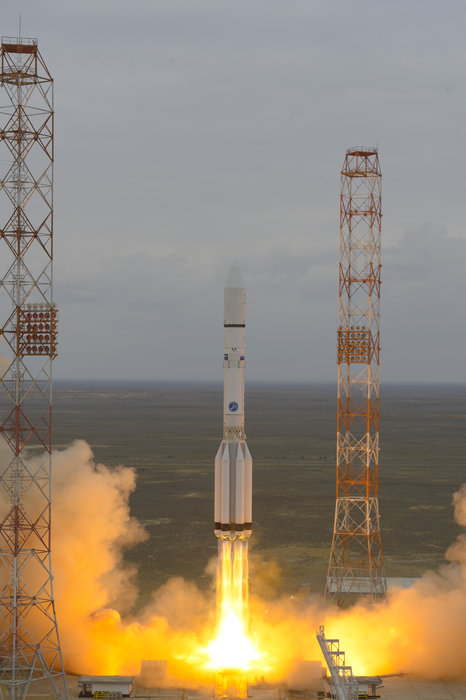
In the early in the morning of March 14th, 2016, a joint EASA-Roscosmos mission blasted off from Kazakhstan on top of a Proton launch vehicle.  The space vehicle will take 7 months traveling through space before arriving to Mars around October 19th.  The mission is actually composed of two vehicles, which will separate 3 days prior to the Mars arrival: Trace Gas Orbiter (TGO) and Schiaparelli, the later entering the martian atmosphere and landing on the surface.

ExoMars 2016 Launch campaign

ESA–Stephane Corvaja, 2016

I wondered if the launch signaled an upcoming Earth-Mars close approach.  A space program wanting to reach Mars on a budget would select a launch date at a time when both planets are at their closest to reduce the fuel required, and time spent traveling through space.  Sure enough, the next Earth-Mars close approach is May 30, 2016, a few days after opposition of May 22nd.  An upcoming great opportunity to turn the telescope to Mars and hopefully capture some of the planet’s features.  Mars’ angular size varies from as little as 3.5″ to an easy observing 25.1″ which is quite dramatic.

Earth-Mars close approach happen roughly every 26 months, and often coincide to Mars missions launches.  The following list from NASA of recent Mars mission launches show a lovely two year interval.

2001:      Mars Odyssey
2003:      Mars Exploration Rovers
2005:      Mars Reconnaissance Orbiter
2007:      Mars Phoenix Lander
2009:      (skipped opportunity)
2011:      Mars Science Laboratory/Curiosity Rover
2013:      MAVEN

The last one in 2013 was in November, hence a Mars 2016, 28 months later falls within that window of opportunity.  The ExoMars program actually has two space vehicles.  The next one is planned for… you guessed it 26 months later: May 2018 launch.

Sources:
[EASA] [NASA]

New Years Eve Aurora Borealis

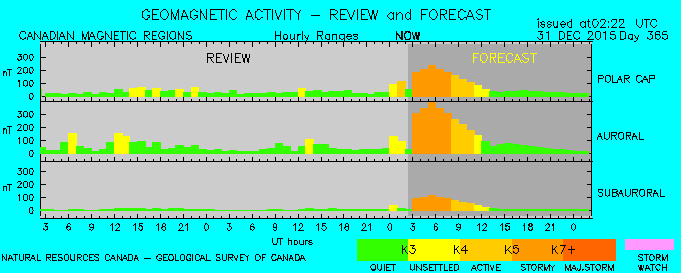
After the Christmas Full Moon, our beloved Sun has unleashed a CME (coronal mass ejection) towards Earth on December 28th, and those charged particles are predicted to reach us on the 31st (NOAA predicts G3-Strong Geomagnetic Storm).  Below is the snap-shot of the past and forecasted geomagnetic activity from Natural Resources Canada as provided at 9:22pm EST.

Geomagnetic Activity Review and Forecast 31Dec2015

Geomagnetic Activity Review and Forecast 31Dec2015 – Canada.ca

Based on their prediction model the peak of the activity will happen the night of 30th to 31st.  Therefore if you live outside of the city and in northern latitudes (north of 50 degrees latitude) you may be surprised by a wonderful light show tonight and tomorrow. Because Earth magnetic field is “springy” it will “ring” for some time and auroras should be present until New Year’s Eve.

Other effects that you may notice is larger GPS errors or longer time to get a “lock”.  Mobile phones won’t be affected by this type of storm.  You need a snow storm to affect your mobile phone signal.  Snow flakes are just the right size and their density in the sky to scatter the signals in the frequency range used by mobile phones.

2015 in review

The WordPress.com stats helper monkeys prepared a 2015 annual report for this blog.

Here’s an excerpt:

A San Francisco cable car holds 60 people. This blog was viewed about 2,200 times in 2015. If it were a cable car, it would take about 37 trips to carry that many people.

Click here to see the complete report.

The Sun in Like You’ve Never Seen Before

Video

A few weeks ago NASA released a video in stunning 4K quality showcasing some of the sharpest and most detailed views of the Sun at different wavelengths. These images were captured by NASA’S Solar Dynamic Observatory launched in space in 2010.

As stated in the introduction,  each minute of video takes 10hrs in the hands of specialists to process. Not too bad considering that I’ve sometimes spent hours to produce a single image.

Reference :NASA

Missile Launch Over San Francisco – Not Astronomy, but Cool Results

Video

Not a UFO!  Last weekend the US Navy launched a Trident II D5 strategic ballistic missile from USS Kentucky (a Ohio class SSNB) off the southern coast of California.  Justin Majeczky and a friend were lucky enough to be shooting a time-lapse video over the Golden Gate bridge when they noticed the missile launch.

https://vimeo.com/145029572

While not an astronomy target, capturing missile or rocket launches, especially at night lends itself very well to astro-photo gear, setup and software.  And nighttime launches often provide nice results, especially after sunset as the exhaust plume reflects sunlight high up on the atmosphere.  Can also trigger the formation of noctilucent clouds.

If you live in near a spaceport, or near a naval war exercise, tracking and capturing a missile or rocket launch with your gear can be rewarding.