Weekend Observation Opportunity: Venus and the Pleiades

There is a great weekend observation and photo opportunity as Venus is passing within a few degrees of the Pleiades open star cluster (Messier 45).  You won’t need a sky chart for this one, simply look West in the evening and Venus should be easily spotted as the brightest point in the sky.  The Pleiades can be observed without any instruments, but if you have binoculars you’ll better appreciate this open star cluster also called Seven Sisters.

A camera and a tripod?  Why not!  Try different settings to see which one give you the best results.

Around April 10th, Venus will pass within 2deg of the Pleiades (Messier 45)

Around April 10th, Venus will pass within 2deg of the Pleiades (Messier 45)

While you are checking out that part of the sky, scan 40 degrees towards the South (to the left) and you’ll find the Hunter constellation (Orion) also great to look at and photograph.  Take the time to observe the colour of the stars, from the red supergiant Betelgeuse to the blue supergiant Rigel, the two brightest stars in Orion.

These two constellation (Taurus and Orion) will set around midnight, therefore they will be low over the horizon (20deg above horizon at 9pm local time).
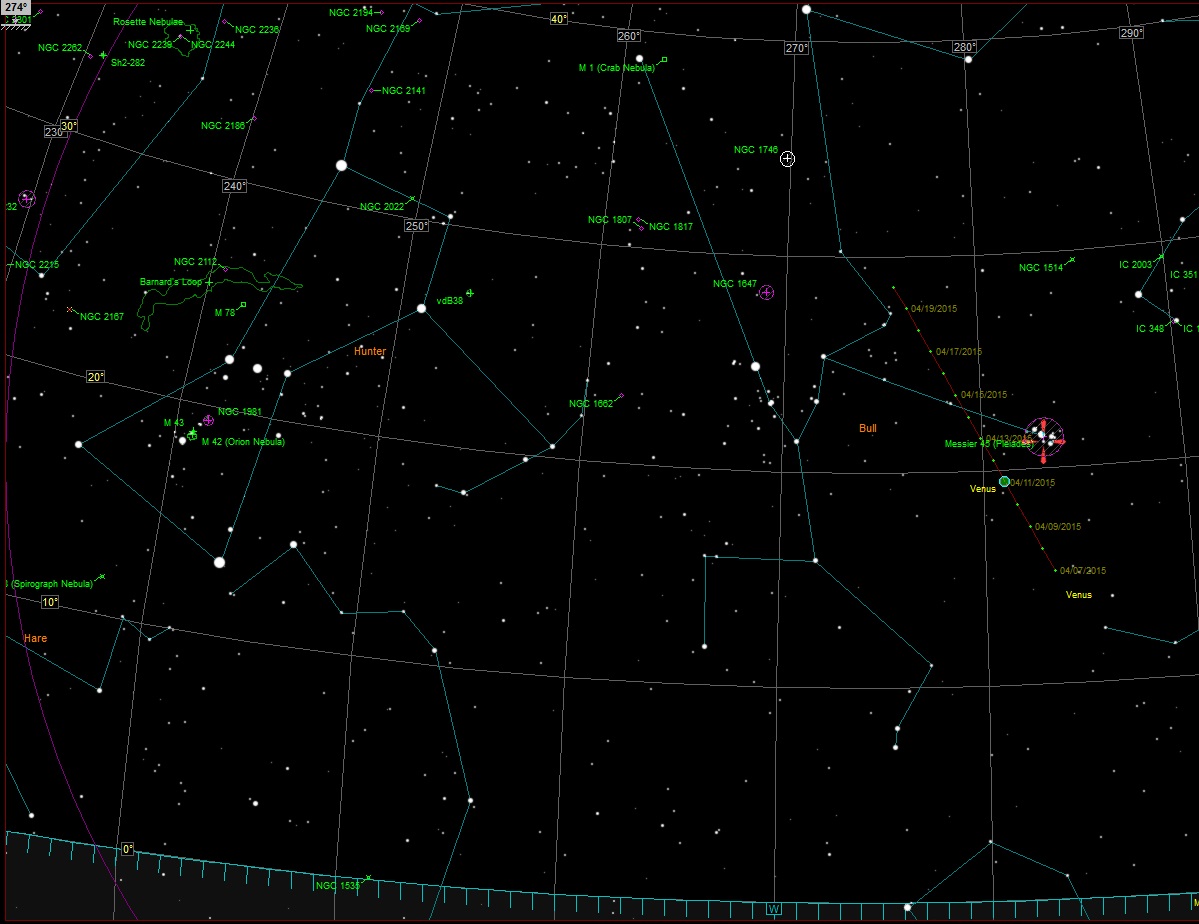
April 10, 2015 - Orion and Taurus Constellations

April 10, 2015 – Orion and Taurus Constellations

Link

Missing the April 4th lunar eclipse?  No problem, NASA has posted on YouTube the entire event, all 45 minutes.

Skywatcher StarGate 18 Truss Dobson

With the new Sky-Watcher StarGate 18, large scopes for all!

Dobsons are great “bang for the buck” with their quick setup, simple optics and ease of use.  An 8″ Dobson should be everyone’s first telescope; not too big, not to expensive, but with great capability and endlessly upgradeable.  Didn’t listen to that bit of wisdom… and now realize my mistake.  But one of the drawbacks with Newtonians is that as you seek to dive deeper into space by increasing the telescope size, you quickly reach a point where the optical tube becomes too big to transport.  One way to get around this issue is to have a “collapsible” optical tube by using a truss design.

When Meade launched the LightBridge series back in 2008 it brought this great concept to everyone’s doorstep.  But the largest offered was a 16″ and weighted in a 130 lbs assembled.  Going bigger was out of the question.  But now Sky-Watcher has addressed the weight issue with a great design and a good choice of materials.  The StarGate 18 weighs in at 110 lbs and looks great!

Sky-Watcher StarGate 18

Sky-Watcher StarGate 18

The optics are standard F4 Newtonian design: 458mm diameter and 1900mm focal length.  The primary mirror is not solid, but designed with ribs to allow for a thinner (and lighter) design, while maintaining rigidity. Even the secondary mirror has cells carved out to reduce weight.  The tubes use quick-assembly clamps and Sky-Watcher claims a setup time under 30 minutes.

The rocker-designed base with counter weight is a very nice touch, everything sliding on Teflon bearings.

OK the $7,300CAD price means it’s not for everyone, but when one considers that a similar sized Ritchey-Chretien astrograph will be over 5x the price, and you still have to find a suitable EQ mount for it, it’s a bargain.

Source: Sky-Watcher

It’s GO for the Thirty Meter Telescope (TMT)

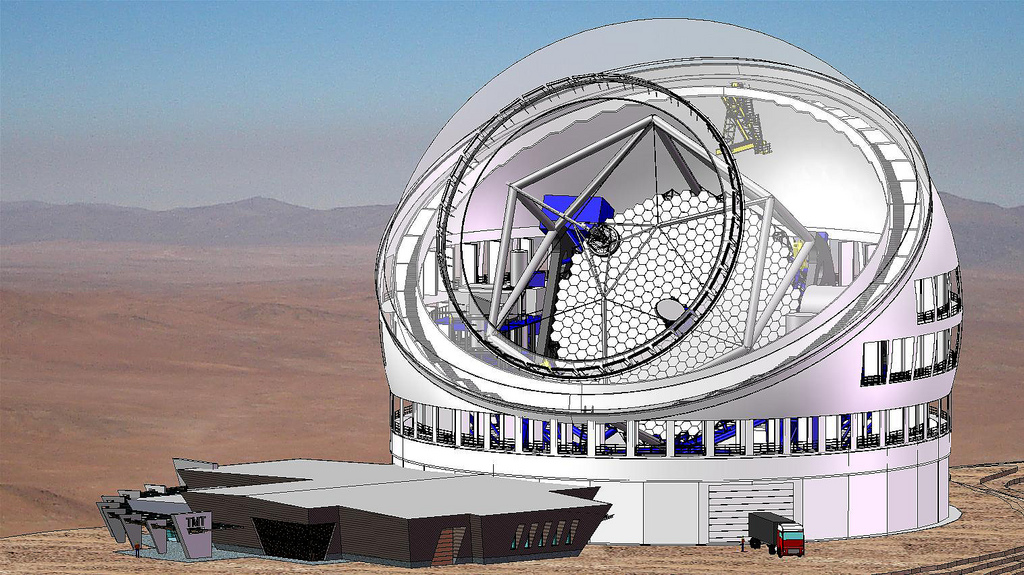
We all have aperture fever, not just us crazy backyard astronomers, and with the latest announcement from the Canadian Government to provide nearly $250 million over 10 years, we should see the TMT operational in 2023-2024.  When completed it will be the largest telescope, until the Europeans have their European Extremely Large Telescope (E-ELT), also set for first light in 2024.

Thirty Meter Telescope - Courtesy TMT International Observatory

Thirty Meter Telescope – Courtesy TMT International Observatory

The telescope optical design is a folded Ritchey-Chrétien. Both the primary and secondary mirrors are hyperboloidal, and together they form a well-corrected focus. The tertiary mirror is used to fold and steer the light path so that the science beam can be delivered to any of eight instruments that will be mounted on the two main Nasmyth platfoms. The image is formed 20 meters from the center of the tertiary mirror. The focal ratio of the telescope is f/15.

The field of view of the telescope is 15 arc minutes (fully illuminated), or 20 arc minutes with slight vignetting at the edges of the field. At f/15, the focal length of TMT is 450 meters (1476 feet)! This means that the 20 arc minute field of view measures 2.618 meters (8.6 feet) in diameter.

The primary mirror focal ratio is f/1. This short focal ratio was chosen to make the telescope compact, which helps to keep the telescope structure and the enclosure affordable. As the name implies, the primary mirror is 30 meters (98 feet) in diameter, and because it is f/1 it has a focal length of 30 meters.

Current king of the largest light-bucket is the 10.4m diameter Gran Telescopio Canarias.  Therefore the 30m TMT and the 39m E-ELT will be a considerable gain in light gathering power over the current crop of telescopes.  Some are predicting that scientists will be able to directly observe planets orbiting distance stars, and perhaps even see distant oceans and weather formations.

It’s always intrigued me how we spend so much on EQ mounts, when these large telescopes operate in a simpler Alt-Az configuration.

Sources: CBC, TMT