JunoCam – Revealing Jupiter from New Angles

JunoCam onboard the Juno spacecraft is providing us with some great pictures of the Jupiter cloud top, but from the rarely seen polar angle.  Pretty much all spacecrafts that have visited Jupiter did so with a fly by along the equatorial plane, which is also the same plane we observe Jupiter here on Earth.  However with the Juno spacecraft, we now have a chance to enter into a polar orbit and take pictures of the polar regions.

Part of the reason behind JunoCam is to get the amateur astronomer community participating in selecting what parts of Jupiter the camera should be snapping pictures, and of processing the raw images.  The image below was captured by JunoCam during Juno’s 3rd swing around Jupiter at a distance of about 37,000km.  The south polar region is on the left.

Jupiter - December 11, 2016 JunoCam - Juno Spacecraft

NASA, JPL-Caltech, SwRI, MSSS; Processing: Damian Peach

The above was the PeriJove3 encounter (3rd pass), and voting on the next PeriJove4 will take place between January 19th and 23rd 2017.  This is where the community can propose and vote for Points of Interest to photograph with JunoCam during the rather quick (2 hours) close pass with Juno.  You can even submit images of Jupiter taken with your equipment to help plan the Points of Interest.

Ref: JunoMission

Link

TIME  magazine has released what their editors consider the best space photos of 2016.

P Crowther, University of Sheffield/NASA/ESA

http://time.com/4510266/best-space-photos-2016
Ref: TIME

Rosetta spacecraft’s last few days

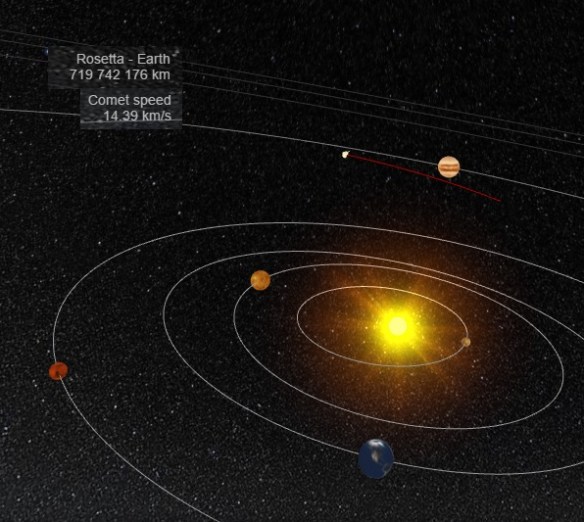
After over 12 years Rosetta will be decommissioned by sending it down to impact with comet 67P/C-G.  This fate was decided as the comet is moving away from the sun, beyond the orbit of Jupiter and the solar panels will not generate enough power to keep the spacecraft operational.  Even “hibernation” is not a possibility as heaters are still required to keep the critical systems idling.  Hence mission control will send commands in the next few days such that on September 29th a series of maneuvers will send it on a impact trajectory with the comet.  As the comet’s gravity is rather weak (1/10,000 of Earth’s) it will most likely not be a fatal impact.  However the Rosetta will be instructed to shutdown upon contact with the surface in order not to “pollute” the deep space communication network with spurious and uncommanded signals.  This is expected to happen on September 30th 10:40 GMT.

So where is comet 67P/C-G?  Travelling towards the orbit of Jupiter, in constellation Virgo, opposite to the sun from Earth’s perspective.  Normally an event like this would be timed to be observable at night from Earth such that telescopes can gather scientific data.  But at apparent magnitude 20 (to compare, Pluto has a mean apparent magnitude of 15) it will be very difficult to observe.  And the impact is not expected to generate a large plume of dust.  Therefore it will be up to Rosetta to record and beam back to Earth as much data during the descent before shutting down for good.

Rosetta and comet 67P/C-G position on September 30th

Rosetta and comet 67P/C-G position on September 30th

Reference: ESA