Auriga and Its Three Bright Open Clusters

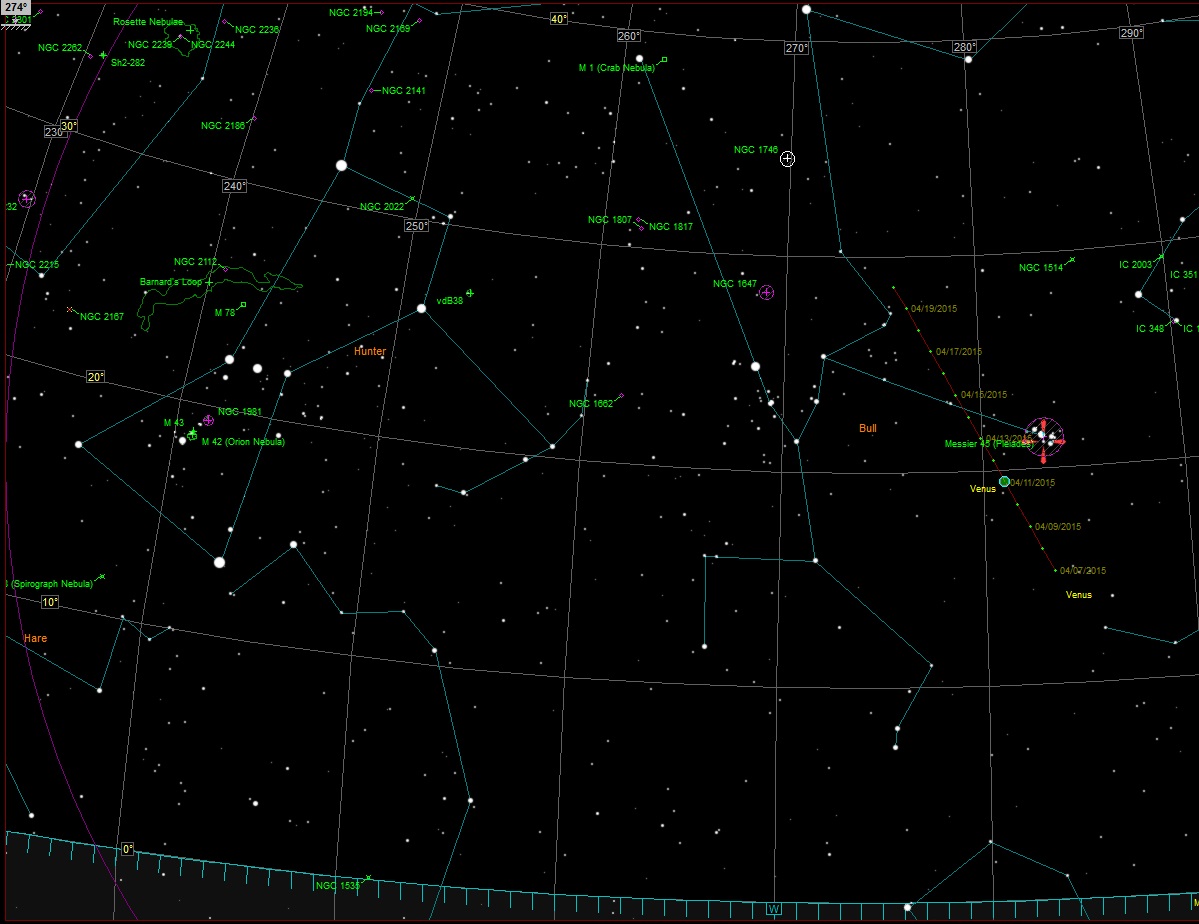
An easy target for anyone is the constellation Auriga and it’s three bright open star clusters.  It may be considered a winter constellation, but there is still plenty of time for some decent observation.  In the early April evenings , Auriga lies west about 45 degrees over the horizon.  It’s brightest star, Capella,  the sixth brightest in the night sky can easily be located.  Therefore these open clusters are easy targets for a quick star-hopping observation for anyone with a small telescope or binoculars.
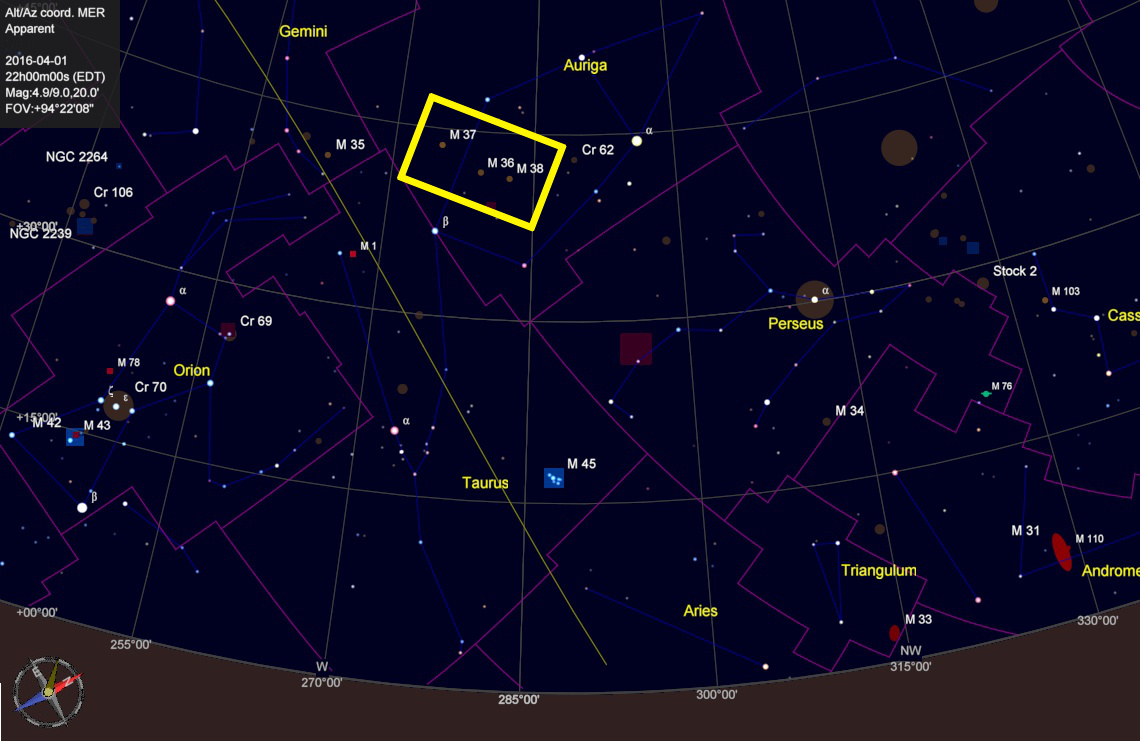
Auriga in April with three bright open clusters (boxed)

Auriga in April with three bright open clusters (boxed)

My last few posts have been the photos that I’ve captured of these three Messier objects: M36, M37 and M38.  Below is a view if the boxed area from above but with the photos of the open clusters inserted at their correct location.

M37, M36 and M38 (respectively) in Auriga

M37, M36 and M38 (respectively) in Auriga

To see larger images of the open clusters, refer to my following blogs:

Messier 36 – Open Cluster in Auriga
Messier 37 – Brightest Open Cluster in Auriga
Messier 38 and NGC1907 – Open Clusters in Auriga


Messier 37 – Brightest Open Cluster in Auriga

Image

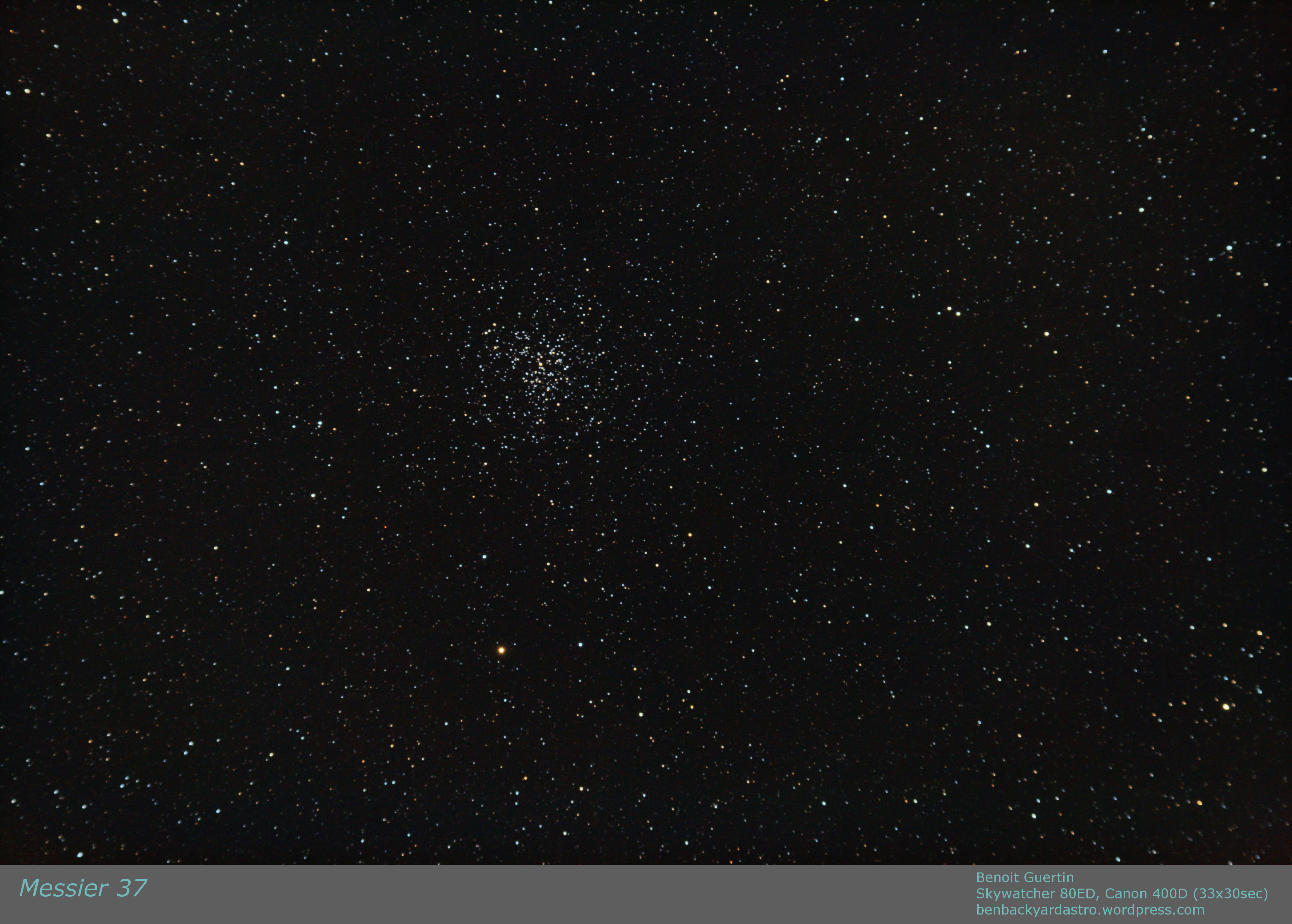
A few weeks ago I spent some time imaging the three bright open clusters in Auriga.  After Messier 36 and 38, I now bring you Messier 37.

Surveys indicated the cluster contains about 1,500 solar masses and about 500 identified stars.  As with M36 and M38 it is located about 4,500 light years from Earth.

Messier 37 - Open Cluster in Auriga

Messier 37 – Open Cluster in Auriga – Benoit Guertin

Large research telescopes often have too narrow field of view to capture open star clusters.  This is where us backyard astronomers with our gear can shine.

Skywatcher 80ED
Canon 400D
33 x 30sec (ISO 800)

Messier 38 and NGC1907 – Open Clusters in Auriga

Image

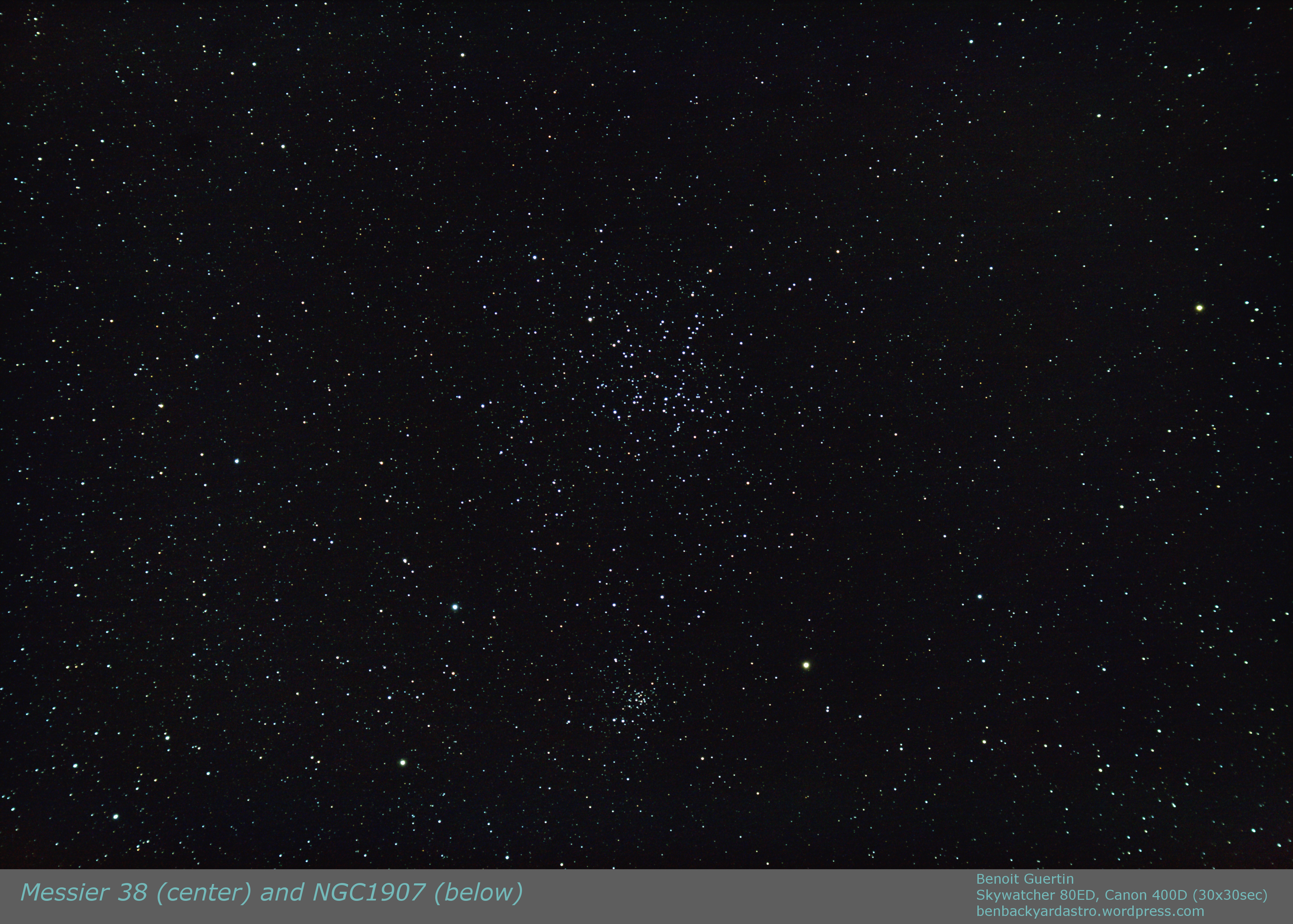
Following my previous post on Messier 36, a simple 2 degree slew of the telescope and I was centered on Messier 38 (NGC1912).  This open cluster measures 21 light years across ( 21′ apparent) or twice the size of M36.  It is also much older than M36 which is why you’ll find less hot blue stars within the group if you compare with M36.

Just half a degree below is an older and smaller open cluster NGC1907.  While some have speculated that they are locked together (a binary cluster?) this cluster is 500 million years old, almost twice the age of M38, hence were formed at different periods and most likely from different molecular gas.  This is just a chanced fly-by with no interactions.

Open Clusters Messier 38 and NGC1907

Open Clusters Messier 38 and NGC1907

Skywatcher 80ED
Canon Digital Rebel XTi (400D)
30 x 30sec (ISO 800)
Registration with IRIS
Post-Processing with GIMP

Messier 36 – Open Cluster in Auriga

Image

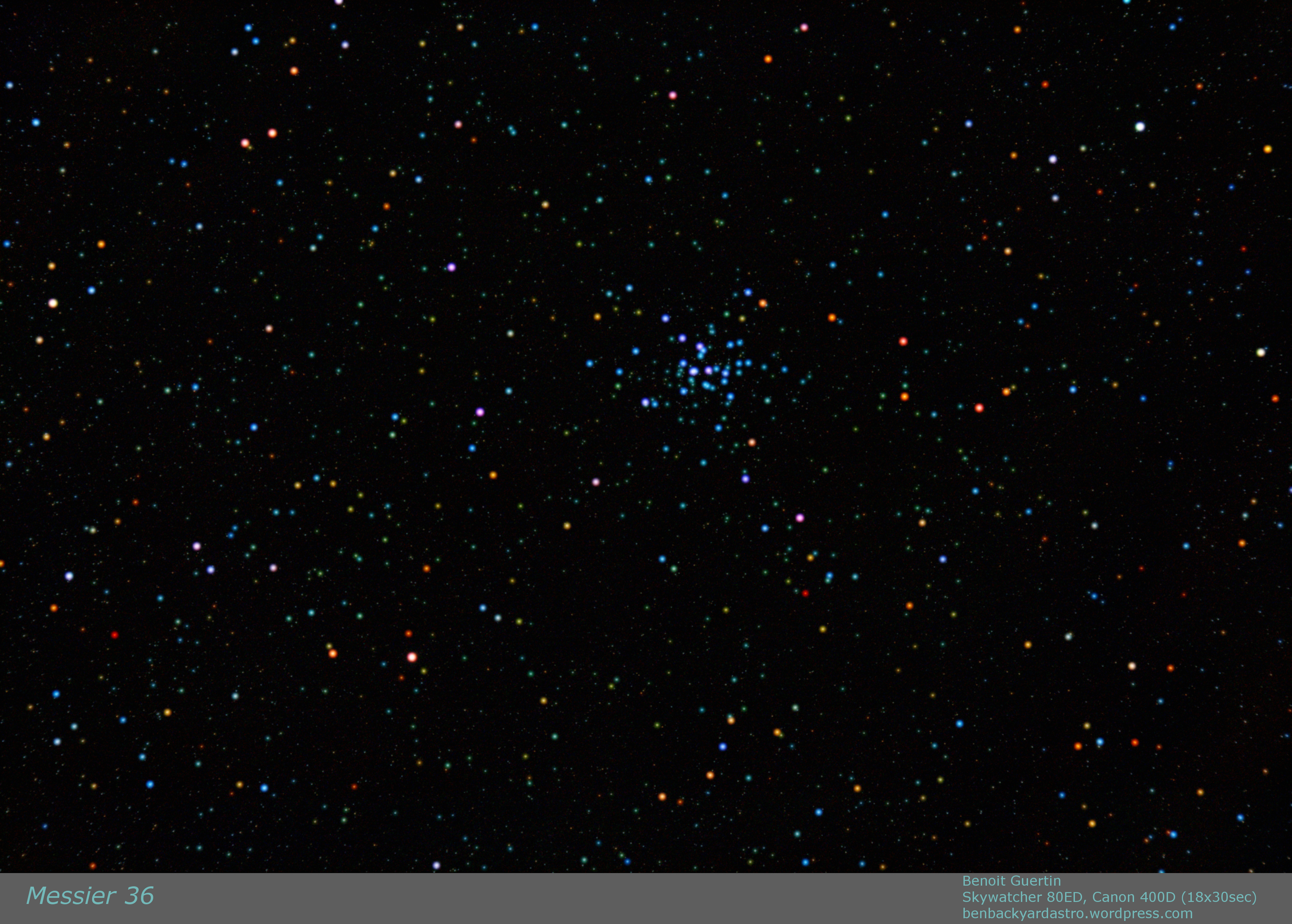
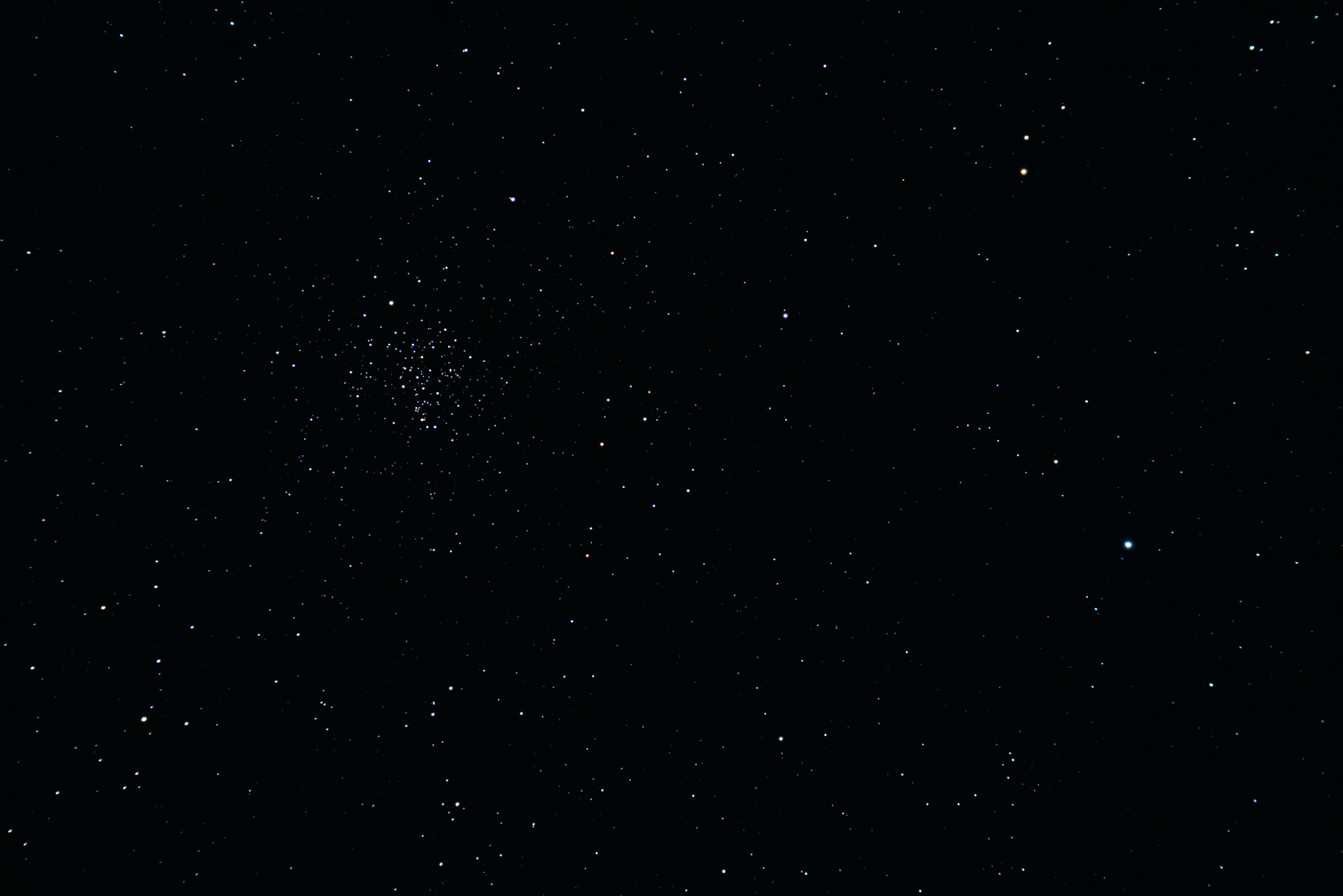
Open Cluster Messier 36 (NGC 1960) is located in the Auriga constellation.  Located about 4,100 light years from Earth, and 14 light years across, it has at least 60 members.  It is very similar to the Pleiades (M45) and if M36 was at the same distance (M45 is 10 times closer) it would be of similar magnitude.  Two other open clusters from Messier’s catalog are located nearby: M37 and M38.  The stars in the cluster are of spectral type B2, and fairly young: 25 million years.

Open Cluster Messier 36. Skywatcher 80ED, Canon 400D 18x30sec

Open Cluster Messier 36. Skywatcher 80ED, Canon 400D 18x30sec

The blue-ish stars contrast with the older yellow and orange stars in the background.  This can be further enhanced by using the SBLUR function in IRIS to selectively blur and enhance the colors of bright stars.  While the colors are exaggerated in the image below, it is nevertheless interesting to see the vast diversity of stars and their color.

Open Cluster Messier 36. Skywatcher 80ED, Canon 400D 18x30sec

Open Cluster Messier 36. Skywatcher 80ED, Canon 400D 18x30sec (SBLUR for colour)

Telescope: Skywatcher 80ED
Camera: Canon Digital Rebel XTi (400D)
Exposure: 18 x 30sec (ISO 800)
Date: 18Mar2016

Faint Images of Galaxies M95 and M96

Image

Galaxies are always a challenge… Imaging objects such as nebulas within our galaxy is much better suited to my small telescope.  At 700mm focal length, galaxies over 30 million light years away are rather small and lack detail.  Nevertheless this is my go at Messier 95 and 96 in the constellation of the Lion.

These galaxies were discovered by Pierre Méchain in 1781 with a 12in telescope, nearly 4 times the size of mine.

Galaxies Messier 95 and 96 - Benoit Guertin

Galaxies Messier 95 and 96 – Benoit Guertin

The image was scaled to 30% and I’ve added insets of the galaxies.

Telescope: Sky-Watcher 80ED
Camera: Canon XTi (ISO 400)
Image: 30 x 30sec

Messier 67 – Open Cluster

Image

On the same night that I imaged Messier 44 I decided to hop over to another nearby open cluster: Messier 67.  While M44 appears three times larger, both of these open clusters are estimated to be of roughly the same size, but M67 happens to be 5 to 6 times farther away.

Click on the image to get the full image, it’s scaled and cropped below.

Open Cluster Messier 67 Benoit Guertin

Open Cluster Messier 67
Benoit Guertin

Telescope: Sky-Watcher 80ED
Camera: Canon XTi (ISO 400)
Image: 19 x 30sec

Messier 44 – Beehive Cluster

Image

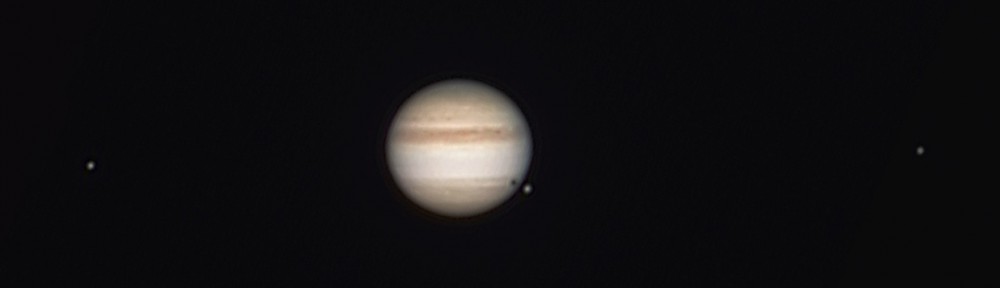
A few days ago after taking some video of Jupiter with a modified webcam, I slewed over to the open cluster Messier 44 also known as the Beehive Cluster and changed over to the Canon XTi to take some long exposures.

Below is the result of stacking 20 x 30sec exposures at ISO 400.

Messier 44 - Open Cluster Benoit Guertin

Messier 44 – Open Cluster
Benoit Guertin

Telescope: Sky-Watcher 80ED
Camera: Canon XTi – ISO 400
Image: 20 x 30sec

Weekend Observation Opportunity: Venus and the Pleiades

There is a great weekend observation and photo opportunity as Venus is passing within a few degrees of the Pleiades open star cluster (Messier 45).  You won’t need a sky chart for this one, simply look West in the evening and Venus should be easily spotted as the brightest point in the sky.  The Pleiades can be observed without any instruments, but if you have binoculars you’ll better appreciate this open star cluster also called Seven Sisters.

A camera and a tripod?  Why not!  Try different settings to see which one give you the best results.

Around April 10th, Venus will pass within 2deg of the Pleiades (Messier 45)

Around April 10th, Venus will pass within 2deg of the Pleiades (Messier 45)

While you are checking out that part of the sky, scan 40 degrees towards the South (to the left) and you’ll find the Hunter constellation (Orion) also great to look at and photograph.  Take the time to observe the colour of the stars, from the red supergiant Betelgeuse to the blue supergiant Rigel, the two brightest stars in Orion.

These two constellation (Taurus and Orion) will set around midnight, therefore they will be low over the horizon (20deg above horizon at 9pm local time).

April 10, 2015 - Orion and Taurus Constellations

April 10, 2015 – Orion and Taurus Constellations

M57 – Ring Nebula

Image

Messier 57, also known as the Ring Nebula is an easy target with all sizes of telescopes, even large binoculars.  Conveniently located almost midway between the bright magnitude 3 stars Beta and Gamma Lyr, it’s very easy to locate.  In the wide field of view photo below, we can clearly see M57’s position with respect to the two bright stars.

Ring Nebula - Messier 57 Planetary Nebula Benoit Guertin

Ring Nebula – Messier 57 Planetary Nebula
Benoit Guertin

M57 is a small target, therefore not ideal for short focal lengths like my Skywatcher 80ED (600mm focal length).  Below is a 1.5x zoom on the nebula itself.  The digital zoom was performed by cropping and scaling the aligned sub images, prior to stacking them.

Ring Nebula - Messier 57 Planetary Nebula Benoit Guertin

Ring Nebula – Messier 57 Planetary Nebula
Benoit Guertin

Telescope: Skywatcher 80ED
Camera: Canon XTi (ISO 800)
Stacking: 21 x 25sec

Full 10Mpix photo

M13 Globular Cluster

Image

Messier 13 Globular Cluster

M13 Globular Cluster

M13 Globular Cluster – Benoit Guertin

Equipment: SW80ED, Canon XTi
Imaging: 29x15sec ISO800

The above image is a crop of the original.  In the full frame image, galaxy NGC6207 (60 million light years away) is faintly visible on the top of the image at 1 o’clock from M13.  As a reference M13 is 22,000 light years away.