Closest Comet in 246 Years

Status

Benoit Guertin's avatar

There’s a good article in Sky & Telescope on comets 252P/LINEAR and the smaller fragment P/2016 BA14, explaining observation opportunities.  A comet hasn’t passed this close to Earth in 246 years.   And as it does the wonderful green halo around 252P/LINEAR  is sure to grow but will probably remain around magnitude 6.

As the comet flies by Earth it will sweep through the constellations quickly and then fade back to below magnitude 12 in short order.  Therefore try not to miss it.

Comets to Pass Near Earth

Status

Benoit Guertin's avatar

Two comets will pass near Earth between March 21st and 23rd. Comets 252P/LINEAR and P/2016 BA14 will pass between 14 and 9 lunar orbits with the Earth.  As both comets  have similar orbits they most likely broke in two following a close encounter with a planet’s gravity.

252P/LINEAR  has surprised everyone by brightening to magnitude 6 as it was predicted to remain in the 12-14 range.  Presently accessible to folks in the southern hemisphere it will be visible to northern observers after the Earth fly-by.

ExoMars March 14th Lift Off, The Sign of a Earth-Mars Close Approach?

In the early in the morning of March 14th, 2016, a joint EASA-Roscosmos mission blasted off from Kazakhstan on top of a Proton launch vehicle.  The space vehicle will take 7 months traveling through space before arriving to Mars around October 19th.  The mission is actually composed of two vehicles, which will separate 3 days prior to the Mars arrival: Trace Gas Orbiter (TGO) and Schiaparelli, the later entering the martian atmosphere and landing on the surface.
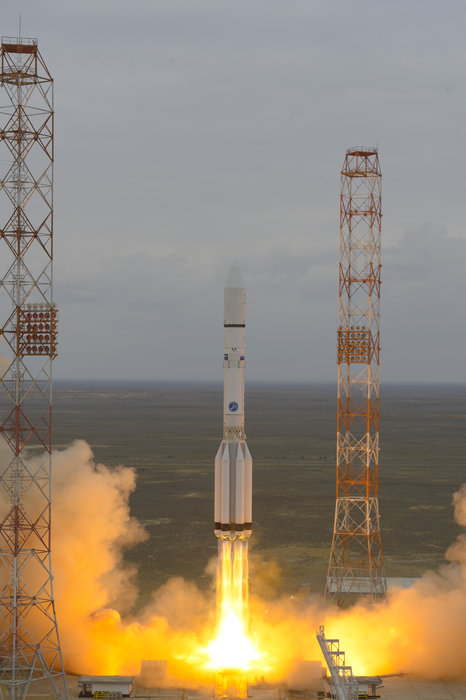
ExoMars 2016 Launch campaign

ESA–Stephane Corvaja, 2016

I wondered if the launch signaled an upcoming Earth-Mars close approach.  A space program wanting to reach Mars on a budget would select a launch date at a time when both planets are at their closest to reduce the fuel required, and time spent traveling through space.  Sure enough, the next Earth-Mars close approach is May 30, 2016, a few days after opposition of May 22nd.  An upcoming great opportunity to turn the telescope to Mars and hopefully capture some of the planet’s features.  Mars’ angular size varies from as little as 3.5″ to an easy observing 25.1″ which is quite dramatic.

Earth-Mars close approach happen roughly every 26 months, and often coincide to Mars missions launches.  The following list from NASA of recent Mars mission launches show a lovely two year interval.

2001:      Mars Odyssey
2003:      Mars Exploration Rovers
2005:      Mars Reconnaissance Orbiter
2007:      Mars Phoenix Lander
2009:      (skipped opportunity)
2011:      Mars Science Laboratory/Curiosity Rover
2013:      MAVEN

The last one in 2013 was in November, hence a Mars 2016, 28 months later falls within that window of opportunity.  The ExoMars program actually has two space vehicles.  The next one is planned for… you guessed it 26 months later: May 2018 launch.

Sources:
[EASA] [NASA]

Tripod and a Camera? Make a TimeLapse

Video

You don’t need a telescope to enjoy astro-photography.  All it takes is a camera, a tripod and a timer remote controller to take interval images without you having to be there.  I know that most of the image taking is done with the camera connected to a computer.  But this remote controller allows for control of the shutter in the BULB setting without a laptop.  See it as a “grab-n-go”, travel-light type of accessory to the camera.

Canon_tc_80n3_remote_control

Set it up to take a large sequence of shots and you got the makings of a timelapse video.  Because there is no tracking with the tripod, keep the exposures under 10 seconds.  Then use video editing software like Microsoft Movie Maker to covert all those images into a video (see my article here).

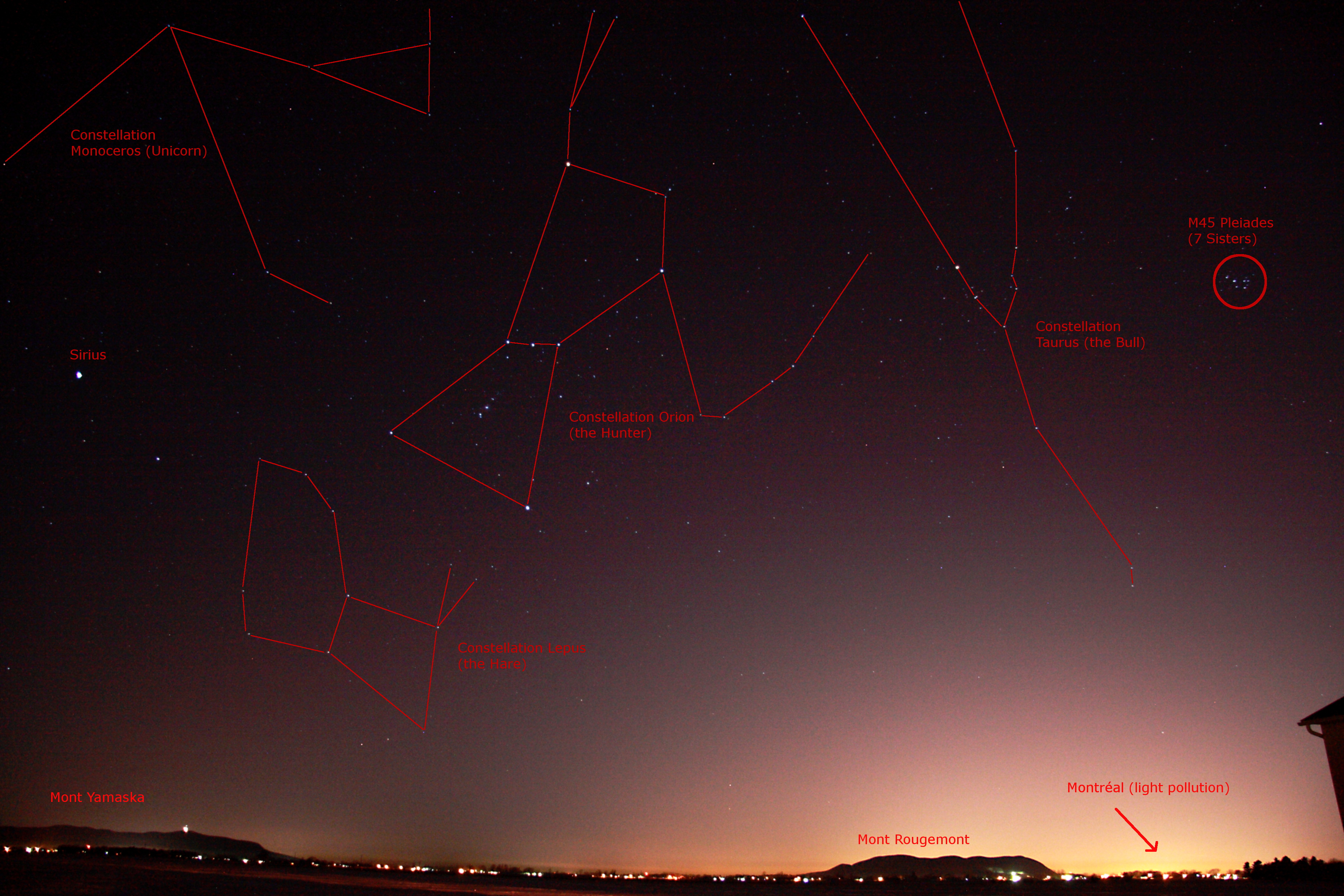
It’s always interesting to analyse your frames to determine what you’ve capture, to identify key or important elements.

Wide field of the sky, mountains and horizon from a Montreal south sore suburb. March 4th, 2016. Benoit Guertin

Wide field of the sky, mountains and horizon from a Montreal south sore suburb.
March 4th, 2016. Benoit Guertin

Unfortunately, my camera battery wasn’t fully charged, and the cold drained it quickly, therefore only got about 100 frames in.

Headlamps -Free Your Hands

As much as we avoid any type of light source when doing nighttime observations, there are moments when a bit of extra light helps locate the right eyepiece, make those small adjustments, read a sky chart or operate the laptop/camera.  For the longest time I’ve been fumbling about with a hand-held flashlight (red film equipped), often resorting to holding it in my teeth to keep my hands free.

A short while ago, while over at a friend’s observatory he handed me a headlamp for the evening.  Wow what a difference that made!  No wondering where I had left the flashlight, and both hands free when changing eyepieces, or checking sky charts.

Headlamp with white and red LED

Headlamp with white and red LED


There are plenty of models on the market, but be sure to have one that has a red night-vision mode.  The Black Diamond Spot that Santa placed under my tree can be dimmed in both in white and red light.

2015 in review

The WordPress.com stats helper monkeys prepared a 2015 annual report for this blog.

Here’s an excerpt:

A San Francisco cable car holds 60 people. This blog was viewed about 2,200 times in 2015. If it were a cable car, it would take about 37 trips to carry that many people.

Click here to see the complete report.

Christmas Full Moon of 2015

Aside

If you get up early on Christmas morning, don’t open your presents, or shake that box right away.  Head towards the window and glance west at the sky.  There over the horizon you’ll see the last full Moon of 2015.

The last time that full Moon happened on December 25th was 1977.  Disco was all the rage and “Saturday Night Fever” starring John Travolta, premiered in NYC.  So yeah, a long time ago…

I’m guessing with the full Moon to light the way, Rudolf might get a bit of a rest this year. 🙂

Observing Pluto – What Does it Take?

With New Horizons‘ flyby of Pluto and all the great images the spacecraft has been returning I’ve wondered: Is it possible to observe Pluto from one’s backyard?  Personally I’ve never bothered trying for Neptune and beyond as I knew my small 80mm aperture telescope would not be up to the task.  Nevertheless I looked up Pluto’s apparent magnitude and found that it varies between 13.6 and 16.3 due to its elliptic orbit around the Sun.  It’s last closest approach (perihelion) was September 1989, and unfortunately Pluto is currently distancing itself for its 248 year journey around the Sun therefore slowly dimming, sitting right now at apparent magnitude 14.

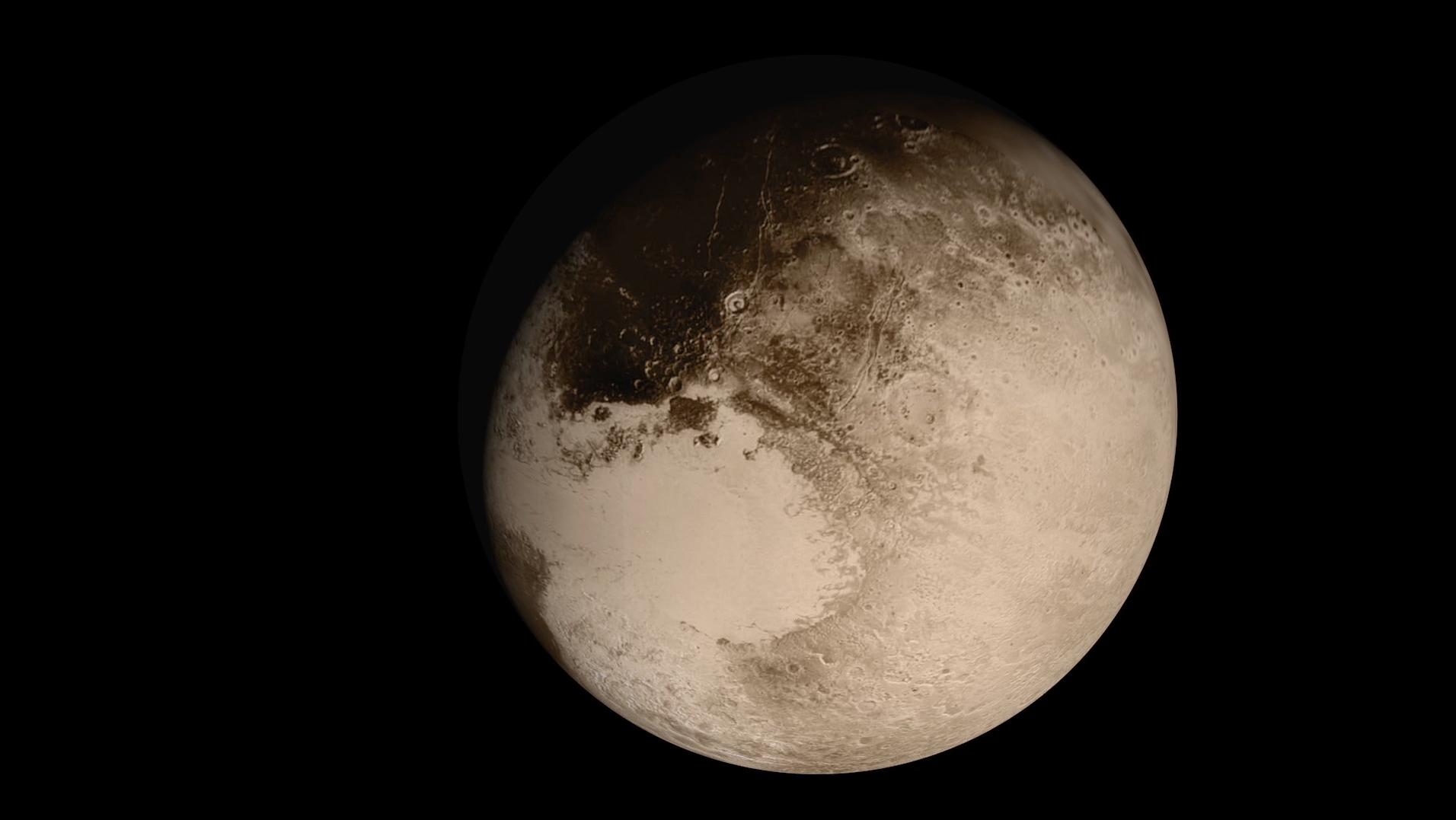
Pluto as viewed by New Horizons during flyby (14 July 2015) - NASA

Pluto as viewed by New Horizons during flyby (14 July 2015) – NASA

What size of telescope does it take to observe an apparent magnitude 14 object?  Based on the theoretical limits it should be possible to make visual observation with a 10in aperture telescope, but most would say you need a 12in if you plan to observe with an ocular.  Of course, equipped long exposure cameras you can have a smaller telescope, but a high focal length would be preferred to reduce to better pick it out from the background of stars.  And I’ve managed to pick up mag 14 stars in my photos with the Skywatcher 80ED with 60sec exposures.  Therefore Pluto should be accessible to backyard astronomy.  Note that at Pluto’s size and distance it shows up as a light point and not a sphere like the other planets.

Up to the challenge?  Middle of November will be a great opportunity to locate Pluto as it will swing within 1deg of Ksi 2 Sagittarius, a magnitude 3.5 star.  In the June edition, Sky & Telescope created a great star-chart to locate Pluto until December 2015.  Good Luck!

Click on image for Sky & Telescope Pluto 2015 Sky Chart

Click on image for Sky & Telescope Pluto 2015 Sky Chart

Reference: Sky & Telescope

Jupiter in 4k Ultra HD

Video

NASA has just released a video rendered in 4K Ultra HD of Jupiter from images captured by the Hubble Space Telescope.

Learn more about this video: http://www.nasa.gov/press-release/goddard/hubble-s-planetary-portrait-captures-new-changes-in-jupiter-s-great-red-spot