Apollo 11 and 17 Landing Sites

Image

What is the smallest detail of the lunar surface can I get with a 80mm telescope (600mm focal length) and Canon 10.1Mpixel camera?  Matching some of the smaller craters in a Moon atlas gives me roughly 6-8km/pixel.  But with image processing anything below 10km doesn’t really show or will blur in the noise.

I tagged a few geological features and dimensioned two craters for reference.  At the same time identified the approximate Apollo 11 and 17 landing sites.  The Apollo Lunar module is only 9.4m wide, hence it is impossible for any Earth bound telescope can possibly pick them up (even Hubble).  However the Lunar Reconnaissance Orbiter (LRO) did manage to pull it off by lowering its orbit as low as 50km above the lunar surface.

Apollo 11 and 17 landing sites and other features

Apollo 11 and 17 landing sites and other features. Moon (October 6th, 2016) – Benoit Guertin

My original photo of the Moon.

NASA Juno Mission Trailer: JOI

Video

Space-thriller themed mission trailer

Secrets lie deep within Jupiter, shrouded in the solar system’s strongest magnetic field and most lethal radiation belts. On July 4, 2016, NASA’s Juno spacecraft will plunge into uncharted territory, entering orbit around the gas giant and passing closer than any spacecraft before. Juno will see Jupiter for what it really is, but first it must pass the trial of orbit insertion. For more information: http://www.nasa.gov/juno and http://missionjuno.swri.edu

Sunspot 2529

Sunspots on the sun come and go.  Count them for many years and you’ll soon find out that there is an 11 year periodic cycle when the solar magnetic activity peaks.  We are presently in Solar Cycle 24 and on the tail end of the double peak of 2011 and 2014.  So why would I want a solar filter when the Sun is heading into a quiet period?

Number of sunspots observed and predicted for 1995 to 2020

Number of sunspots observed and predicted for 1995 to 2020

Well, just because the number of sunspots goes down doesn’t mean that there’s not good some great observing opportunities.  Sunspot 2529 provided that perfect occasion to finally try out my new solar filter.
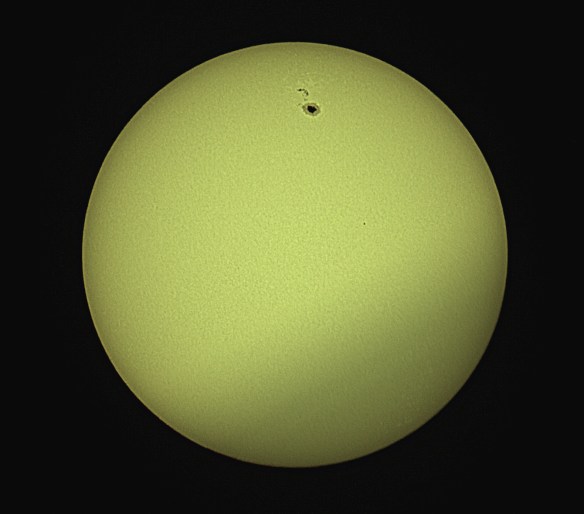
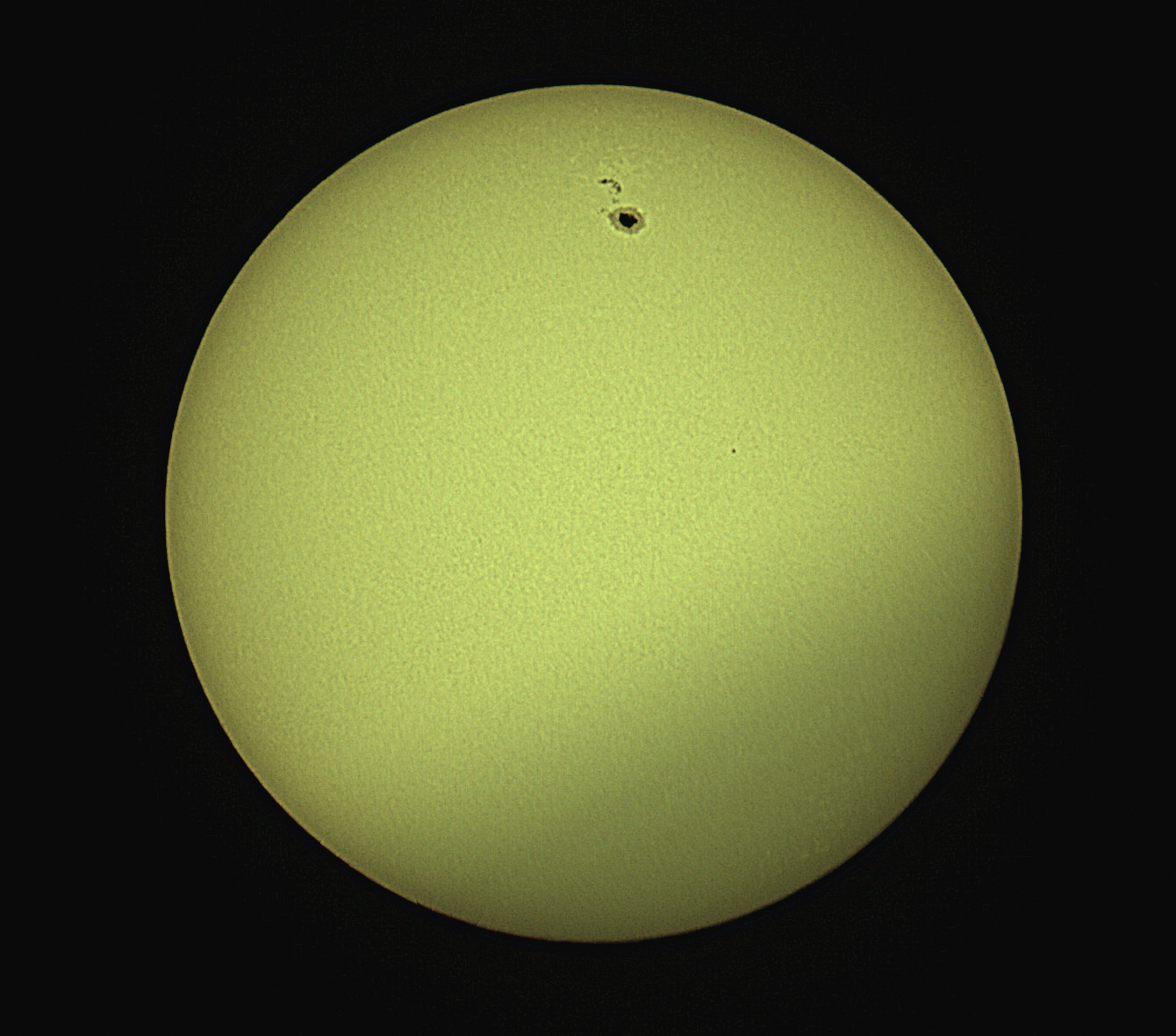
Sunspot 2529 (April 10, 2016) - Benoit Guertin

Sunspot 2529 (April 10, 2016) – Benoit Guertin

The above image was captured on April 10th, 2016 with on my Skywatcher 80ED with Canon 400D at ISO 200 and 1/500s.  19 frames were processed with Registax6.  Sunspot 2529 is still visible today and may be there for another week as readings indicate that it’s quite stable.

There are various types of solar filter out there.  They all essentially do the same thing which is to permit only a small percentage (roughly 0.001%) of the white light to pass through.  Solar filters are not designed to allow observation of prominence and flares, special hydrogen-alpha narrow-band pass filters are required for that,  but they do allow a view of sunspots and granulation if you happen to have sufficient focal length.  By blocking out most of the sunlight, you can then safely observer or photograph the sun.  Remember not to install your finderscope, and move the telescope away from the sun before removing the solar filter.  Your telescope is a MIGHTY strong magnifying glass.

Shopping around there are generally two types of solar filter: glass and film.  While the glass are more durable, the films offer just as good optical performance at a lower price, especially for larger aperture.

Thousand Oaks Optical R-G Solar Filter

Thousand Oaks Optical R-G Solar Filter

Normally for anything in the optical path, especially filters, backyard astronomers are always looking for the smoothest and most parallel surfaces, but for solar film, it appears that the ripples from the loose film have no effect on the image quality.

The filter that I selected is the R-G Solar Filter from Thousand Oaks Optical.  It provides a light yellow pleasant view of the sun, and works very well both visually and with the DSLR.  I enhanced the yellow in the photo of the sun above, but it’s quite close to what can be seen and photographed.

Mark your calendars for May 9th 14:57UT, Mercury will transit in front of the Sun.  The last time that happened was 2006.
ExoMars March 14th Lift Off, The Sign of a Earth-Mars Close Approach?

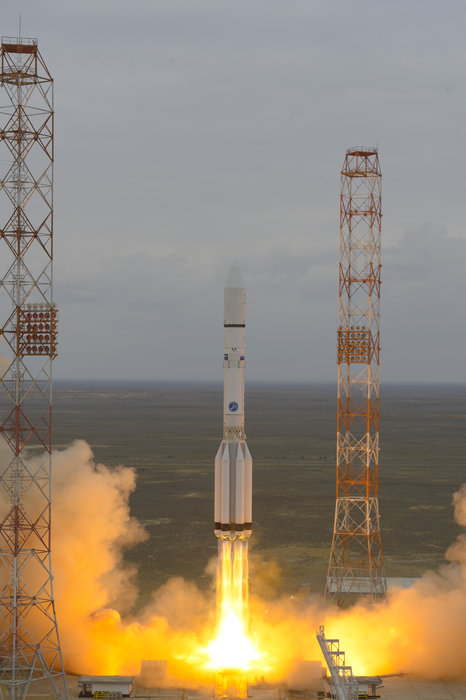
In the early in the morning of March 14th, 2016, a joint EASA-Roscosmos mission blasted off from Kazakhstan on top of a Proton launch vehicle.  The space vehicle will take 7 months traveling through space before arriving to Mars around October 19th.  The mission is actually composed of two vehicles, which will separate 3 days prior to the Mars arrival: Trace Gas Orbiter (TGO) and Schiaparelli, the later entering the martian atmosphere and landing on the surface.

ExoMars 2016 Launch campaign

ESA–Stephane Corvaja, 2016

I wondered if the launch signaled an upcoming Earth-Mars close approach.  A space program wanting to reach Mars on a budget would select a launch date at a time when both planets are at their closest to reduce the fuel required, and time spent traveling through space.  Sure enough, the next Earth-Mars close approach is May 30, 2016, a few days after opposition of May 22nd.  An upcoming great opportunity to turn the telescope to Mars and hopefully capture some of the planet’s features.  Mars’ angular size varies from as little as 3.5″ to an easy observing 25.1″ which is quite dramatic.

Earth-Mars close approach happen roughly every 26 months, and often coincide to Mars missions launches.  The following list from NASA of recent Mars mission launches show a lovely two year interval.

2001:      Mars Odyssey
2003:      Mars Exploration Rovers
2005:      Mars Reconnaissance Orbiter
2007:      Mars Phoenix Lander
2009:      (skipped opportunity)
2011:      Mars Science Laboratory/Curiosity Rover
2013:      MAVEN

The last one in 2013 was in November, hence a Mars 2016, 28 months later falls within that window of opportunity.  The ExoMars program actually has two space vehicles.  The next one is planned for… you guessed it 26 months later: May 2018 launch.

Sources:
[EASA] [NASA]

The Sun in Like You’ve Never Seen Before

Video

A few weeks ago NASA released a video in stunning 4K quality showcasing some of the sharpest and most detailed views of the Sun at different wavelengths. These images were captured by NASA’S Solar Dynamic Observatory launched in space in 2010.

As stated in the introduction,  each minute of video takes 10hrs in the hands of specialists to process. Not too bad considering that I’ve sometimes spent hours to produce a single image.

Reference :NASA

Cassini’s 48km Close Approach to Saturn’s Moon Enceladus

Video

Today the Cassini spacecraft made a close approach and dive through the plume of icy spray from Enceladus, Saturn’s sixth largest moon.  What surprised me was the low altitude flyby: just 48km from the moon’s surface.

OK, by aircraft standard a 48km altitude is still way up there as commercial aircraft operate at an altitude of 10km, and even the famed U2 and SR-71 spy planes designed to fly above surface or air launched missiles top out at 20 and 25km altitude respectively.  But for a multi-billion dollar spacecraft this is quite low due to the high risk.  Low Lunar Orbit used during the Apollo missions were at a 100km altitude, and all the hype on New Horizons Pluto flyby, it was at a distant 12,500km pass.  OK ESA’s Rosetta spacecraft was maneuvered down to 29km around comet 69P, but has since moved out to a safer 300km orbit.

Looking forward to seeing what comes out of Cassini’s E-21 flyby.

Source: JPL’s Cassini E-21 Flyby Page

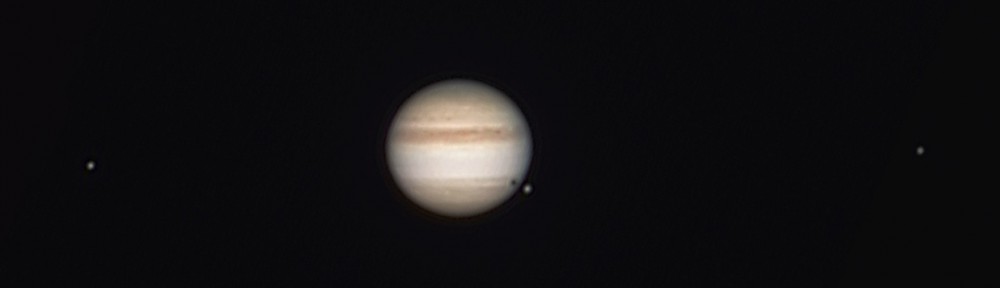
Jupiter in 4k Ultra HD

Video

NASA has just released a video rendered in 4K Ultra HD of Jupiter from images captured by the Hubble Space Telescope.

Learn more about this video: http://www.nasa.gov/press-release/goddard/hubble-s-planetary-portrait-captures-new-changes-in-jupiter-s-great-red-spot


It’s GO for the Thirty Meter Telescope (TMT)

We all have aperture fever, not just us crazy backyard astronomers, and with the latest announcement from the Canadian Government to provide nearly $250 million over 10 years, we should see the TMT operational in 2023-2024.  When completed it will be the largest telescope, until the Europeans have their European Extremely Large Telescope (E-ELT), also set for first light in 2024.

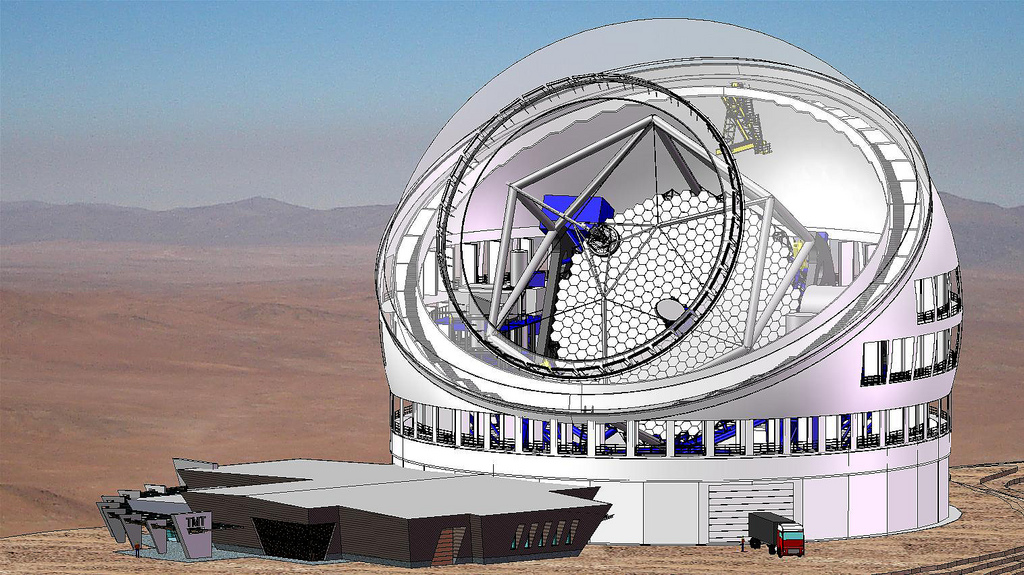
Thirty Meter Telescope - Courtesy TMT International Observatory

Thirty Meter Telescope – Courtesy TMT International Observatory

The telescope optical design is a folded Ritchey-Chrétien. Both the primary and secondary mirrors are hyperboloidal, and together they form a well-corrected focus. The tertiary mirror is used to fold and steer the light path so that the science beam can be delivered to any of eight instruments that will be mounted on the two main Nasmyth platfoms. The image is formed 20 meters from the center of the tertiary mirror. The focal ratio of the telescope is f/15.

The field of view of the telescope is 15 arc minutes (fully illuminated), or 20 arc minutes with slight vignetting at the edges of the field. At f/15, the focal length of TMT is 450 meters (1476 feet)! This means that the 20 arc minute field of view measures 2.618 meters (8.6 feet) in diameter.

The primary mirror focal ratio is f/1. This short focal ratio was chosen to make the telescope compact, which helps to keep the telescope structure and the enclosure affordable. As the name implies, the primary mirror is 30 meters (98 feet) in diameter, and because it is f/1 it has a focal length of 30 meters.

Current king of the largest light-bucket is the 10.4m diameter Gran Telescopio Canarias.  Therefore the 30m TMT and the 39m E-ELT will be a considerable gain in light gathering power over the current crop of telescopes.  Some are predicting that scientists will be able to directly observe planets orbiting distance stars, and perhaps even see distant oceans and weather formations.

It’s always intrigued me how we spend so much on EQ mounts, when these large telescopes operate in a simpler Alt-Az configuration.

Sources: CBC, TMT

Could the Moon have its own moon?

I was reading the “Science & Vie” magazine when I came across a question from one of the readers: “Does the Moon have satellites?”  At first I considered this quite a silly question, but then realized that we have placed artificial satellites around the Moon.  So why could there not be natural ones?

The Moon is not billiard-ball smooth gravitationally.  It’s heavily scared surface due to past asteroid and comet impacts have affected the local density of the surface crust, and therefore the local gravity field varies across the surface of the Moon.

Map of gravity acceleration values over the entire surface of Earth's Moon.  Lunar Gravity Model 2011

Map of gravity acceleration values over the entire surface of Earth’s Moon. Lunar Gravity Model 2011

One of the famous effects of these local gravitational variations is the Apollo 11 landing, where Neil Armstrong had to take manual control to land, some 5km down range where the navigational computer was targeting.

Another factor is that any satellite around the Moon would also be under the influence of the Earth and the Sun.  Any asteroid captured by the Moon would quickly be ejected due to all these influences.  Now there are more favorable orbital angles: 27, 50, 76 and 86 degrees from the Moon’s equator.  But it would still be a highly unstable orbit.  All spacecraft that are placed in orbit around the Moon need to use up propellant to maintain orbit over time.  And when propellant is about to run out, most space agencies elect to purposely crash the satellite to obtain additional science data.  One recent example is NASA’s LADEE moon orbiter crashing on the Moon on April 18th, 2014.

In conclusion, no our Moon does not have any natural satellites, and if by chance it would capture a wandering asteroid, most experts believe it would only survive a century at most before impacting the lunar surface or getting flung out of orbit.