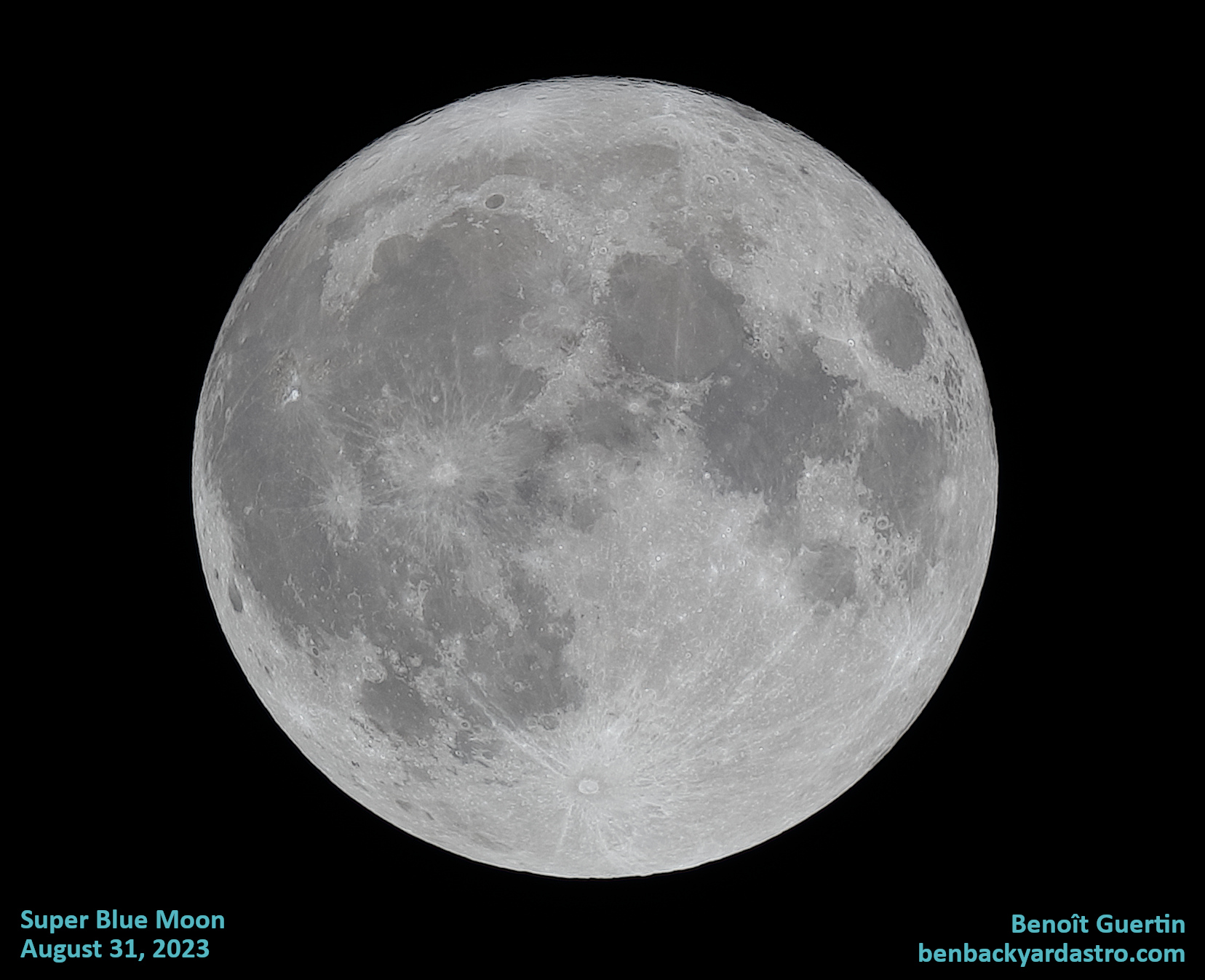
Back in 2017 I color enhanced one of my photos of the moon to see if I could pick up the subtle hues due to the different minerals as I had seen some posts in forums. I decided to redo this experiment, but this time with a photo of the Super Blue Moon from August last year. I figured starting off with a brighter and sharper photo will yield better results.
Using a photo editor I duplicated the layer and boosted the color saturation. Then I blended both layers together to get a nice result. The reason why I don’t simply boost the saturation in the original image is that doing so also increases the “noise” in the image. Keeping a grayscale and a color layer separate preserves the details while enhancing colors.
The result is often referred to as the Mineral Moon because the difference in orange and blue hues are due to the different concentration of minerals in the regolith. Blueish areas are high in titanium, possibly as high as 10%, compared to on Earth where titanium is approximately 1% of the soil content. The orange, brown areas have higher iron content.
The newer and brighter impact craters are even more contrasting over the dark areas formed by old lava flow during the early formation of the Moon.
Who knew that with nothing more than a DSLR and small telescope from a backyard you can map the geology, age and minerals on the Moon. If you have a good photo of the Moon on your computer, give it a try!
We’re heading into the peak of Solar Cycle 25, which should happen sometime in 2025, and active solar region 3536 produced on December 31st, the most powerful recorded solar blast since 2017, measured at X5. Don’t let the size of the sunspot fool you, it has been crackling with multiple C class flares since it appeared on the limb of the Sun. Flares are classified in increasing strength as A, B, C, M or X according to their X-ray emissions. X-class flares can cause disruptions in communication and GPS guidance here on Earth.
The Sun on January 4, 2024
The above photo was taken with my Skywatcher 80ED apochromatic doublet telescope paired with a Canon 80D DSLR. Four different active solar regions are identified on the photo.
So far none of the ejecta from active region 3536 have struck Earth, but as this active region is still showing beta-gamma magnetic configuration there’s still a high chance of more flares.
On April 8, 2024 a total solar eclipse will be visible for people in Mexico, USA and Canada. The Moon will pass between Earth and the Sun, and those in the path’s of Moon’s shadow will be able to see an eclipse. I created the video below using Stellarium to show the shadow’s trajectory from west to east.
This coming April 8, 2024 a total solar eclipse will happen over much of the USA, including portions of Canada and Mexico. If you are planning to view or photograph the solar eclipse, you need to use the right solar filter to protect your eyes and your equipment. A solar filter is a special device that blocks most of the Sun’s light, allowing only a very small fraction to pass through. Without a solar filter, the intense brightness of the Sun can damage your retina, causing permanent blindness. It can also damage your camera sensor, lens, or telescope. I’m sure you’ve all seen or even experimented with burning or meting things using a magnifying glass and sunlight. I don’t need any further explanation.
There are different types of solar filters, such as glass, film, or foil filters. They have different advantages and disadvantages, depending on their cost, durability, optical quality, and ease of use. You should choose a solar filter that fits your budget, your equipment, and your viewing preferences. Some filters are designed to be attached to the front of your camera lens or telescope, while others are meant to be held in front of your eyes or mounted on a cardboard frame.
The simplest are cardboard glasses which have a solar film. They are cheap, you can get a dozen for less than $40 and anybody can use them to view the eclipse.
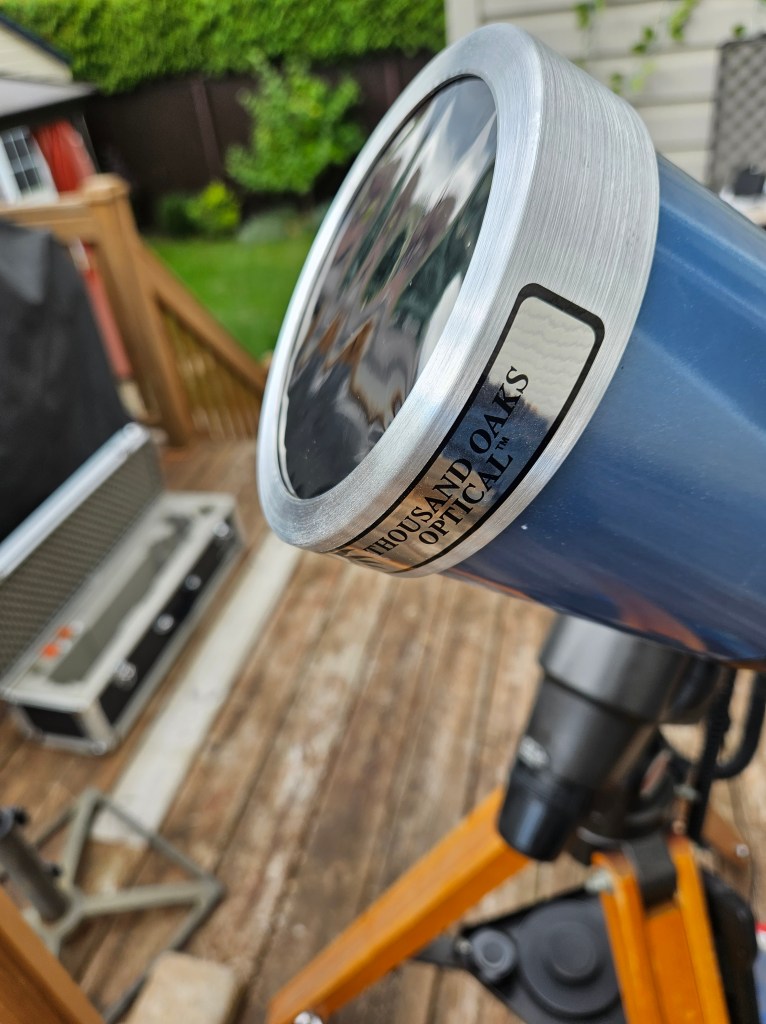
Photo: Thousand Oaks Optical
If you have equipment like a camera or a telescope, you can get the same solar film in a cell that can be mounted ahead of the optical body. These are a little more expensive but ensure a good fit and won’t fall off. Because they use a thin solar film, you must be careful when manipulating and storing them to avoid a tear or puncture. Don’t worry about the “ripples” in the film, it doesn’t affect the optical properties as the thickness is uniform.
What I use on my Skywatcher 80ED telescope
Film type solar filters can also be ordered as a sheet and then cut/mounted to size for your specific application. It’s often the simplest and cheapest way to protect your equipment.
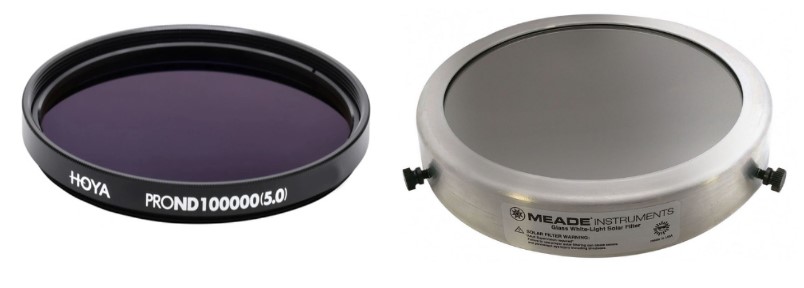
Glass solar filters are also available for both DSLR and telescope use, but the price climbs quickly with increased size. So their application tends to be limited to DSLR lenses and will screw to the end of the lens body like your regular ND or UV filter.
Glass solar filters for DSLR and telescopes
When choosing a solar filter, you should look for one that has a certified rating of ND5 or higher. This means that it blocks 99.999% of the Sun’s light, leaving only 0.001% or less to reach your eyes or camera. You should also check that the filter is in good condition, with no scratches, holes, or cracks. A damaged filter can let in harmful rays that can hurt your eyes or equipment, not to mention mess up that once in a lifetime photo. I’ll put a link to Thousand Oaks Optical below, as I’ve been really happy with the quality and performance of the filter for my telescope.
A solar filter is essential for viewing or photographing a solar eclipse safely and effectively. It will allow you to see the Sun’s corona, the thin ring of light that surrounds the dark disk of the Moon. It will also help you capture stunning images of this beautiful phenomenon. Remember to use the right solar filter for your needs and enjoy the show!
The 2024 astronomy calendar is now published. Backyard astronomers can look forward to several celestial events, like the April 8 total solar eclipse, and the partial lunar eclipse on September 18th. Our favorite gas giants will be at opposition, this year in the following order: Saturn, Neptune, Uranus, and Jupiter.
Welcome to a journey into our Universe with Dr Dave, amateur astronomer and astrophotographer for over 40 years. Astro-imaging, image processing, space science, solar astronomy and public outreach are some of the stops in this journey!


 Ben Backyard Astronomy