Taking photos of a partial solar eclipse wasn’t high on my TO DO list on this past Saturday. Experiencing a solar eclipse is about location, and my city (Montreal) was not in the best path of the Moon’s shadow that day. At the maximum eclipse, the sun would be at best 17% covered from my viewing location. People in the south-west of the United States were the lucky ones to see the show.

As you may know, a partial solar eclipse happens when the moon covers only a part of the sun, creating a crescent-shaped sun. It’s not as spectacular as a total solar eclipse, but still pretty amazing to see. The problem is, you need clear skies to see it well. And that’s where the challenge came in.
When I glanced out around 11am, one hour before the start of the eclipse, it didn’t look good, I was worried that I would miss the eclipse, and any attempt to take photos ruined by clouds. The forecast was for partly cloudy and I could see patches of blue sky in the distant, so I decided to give it a try anyways and setup the equipment hoping for a few lucky minutes. Best to be ready for the few minutes that I may have. At worse case, if the clouds were thin I could still view it with an eyepiece.
I grabbed by Vixen Great Polaris motorized mount, got it installed in a rough polar alignment and gave it some power to track the sun. The telescope of was my Skywatcher 80ED (600mm f/7.5) simply because it’s the one that I have a solar filter that will fit. My DSLR, a Canon 80D is coupled to the telescope to capture the moment. A longer focal length would have been nice, but that will do. Now all I had to do is wait for a break in the clouds.

And that break arrived at 12:50pm a few minutes before maximum eclipse (1:18pm). I had to be quick, center the image, adjust the focus and have the camera on the right setting. I settled with ISO 100 and 1/1000s to not over expose and reduce the blurring effect of the atmosphere.
When taking astronomy photos, don’t trust the light-meter of your camera, always check the histogram to ensure the peak image intensity doesn’t pass the 80% mark. You want to be sure you’re working within the dynamic range of your sensor and not getting some clipping.

With that short 15 minute break in the clouds I was able make efficient use by letting my kids view the eclipse with an eye-piece, nothing like an unassisted live view, and then switched the setup to the DSLR for some photos.

As we are nearing another solar maximum, there’s no surprises in seeing a few sunspots in the photo. I find the sunspots add to the dynamic nature of our sun, that it’s not a steady and static source of light. There are 6 visible active solar regions in the photo, AR3464 and AR3465 being the most visible ones in the middle.

Even though I didn’t have ideal conditions I was happy how the photos turned out and the opportunity to witness this really cool event.
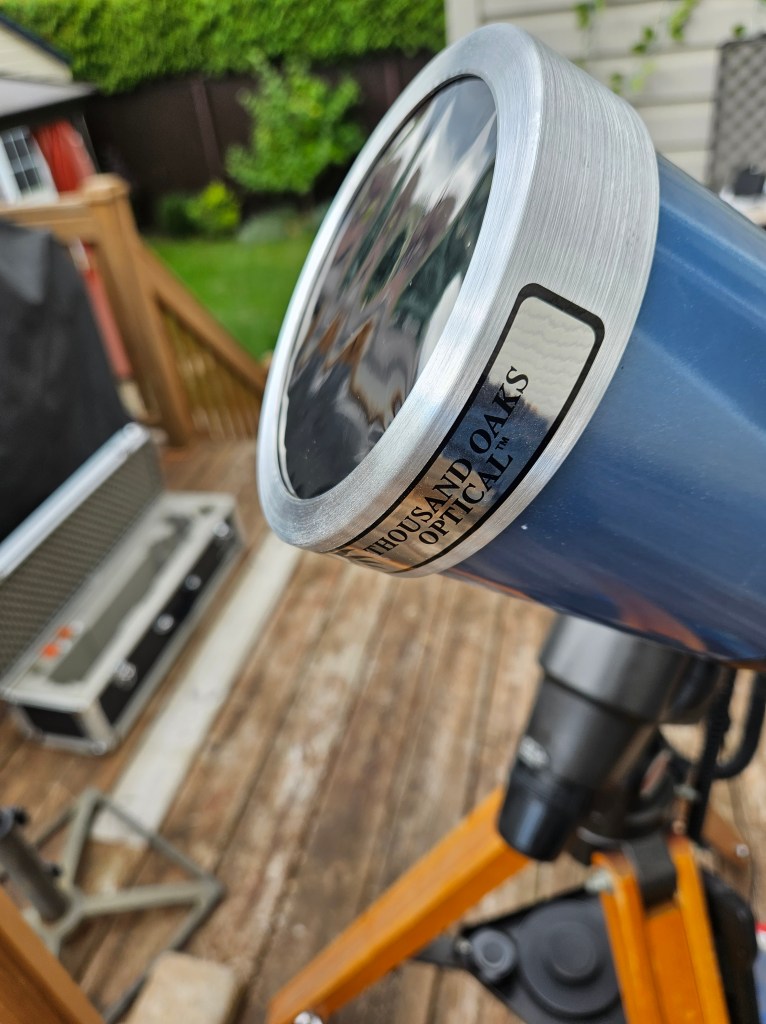
A reminder for all solar observation, the proper filter is required to protect your eyesight and the equipment. If you’ve ever played with a magnifying glass outdoors, you know that focusing the sun’s rays will melt or burn anything. The Thousand Oaks optical solar filter cuts out 99.999% of the sunlight such that observation an photography can be done safely.
 Ben Backyard Astronomy