August 13th – Celestial Pole Over the House

Image

The Perseids peak had already passed, but the sky was better so I decided to set up the trusty Canon XTi and see if I could catch some meteors.  This time instead of pointing the camera straight up, I decided to frame the top of the house to provide some reference.

Out of the over 120 shots taken, a sequence of 30 frames were without clouds obscuring the stars.  This was a perfect opportunity to mark the celestial pole by adding the images without alignment.
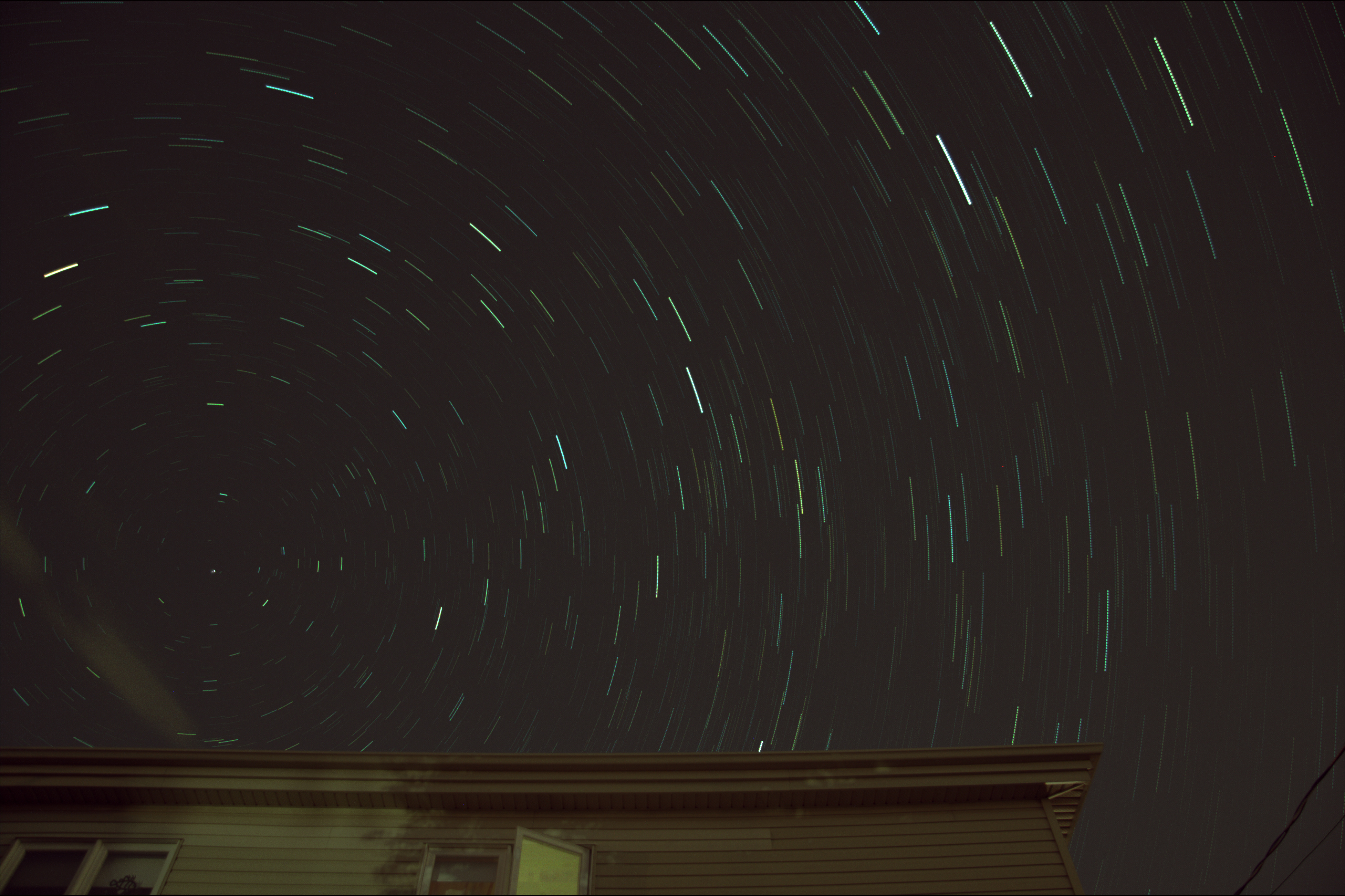
Celestial Pole on August 13, 2015 30 x 30sec

Celestial Pole on August 13, 2015
30 x 30sec

Canon XTi
17mm F4.0 ISO800
30 x 30sec
August 12th – No Perseids but did get some constellations

Image

The 2015 Perseids were predicted to be great, largely thanks to Mother Nature turning off its night-light (aka our Moon).  Unfortunately the weather wasn’t as cooperative…  With clouds over the horizon I knew my window to try to capture some Perseids was quickly vanishing.  Nevertheless I setup my camera on a tripod and hoped for the best.

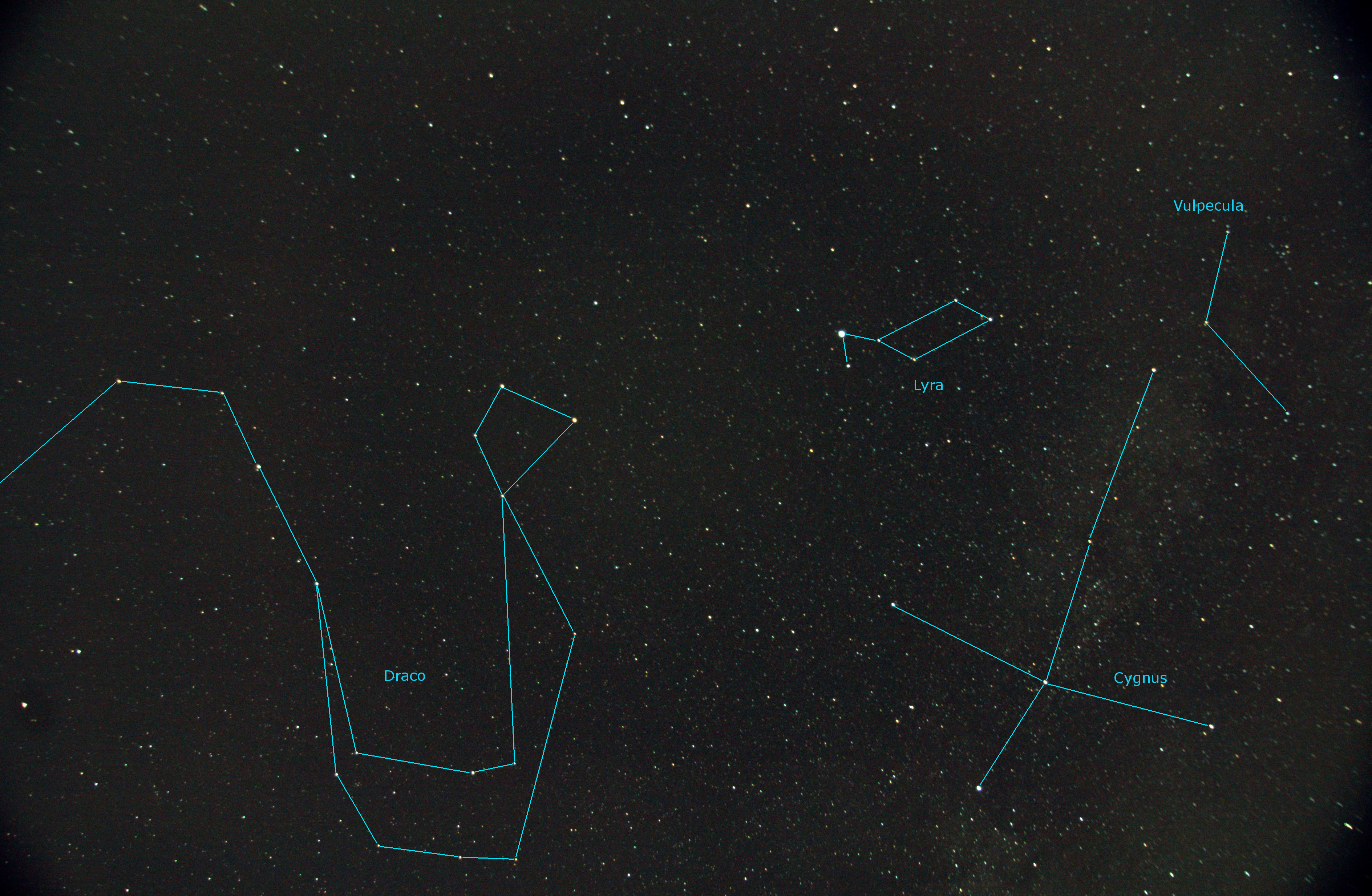
The best I got was 13 shots without clouds.  A quick scan of them did not reveal any notable meteor streak.  But it wasn’t all a waste.  I was able to process, align and stack them to provide a good 60deg field of view around the zenith.

Constellations Draco, Lyra, Cygnus and Vulpecula 13 x 30sec (17mm F4.0 ISO400) 12-aug-2015 Benoit Guertin

Constellations Draco, Lyra, Cygnus and Vulpecula
13 x 30sec (17mm F4.0 ISO400)
Benoit Guertin

Canon XTi
17mm F4.0 ISO400
13 x 30sec
Fixed mount, no tracking

Faint Images of Galaxies M95 and M96

Image

Galaxies are always a challenge… Imaging objects such as nebulas within our galaxy is much better suited to my small telescope.  At 700mm focal length, galaxies over 30 million light years away are rather small and lack detail.  Nevertheless this is my go at Messier 95 and 96 in the constellation of the Lion.

These galaxies were discovered by Pierre Méchain in 1781 with a 12in telescope, nearly 4 times the size of mine.

Galaxies Messier 95 and 96 - Benoit Guertin

Galaxies Messier 95 and 96 – Benoit Guertin

The image was scaled to 30% and I’ve added insets of the galaxies.

Telescope: Sky-Watcher 80ED
Camera: Canon XTi (ISO 400)
Image: 30 x 30sec

Messier 67 – Open Cluster

Image

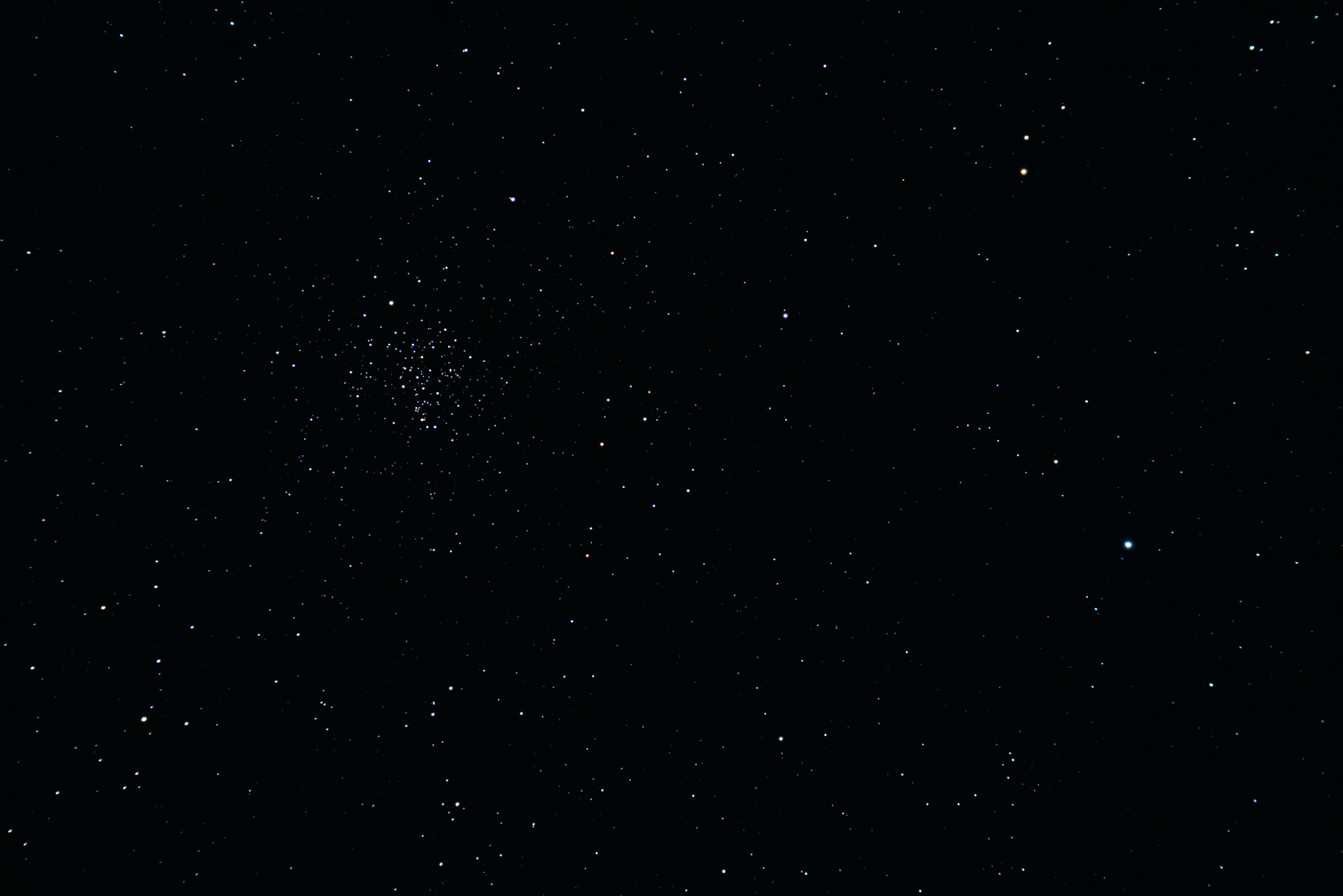
On the same night that I imaged Messier 44 I decided to hop over to another nearby open cluster: Messier 67.  While M44 appears three times larger, both of these open clusters are estimated to be of roughly the same size, but M67 happens to be 5 to 6 times farther away.

Click on the image to get the full image, it’s scaled and cropped below.

Open Cluster Messier 67 Benoit Guertin

Open Cluster Messier 67
Benoit Guertin

Telescope: Sky-Watcher 80ED
Camera: Canon XTi (ISO 400)
Image: 19 x 30sec

Photons From 200 Million Years Ago

Image

Yesterday when I processed and posted the open cluster Messier 44, I noticed I had captured a faint galaxy in the background.  So while the stars in the open cluster are within our galaxy at a distance of 577 light years, that faint galaxy UGC 4526 is located at 200 million light years away.  Therefore the photons captured by my 80mm telescope lens in my backyard and counted by my Canon camera exited the stars within that galaxy at the start of the Jurassic period when dinosaurs just became the dominant vertebrate on land.  The light travelled 1,903,000,000,000,000,000,000 km to land on the camera sensor where each pixel is no bigger than 5.7micro-meter.  Pretty mind-blowing when one thinks about it!

Magnitude 14 Galaxy UGC 4526 in M44 Benoit Guertin

Magnitude 14 Galaxy UGC 4526 in M44
Benoit Guertin

Messier 44 – Beehive Cluster

Image

A few days ago after taking some video of Jupiter with a modified webcam, I slewed over to the open cluster Messier 44 also known as the Beehive Cluster and changed over to the Canon XTi to take some long exposures.

Below is the result of stacking 20 x 30sec exposures at ISO 400.

Messier 44 - Open Cluster Benoit Guertin

Messier 44 – Open Cluster
Benoit Guertin

Telescope: Sky-Watcher 80ED
Camera: Canon XTi – ISO 400
Image: 20 x 30sec

M57 – Ring Nebula

Image

Messier 57, also known as the Ring Nebula is an easy target with all sizes of telescopes, even large binoculars.  Conveniently located almost midway between the bright magnitude 3 stars Beta and Gamma Lyr, it’s very easy to locate.  In the wide field of view photo below, we can clearly see M57’s position with respect to the two bright stars.

Ring Nebula - Messier 57 Planetary Nebula Benoit Guertin

Ring Nebula – Messier 57 Planetary Nebula
Benoit Guertin

M57 is a small target, therefore not ideal for short focal lengths like my Skywatcher 80ED (600mm focal length).  Below is a 1.5x zoom on the nebula itself.  The digital zoom was performed by cropping and scaling the aligned sub images, prior to stacking them.

Ring Nebula - Messier 57 Planetary Nebula Benoit Guertin

Ring Nebula – Messier 57 Planetary Nebula
Benoit Guertin

Telescope: Skywatcher 80ED
Camera: Canon XTi (ISO 800)
Stacking: 21 x 25sec

Full 10Mpix photo

M13 Globular Cluster

Image

Messier 13 Globular Cluster

M13 Globular Cluster

M13 Globular Cluster – Benoit Guertin

Equipment: SW80ED, Canon XTi
Imaging: 29x15sec ISO800

The above image is a crop of the original.  In the full frame image, galaxy NGC6207 (60 million light years away) is faintly visible on the top of the image at 1 o’clock from M13.  As a reference M13 is 22,000 light years away.