Missing the April 4th lunar eclipse? No problem, NASA has posted on YouTube the entire event, all 45 minutes.
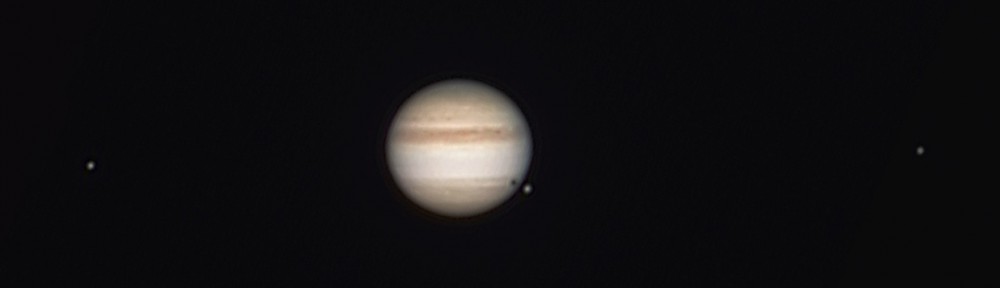
Missing the April 4th lunar eclipse? No problem, NASA has posted on YouTube the entire event, all 45 minutes.
I was reading the “Science & Vie” magazine when I came across a question from one of the readers: “Does the Moon have satellites?” At first I considered this quite a silly question, but then realized that we have placed artificial satellites around the Moon. So why could there not be natural ones?
The Moon is not billiard-ball smooth gravitationally. It’s heavily scared surface due to past asteroid and comet impacts have affected the local density of the surface crust, and therefore the local gravity field varies across the surface of the Moon.

Map of gravity acceleration values over the entire surface of Earth’s Moon. Lunar Gravity Model 2011
One of the famous effects of these local gravitational variations is the Apollo 11 landing, where Neil Armstrong had to take manual control to land, some 5km down range where the navigational computer was targeting.
Another factor is that any satellite around the Moon would also be under the influence of the Earth and the Sun. Any asteroid captured by the Moon would quickly be ejected due to all these influences. Now there are more favorable orbital angles: 27, 50, 76 and 86 degrees from the Moon’s equator. But it would still be a highly unstable orbit. All spacecraft that are placed in orbit around the Moon need to use up propellant to maintain orbit over time. And when propellant is about to run out, most space agencies elect to purposely crash the satellite to obtain additional science data. One recent example is NASA’s LADEE moon orbiter crashing on the Moon on April 18th, 2014.
In conclusion, no our Moon does not have any natural satellites, and if by chance it would capture a wandering asteroid, most experts believe it would only survive a century at most before impacting the lunar surface or getting flung out of orbit.
Weather permitting, North America will have a partial solar eclipse today October 23rd. The eclipse will take place at sunset
Information available at the NASA Eclipse web site.
People located west and north will be at a better location to see a greater portion of the eclipse. In the east, the eclipse will start around 5:40pm EDT, but will end after sunset.
Various methods of viewing the eclipse safely is listed in a CBC News article
NASA/JPL-Caltech
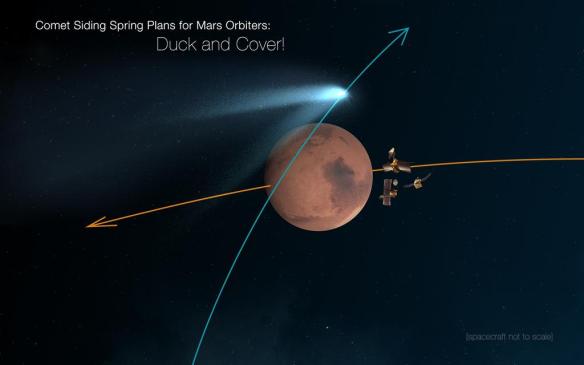
On October 19th a once in a lifetime event will happen. Comet Siding Spring (C/2013 A1) will pass very close to Mars, one tenth the distance of the closest Earth-comet pass. While there is no chance of impact, NASA has moved some of its Mars orbiting satellite to be behind the planet is it passes through the comet’s dust tail in order to protect the equipment.
At predicted magnitude 11, it will be limited to large telescopes with camera or CCD. But its close proximity to Mars will make it an easy target to locate. Unfortunately for North America, the closest approach will take place 2:28pm EDT.
Luckily NASA has setup as dedicate web site leading up to and after the even publish information and photos. The SLOOH telescope will also have a live webcast.
Mark Bailey
Electronics plus software tips and tricks
Clear Skies and Clean Shutdowns
A site dedicated to learning Astronomy One Step at a Time
Charles Bracken
one post at a time
Astronomy, space and space travel for the non scientist
My adventures with amateur astronomy
Discoveries, Journeys & Milestones in Space Exploration
Welcome to a journey into our Universe with Dr Dave, amateur astronomer and astrophotographer for over 40 years. Astro-imaging, image processing, space science, solar astronomy and public outreach are some of the stops in this journey!
Observations, mostly astronomical from Limavady, UK (55N, 6.9W).
Photography Blog of James Silvester
Astronomy and Amateur Radio
The latest news on WordPress.com and the WordPress community.
 Ben Backyard Astronomy