One of the brightest star in the night sky disappeared for a few seconds

A once in a century astronomical event took placed on in the evening of December 11, when the bright red star Betelgeuse briefly winked out of the night sky for a few seconds. It wasn’t the talked about great dimming that is expected to preclude the explosive supernova ending of this red supergiant. It was caused by passing asteroid Leona. This is a rare and exciting opportunity for scientists to observe both objects in detail, as well as to test our knowledge of their sizes, shapes and orbits.

Betelgeuse Red Super Giant in Orion (Benoit Guertin)

We are all used to eclipses, when the Moon or Earth occults the other heavenly body and passes in the shadows. Asteroid-star occultations are actually very common, about half a dozen happen every day. However being able to observe one to the naked eye is extremely rare.

Betelgeuse is one of the largest and most luminous stars in the sky, located about 650 light-years away in the constellation of Orion. It is a red supergiant, if it were placed at the center of our solar system, it would engulf the orbits of Mercury, Venus, Earth and Mars. It is also a variable star, changing its brightness and color over time due to pulsations, convection and dust formation.

Asteroid Leona is a much smaller and fainter object, orbiting the Sun between Mars and Jupiter and originated from the outer asteroid belt. Leona is about 66 kilometers in diameter and has an irregular shape, but just large enough to block out a bright star such as Betelgeuse. Leona is a dark reddish high carbon asteroid making it a challenge to observe even with an amateur telescope at a magnitude 14 brightness, so only large telescopes will be able to capture the momentary dimming.

The occultation of Betelgeuse by Leona was visible from a narrow path across the Earth, stretching from southern Europe, Turkey, Greece, Italy, the tip of Florida and Mexico. The occultation is expected reduce the brightness by 3 magnitudes, making it disappear to the naked eye.

The occultation of Betelgeuse by Leona is a rare and valuable opportunity for both amateur and professional astronomers. It will allow us to measure the diameters and shapes of both objects with unprecedented precision, as well as to study their atmospheres and surfaces. It will also help us to refine our models of their orbits and motions, which are affected by various factors such as gravity, radiation pressure and thermal effects. Moreover, to the lucky few it was a sight that will not be repeated for many years to come.
Red Dwarf Spaceship Spotting?

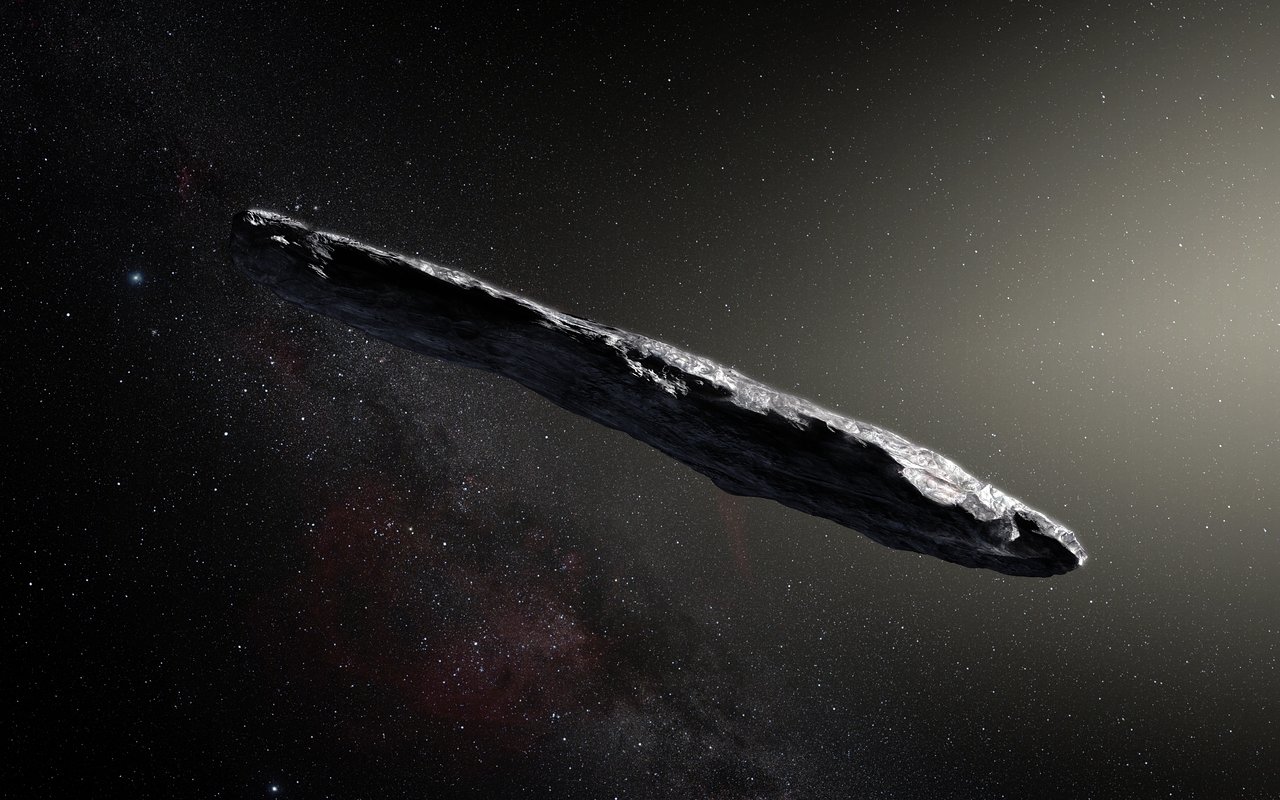
The big news this week is the first recordings and observations of an interstellar object.  Of the 750,000 asteroids and comets that have been cataloged up to now, every one of them originate from within our solar system. This object detected by the Pan-STARRS1 telescope and named A/2017 U1 or “Oumuamua”, a Hawaiian word for scout or messenger from the distant past, came from another part of our galaxy. Based on measurements made from multiple ground-based telescopes it is believed to be rather long and of a deep red color . Below is an artist’s rendering of this extra-solar visitor. While a comet would have generated some type of coma or tail travelling near the Sun, no such activity was recorded, hence it’s believed to be an asteroid-type object.

Artist’s impression of the interstellar asteroid `Oumuamua

Credit: ESO/M. Kornmesser


Measurements over multiple nights allowed to establish the trajectory, which clearly shows that it did not originate from the Oort cloud or other asteroid/comet rich fields surrounding the Sun. While the discovery was made only on an October 19 image, its closest approach to the Sun was September 9th.

eso1737b

Diagram showing the trajectory of A/2017 U1 (ESO/K. Meech, et al.)

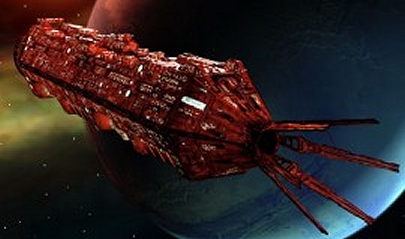
Now I thing they got it all wrong.  What they picked-up was the Red Dwarf mining ship swinging by our neighborhood!

RedDwarfShip

Red Dwarf mining vessel owned by the Jupiter Mining Corporation (BBC)


ESO Press Release

Large Asteroid to Pass Near Earth

On April 19th a considerable sized asteroid will pass about 4.6 lunar distances (1.8 million km) from Earth.  While there is no chance of it impacting our planet, this 650m asteroid was only discovered three years ago, and it will be the closest encounter of a large asteroid since asteroid Toutatis in September 2004. The next predicted fly-by of a large asteroid is 2027 with 800m wide 1990 AN10.

The expected magnitude could reach up to 11 during the close approach, hence a decent sized scope will be required, and due to the rapid movement may be hard to locate and track.

Sky chart for asteroid 2014 JO25 covering April 18th to 20th 2017

And as a bonus, comet PanSTARRS (C/2015 ER61) will also make its closest approach to Earth on the 19th, but 10 times farther away as the asteroid.  I should be visible with small telescopes or binoculars in the constellation Aquarius in the dawn sky.

Source: NASA/JPL

Could the Moon have its own moon?

I was reading the “Science & Vie” magazine when I came across a question from one of the readers: “Does the Moon have satellites?”  At first I considered this quite a silly question, but then realized that we have placed artificial satellites around the Moon.  So why could there not be natural ones?

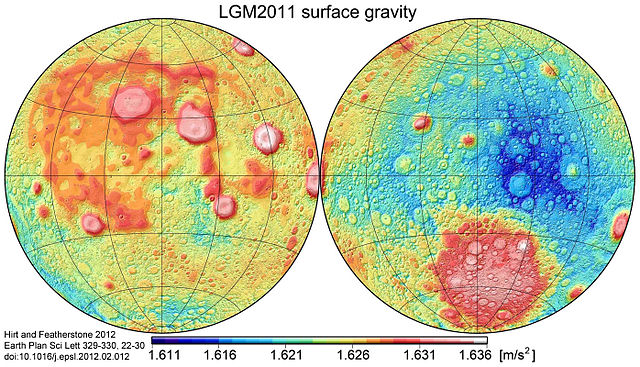
The Moon is not billiard-ball smooth gravitationally.  It’s heavily scared surface due to past asteroid and comet impacts have affected the local density of the surface crust, and therefore the local gravity field varies across the surface of the Moon.

Map of gravity acceleration values over the entire surface of Earth's Moon.  Lunar Gravity Model 2011

Map of gravity acceleration values over the entire surface of Earth’s Moon. Lunar Gravity Model 2011

One of the famous effects of these local gravitational variations is the Apollo 11 landing, where Neil Armstrong had to take manual control to land, some 5km down range where the navigational computer was targeting.

Another factor is that any satellite around the Moon would also be under the influence of the Earth and the Sun.  Any asteroid captured by the Moon would quickly be ejected due to all these influences.  Now there are more favorable orbital angles: 27, 50, 76 and 86 degrees from the Moon’s equator.  But it would still be a highly unstable orbit.  All spacecraft that are placed in orbit around the Moon need to use up propellant to maintain orbit over time.  And when propellant is about to run out, most space agencies elect to purposely crash the satellite to obtain additional science data.  One recent example is NASA’s LADEE moon orbiter crashing on the Moon on April 18th, 2014.

In conclusion, no our Moon does not have any natural satellites, and if by chance it would capture a wandering asteroid, most experts believe it would only survive a century at most before impacting the lunar surface or getting flung out of orbit.