Does Earth Influence the Sun?

I recently came across an article in the french Science & vie magazine, where a reader asked if Earth influences the Sun. I found it rather interesting, and while I had my doubts I still wanted to know more about it.

sun-earth

The reader wasn’t the first to wonder if there was any interaction, various models and observations have been put forward since the late 1800s. We often read about two bodies interacting in space. The first exoplanet was discovered due to its gravitational influence on its star causing it to wobble. This type of gravitational influence works when two bodies have a mass within one or two orders of magnitude of each other.  But in the case of our Sun, it is 99.86% of the solar system’s mass, and most of the remaining is taken up by Jupiter and Saturn.  Therefore from a gravitational perspective Earth has no effect on the Sun.

But could the 11 year period in solar activity, characterized by the rise and fall of number of observed sun spots be caused by the planets? The exact source of that periodicity has yet to be clarified.  Well a team of researchers at the Helmholtz-Zentrum Dresden-Rossendorf (HZDR) put out a paper in 2016 after demonstrating that every 11.07 years the planets Venus, Earth and Jupiter are aligned.  Coincidence?

They explained that while the effects are rather small, the repeated nudging could be enough to tip the Sun’s magnetic field instabilities one way or the other causing this 11 year solar cycle that we observe, much like an object entering into resonance.  In this case it’s the Sun’s magnetic field acting like a dynamo that would resonate due to the planet’s alignment every 11 years.

However many are skeptical about any real effect pointing that the source of the Sun’s magnetism comes from deep within, while the planet’s effect, if ever, would be limited to the Sun’s surface. But the crushing blow is when you look at fact that the solar cycle varies between 7 and 14 years, the number 11 just happens to be the average over the last 24 observed cycles.  Unfortunately the three planet’s alignment don’t vary by that amount.

In the end, the Sun is still king and does what it wants in this solar system, regardless what the planets say or do.

Red Dwarf Spaceship Spotting?

The big news this week is the first recordings and observations of an interstellar object.  Of the 750,000 asteroids and comets that have been cataloged up to now, every one of them originate from within our solar system. This object detected by the Pan-STARRS1 telescope and named A/2017 U1 or “Oumuamua”, a Hawaiian word for scout or messenger from the distant past, came from another part of our galaxy. Based on measurements made from multiple ground-based telescopes it is believed to be rather long and of a deep red color . Below is an artist’s rendering of this extra-solar visitor. While a comet would have generated some type of coma or tail travelling near the Sun, no such activity was recorded, hence it’s believed to be an asteroid-type object.

Artist’s impression of the interstellar asteroid `Oumuamua

Credit: ESO/M. Kornmesser


Measurements over multiple nights allowed to establish the trajectory, which clearly shows that it did not originate from the Oort cloud or other asteroid/comet rich fields surrounding the Sun. While the discovery was made only on an October 19 image, its closest approach to the Sun was September 9th.

eso1737b

Diagram showing the trajectory of A/2017 U1 (ESO/K. Meech, et al.)

Now I thing they got it all wrong.  What they picked-up was the Red Dwarf mining ship swinging by our neighborhood!

RedDwarfShip

Red Dwarf mining vessel owned by the Jupiter Mining Corporation (BBC)


ESO Press Release

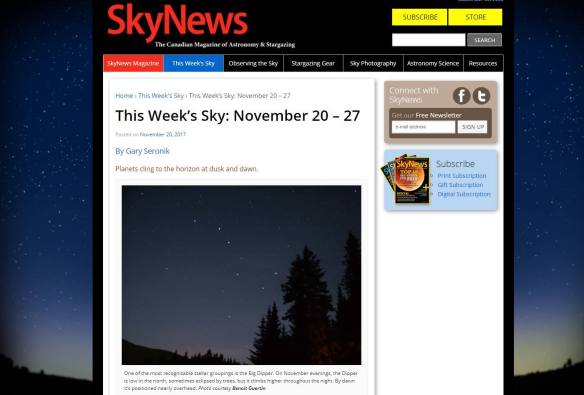
My photo in this week’s SkyNews

Today I got an e-mail from Gary that a photo of the Big Dipper that I had submitted a few months ago got selected for this week’s column on SkyNews. Couldn’t be happier. I wish all my weeks could start this way.

My photo featured on SkyNews

Astrophotography is a combination of equipment, experience, location/timing and luck. With this photo I just happen to hit everything right and was lucky.

Using the best equipment helps, but for this photo it was the simplest of setup: my very worn Canon Rebel XTi DSLR with a zoom lens set to 17mm F4 mounted on an old steel camera tripod my father used in the 60s. So nothing special, and within everyone’s reach.

OK, for the next part I had experience on my side. It allowed me to pick the right camera settings, but was also lucky as my photo viewing was limited to that small LCD screen on the camera. I had no laptop to fully explore and review the photos and make the necessary adjustments.  Even the focus was reviewed through the small camera LCD.  That night I only took 4 images with 20 second exposure crossing my fingers that I would have something worthwhile once back home.

And then there is the post-processing on the computer, which is a lot of trial-error. In image processing doing steps A + B will not give you the same results as performing B + A. We all have our “recipes” for what produces good results, but every photo ends up being a unique project. With this one, I knew there was good potential.

Finally there is the location and timing.  I was up in cottage country, away from city lights, and a clear sky. However there was a full moon rising, couldn’t wait too long as the sky would start to brighten. A Big Dipper low in the sky next to the trees framed everything very well.

Thanks Gary and SkyNews for selecting my photo. For all the experimentation that I do with the camera, once in a while I get everything right. I’m just happy someone noticed and said “Hey, that’s a great photo we could use.”

Color of the Moon

The Moon is white right? OK, OK… it only looks white because of the high contrast with the dark sky, it’s more grey.  What? No? You mean it has color?

From samples returned by the Apollo missions we know that two of the main minerals making up the lunar regolith is titanium oxide (TiO2) and iron oxide (FeO) based basalts.  While TiO2 is quite white and used in many household products from white toothpaste to white kitchen tiles, FeO is rust and closer to orange-brown (think Mars). On the Moon the result is a slightly blue-ish color in the areas with high TiO2, and more of a brown-red for the higher FeO and low TiO2 zones.

A normal image of the moon taken with DSRL, the different in hues is subtle as seen below.

Moon Natural Color (November 7, 2017) - Benoit Guertin

Moon Natural Color (November 7, 2017) – Benoit Guertin

But it can be exaggerated by playing with the color saturation, and you get the image below, where various hues of blue-grey, orange and brown become apparent. The sharp boundaries between colors are caused by the different mineral make-up of the lava flows during the early formation of the Moon. Common interpretation of the age of the lunar surface is that the blue-grey areas are “younger” than the orange-brown.

Moon_2017-11-07_colors

Who says you can’t pull scientific information with simple backyard astronomy gear? The same technique, but with narrow-band filters is used by NASA and other space and research agencies to catalog the make-up of the lunar surface.

So if you are planning lunar prospecting for future mining rights, all you need is a telescope and a DSLR.

Open Cluster NGC 6709

Not too far my previous post’s open cluster lies a smaller and younger NGC 6709.  Both were imaged on the same evening, but I only got 15 minute of integration due to advancing clouds.  However with these open clusters, I don’t think a greater number of frames would amount to much more details.

Open Cluster NGC 6709

Open Cluster NGC 6709

Skywatcher 80ED
Canon Rebel XTi
30 x 30sec (ISO 400)

Image is cropped and scaled 50%.

Open Cluster NGC 6633

Open star clusters are the galaxy’s youngest stars. They are created from the collapse of giant molecular gas clouds, often forming large and very hot stars shinning brightly in the blue-white part of the spectrum.  As they are rapidly consuming their fuel, they are also short-lived.  By ending as a super nova, they create the heavier elements beyond carbon that exists all around us.

Below is open star cluster NGC 6633, estimated to be 660 million years old (our solar system is 4.6 billion years old). The cluster is of a decent size covering just about the size of a full Moon in the night sky.  The brighter and whitish stars stand out against older and further stars in the background.

Open Star Cluster NGC 6633

Open Star Cluster NGC 6633

Younger star clusters such as the Pleiades (Messier 45) have yet to burn away their molecular gas clouds.  However there is no hint of glowing gas (nebula) with NGC 6633.

Skywatcher 80ED
Canon Rebel XTi
51x30sec (25.5 minutes) ISO 400

Cassiopeia – the W in the sky

Some constellations are easier to spot than others.  Cassiopeia with its distinctive W is visible year round in the northern hemisphere above the 34th parallel. In the image below it easily stands out from the fainter background stars.

Cassiopeia above the three line - Benoit Guertin

Cassiopeia above the three line – Benoit Guertin

The five stars drawing a W in the sky are all naked eye magnitude 3 and brighter stars, and in the image above I used a layering technique to increase the color and brightness of those stars to really make them stand out.

  1. Duplicate your base image, and set this layer to lighten only
  2. Apply a blur to the top layer(about 8-12 pixels)
  3. Increase the color saturation and brightness.  Play with the curves to brighten the bright stars, but not the background sky.
  4. Use a mask as required to filter out the bright foreground elements, such as light reflecting off a building roof-line in my image above.

Canon Rebel XTi
17mm f/4
4 x 20sec ISO800


This Weekend: 4 Planets in Plain Sight

If you are able to get out of bed early before sunrise and the sky is clear, you can catch a view of our three closest planets, and if you include Earth that makes 4.  Mercury was at the greatest elongation on September 12th (furthest from the Sun when viewed from Earth) which makes it a good time to spot without the glare of the Sun.  But it happens that Mars and Venus are also on that same side of the Sun, making a chanced planetary alignment.

The sky map below [click for larger] shows the position of Mercury, Mars and Venus for the morning of the 16 to the 19 of September.  Bright star Regulus and our Moon are also there to make this a worth-while event, especially on Monday the 18th.

September_AlignmentMars and Mercury will be closest on the 16th, while the 18th will probably be the most photogenic as the Moon will be a thin crescent in the middle of this alignment.

Ursa Major

Ursa Major, or Big Dipper is one of the most recognizable constellation in the Northern hemisphere. People often use it to locate Polaris, the North Star.  Can you find Polaris? (Hint: upper right)

Ursa Major (Big Dipper) low in the sky in late summer around 11pm

Ursa Major (Big Dipper) low in the sky in late summer around 11pm

Canon Rebel XTi (450D)
17mm f/4
Stacking of 4 x 20 seconds @ ISO800
Post processing with GIMP

Moonlit Mountain Under the Stars

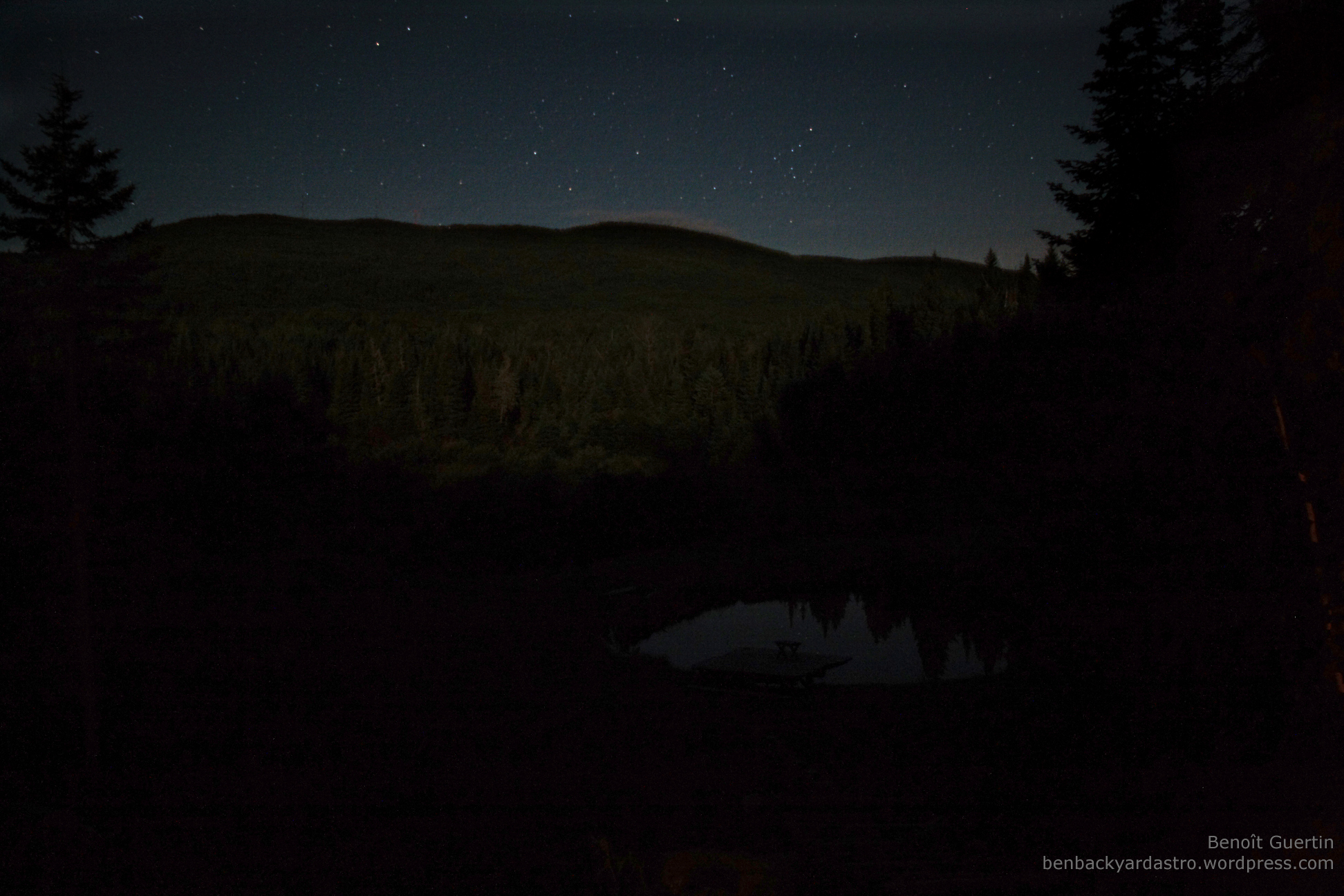
When I took the four shots to create this image below the Moon was just starting to rise above the tree-line behind me.  A full moon may be 1,000,000 times dimmer than the Sun it’s still bright enough to cast shadows and considerably light up the scene in a long exposure photo.

Over the mountain top a loose grouping of stars identified as Melotte 111 open star cluster.  These are about 40 bright stars laying 280 light years away all moving together.  It lies in the Coma Berenices constellation.

ComaBerenices_2017-08-10

Canon Rebel XTi (450D)
17mm f/4
20sec @ ISO800
The sky is a stack of 5 x 20sec.  The foreground is a single 20sec shot.