Novembre 14th SuperMoon

Status

Benoit Guertin's avatar

Lots of talk in the last week about the upcoming SuperMoon on November 14th.  While it will be the closest and largest Full Moon since 1948, the differences won’t be that significant.  It’ll look just like any other Full Moon, one that happens every month.  Nothing special will happen to the solar system or the Earth.

However it’s a good opportunity to experiment with your camera and composition as the Moon is rising over the Horizon.  Play around with different settings and different lens.  You can even spend the day before scouting a good spot with view to the East.

Don’t need dark skies.  Don’t need a special mount or stand. This is astro-photography accessible to all.

Missed the 2016 October Hunter Moon? No Worries

Aside

Missed the photo opportunity with the October Hunter Moon?  No worries, while some are claiming it to be a Supermoon, they are mistaken.  November’s full moon will be just 3hrs after perigee (closest to Earth), while the difference was 20hrs for October.  So the November full moon will be larger than the Hunter Moon that just gone by.

So mark November 14th at 13:52 UTC on your calendar!  For North-America, morning of November 14th prior to sunrise will be your best bet.  In Asia it will be in the evening.  Unfortunately for Europe it’ll take place in the afternoon.


October 5th 2016 – Mars, Saturn and the Moon

Image

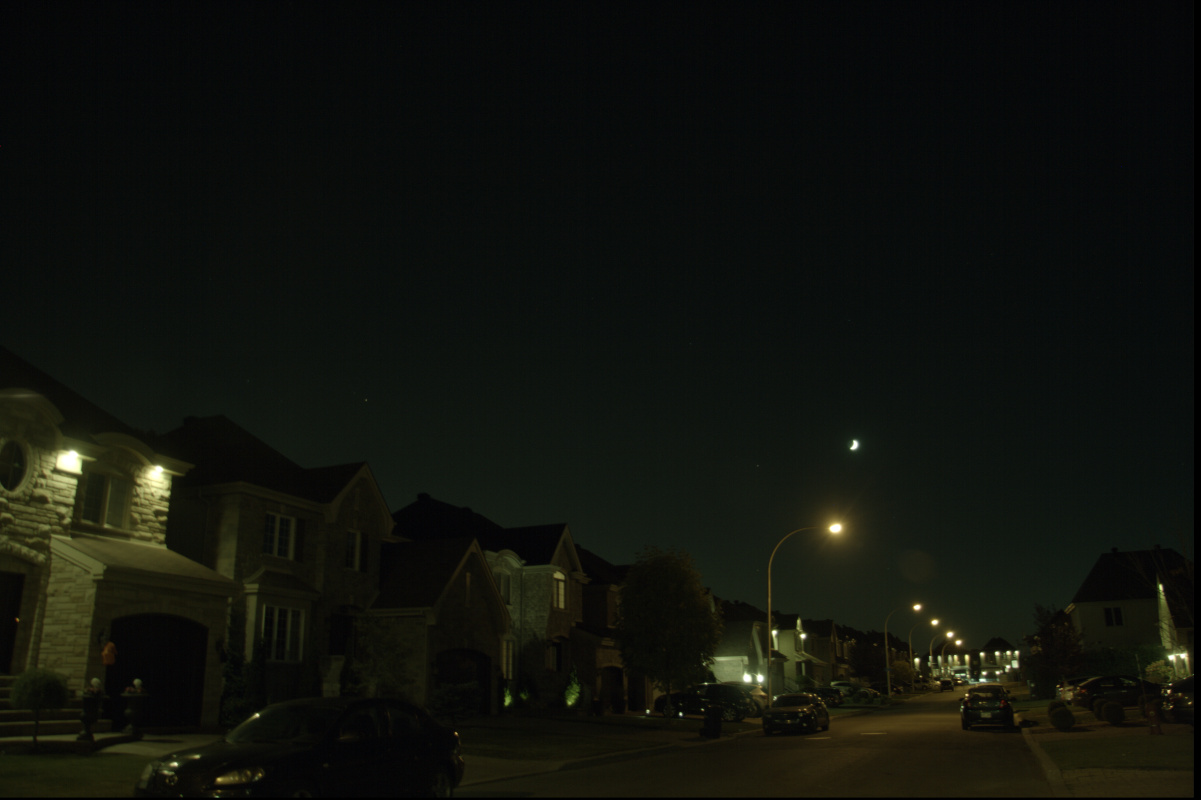
Didn’t have the luxury to scout a better setting to frame the picture.  In the street was actually better than my backyard with all the electric and utility poles/wires.  But nevertheless took a few minutes to frame the scene down the street while standing under a street light.  Click on the image to expand.

October 5th, 2016 - Mars, Saturn and the Crescent Moon

October 5th, 2016 – Mars, Saturn and the Crescent Moon

Almost in the same horizontal plane, you have Mars on the left and Saturn close to the Moon.

As it wasn’t fully dark yet, and I was on a tripod the exposure was rather short: 1/2sec at ISO 400.  Hence no rich star field this time around.  But you do see some of the bright stars such as Antares below Saturn.  Below is an overlay with a star chart.

Overlay with star chart - October 5th, 2016

Overlay with star chart – October 5th, 2016

If you missed it, there is still tomorrow… the Moon will have moved to a position above Saturn.

October 5th 2016 Photo Opportunity 

Great photographic opportunity tonight and tomorrow with a crescent Moon near Saturn in the early evening sky.  Mars is also visible a bit further east and if you have a clear view of the horizon you may catch a glimpse of Venus before it sets.

Octobre 5th 2016 Southwest Evening Sky

Octobre 5th 2016 Southwest Evening Sky (SkyNews.ca)

Ref: SkyNews.ca

Rosetta spacecraft’s last few days

After over 12 years Rosetta will be decommissioned by sending it down to impact with comet 67P/C-G.  This fate was decided as the comet is moving away from the sun, beyond the orbit of Jupiter and the solar panels will not generate enough power to keep the spacecraft operational.  Even “hibernation” is not a possibility as heaters are still required to keep the critical systems idling.  Hence mission control will send commands in the next few days such that on September 29th a series of maneuvers will send it on a impact trajectory with the comet.  As the comet’s gravity is rather weak (1/10,000 of Earth’s) it will most likely not be a fatal impact.  However the Rosetta will be instructed to shutdown upon contact with the surface in order not to “pollute” the deep space communication network with spurious and uncommanded signals.  This is expected to happen on September 30th 10:40 GMT.

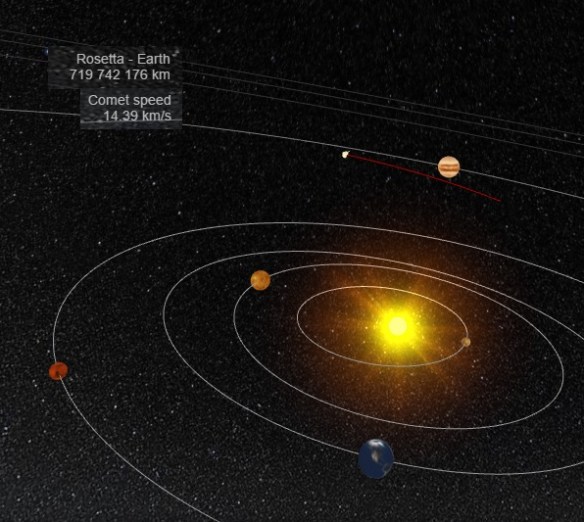
So where is comet 67P/C-G?  Travelling towards the orbit of Jupiter, in constellation Virgo, opposite to the sun from Earth’s perspective.  Normally an event like this would be timed to be observable at night from Earth such that telescopes can gather scientific data.  But at apparent magnitude 20 (to compare, Pluto has a mean apparent magnitude of 15) it will be very difficult to observe.  And the impact is not expected to generate a large plume of dust.  Therefore it will be up to Rosetta to record and beam back to Earth as much data during the descent before shutting down for good.

Rosetta and comet 67P/C-G position on September 30th

Rosetta and comet 67P/C-G position on September 30th

Reference: ESA

2016 Harvest Moon

Image

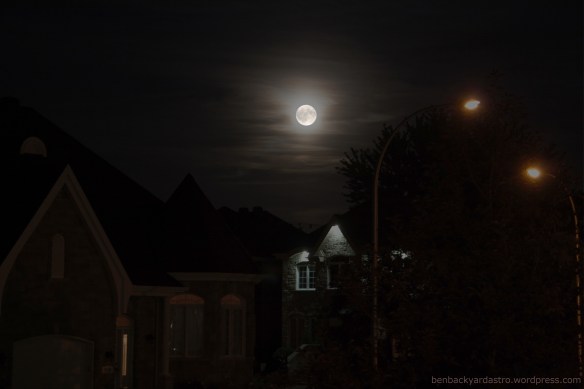
A Full Moon near the autumn equinox?  Well that’s a Harvest Moon.  While the Moon over the horizon can look rather large, there’s some disagreement whether the 2016 Harvest Moon should also be a Super Moon.  I’ll let them sort it out while I snap a few pictures…

2016 Harvest Moon - Benoit Guertin

2016 Harvest Moon – Benoit Guertin

Photo details:
Combined a short and long exposure with Canon XTi
85mm F5.6 1/250sec (ISO200)
61mm F5.6 0.5sec (ISO400)

Autumn – Darker Skies and No Mosquitos

I hadn’t taken the telescope out since April. With other projects and hobbies I just didn’t bother setting up the equipment.  But a few nights ago looking at a dark blue evening sky I noticed a nice crescent Moon and a triangular star formation over the horizon. The kids weren’t in bed yet so I grabbed my gear and made a quick set-up for observation with the 80ED telescope.

After an observation of the Moon, spending time examining the lights and shadows across the lunar craters and valleys I looked at the triangular star formation and suspected that at least one was a planet.  Slewed the telescope over and discovered Mars. Tried different eye pieces and settled for an Orion Edge-On 9mm planetary with Televue 2x Barlow.

With the kids off to bed I changed the set-up for webcam imaging before Mars could dip below the horizon. Follow up processing that evening wasn’t very rewarding.  Mars is some distance with Earth therefore appeared rather small compared with other times I pointed the telescope and with the heavy atmospheric turbulence imaging at such a low altitude it blurred the scant details I could have captured.

But that evening I broke the ice and got the gear out. And since I’ve been enjoying the night sky when weather permits. With the galactic plane crossing the sky it’s a great time for wide angle shots. It’s also much faster to set-up and more forgiving to an incorrect polar alignment. I got three photo sessions to analyze and hope to have some good shots to show in the next few days.

Autumn,  with cooler nights, dark skies and no mosquitos it’s prime time to enjoy the night sky.

NASA Juno Mission Trailer: JOI

Video

Space-thriller themed mission trailer

Secrets lie deep within Jupiter, shrouded in the solar system’s strongest magnetic field and most lethal radiation belts. On July 4, 2016, NASA’s Juno spacecraft will plunge into uncharted territory, entering orbit around the gas giant and passing closer than any spacecraft before. Juno will see Jupiter for what it really is, but first it must pass the trial of orbit insertion. For more information: http://www.nasa.gov/juno and http://missionjuno.swri.edu

Backyard Astronomers Capture Impact on Jupiter

Video

With Earth having passed between Jupiter and the Sun on March 8th, we have some of the finest observations of the Jovian planet.  It’s only normal to have a few backyard astronomers setting their sights on the largest planet (myself included, still got unprocessed videos from March 27th).  However Gerrit Kernbauer was lucky enough to record an unusual event: something slammed into Jupiter!

Phil Plait of Bad Astronomy reported that Gerrit Kernbauer with his 20cm telescope in Austria, captured on March 17th what appeared to be an impact of sort.

The issue was to confirm that it was an actual impact, and not some other natural effect or electronic noise in his setup.  What better than to have a second independent observation, and that came from John McKeon with a 28cm telescope in Ireland.

Maybe I should go take a look at my videos on Jupiter from March 27th just in case…  Actually with my 80mm telescope,  I don’t think it would have picked up such an impact.

[SLATE]

Closest Comet in 246 Years

Status

Benoit Guertin's avatar

There’s a good article in Sky & Telescope on comets 252P/LINEAR and the smaller fragment P/2016 BA14, explaining observation opportunities.  A comet hasn’t passed this close to Earth in 246 years.   And as it does the wonderful green halo around 252P/LINEAR  is sure to grow but will probably remain around magnitude 6.

As the comet flies by Earth it will sweep through the constellations quickly and then fade back to below magnitude 12 in short order.  Therefore try not to miss it.