
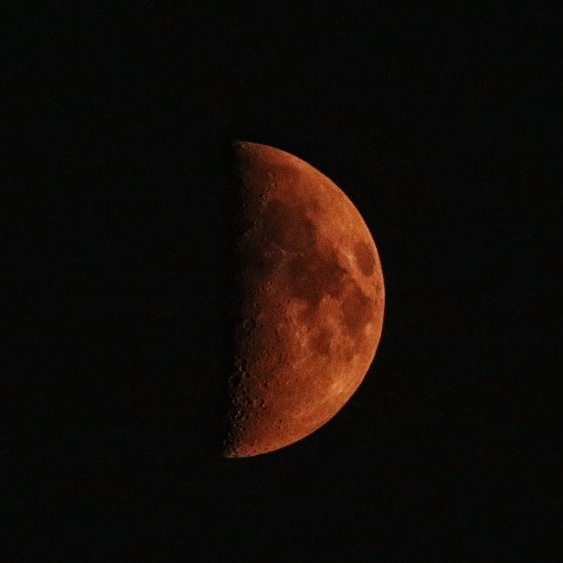
Most people are used to seeing or reading about a Blood Moon during a lunar eclipse. But other atmospheric conditions can cause the Moon to turn red, forest fire smoke being one of them. Due to large uncontrolled forest fires in Northern Quebec and dominant northwestern winds, vaste quantities of smoke made it’s way south to the Montreal area on June 25th creating this eerie blood red moon in the evening.
To comprehend why the moon turns red, we must first delve into the concept of atmospheric scattering. When sunlight reaches the Earth’s atmosphere, it interacts with particles and gases, scattering its various wavelengths. The shorter blue and green wavelengths disperse more easily, giving the sky its typical blue appearance during the day. On the other hand, the longer red wavelengths have a tendency to linger and scatter less, leading to a reddish hue during sunrise or sunset.
When forests experience wildfires or controlled burns, vast quantities of smoke are released into the atmosphere. This smoke consists of numerous particles, such as ash, soot, and other microscopic compounds. These particles can have a profound impact on the scattering of sunlight, resulting in unique atmospheric phenomena, including the red moon.
The particles present in forest smoke, especially those from larger fires, can scatter sunlight more effectively due to their small size and composition. When smoke particles disperse in the atmosphere, they cause the scattering of shorter wavelengths, such as blue and green, while allowing the longer red wavelengths to pass through with less interference. As a result, the moon, which reflects sunlight, takes on a reddish hue when viewed through the smoke-filled atmosphere.
This interplay between the scattered light and the moon’s reflection creates a visually stunning spectacle, where the moon seems to glow with an ethereal crimson radiance.
While the red moon phenomenon caused by forest smoke is undoubtedly mesmerizing, it serves as a stark reminder of the importance of forest conservation and proper fire management. Uncontrolled wildfires can have devastating consequences for ecosystems, wildlife, and humans. Through responsible land management practices, including controlled burns and fire prevention measures, the likelihood of large-scale forest fires can be minimized.
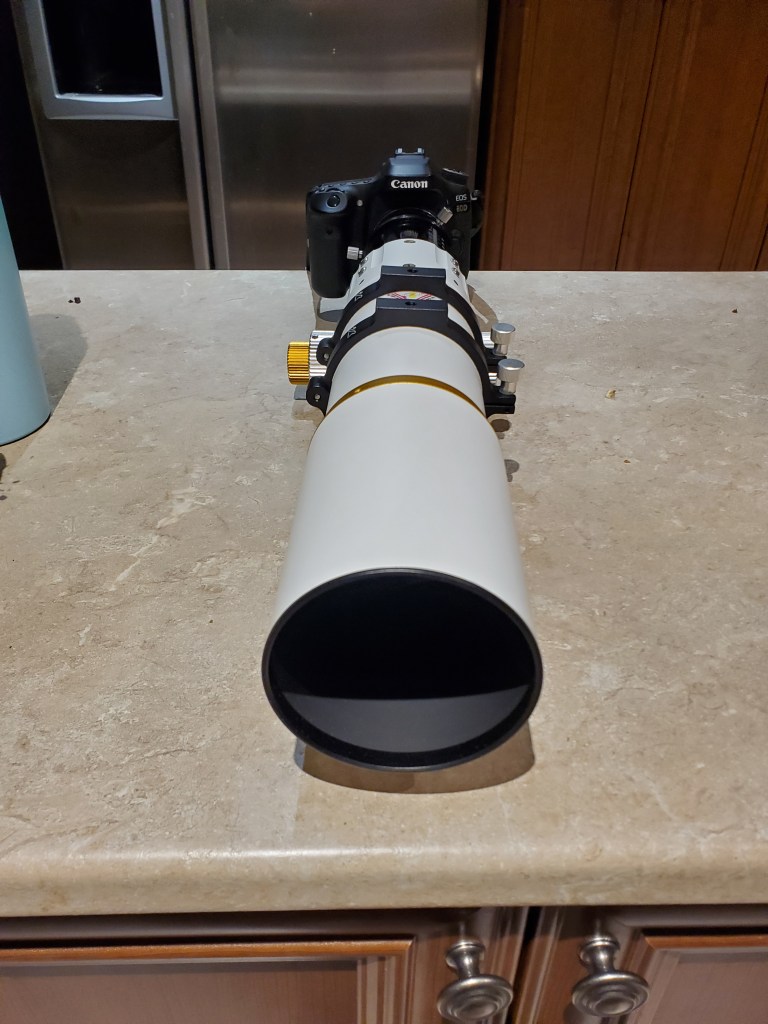
The above photo is a single shot, hand-held, taken with my William Optics Gran Turismo 71 f5.9 triplet with Canon80D. ISO6400 and 1/60s
 Ben Backyard Astronomy